The Naga’s Necklace and Angkor Sumek
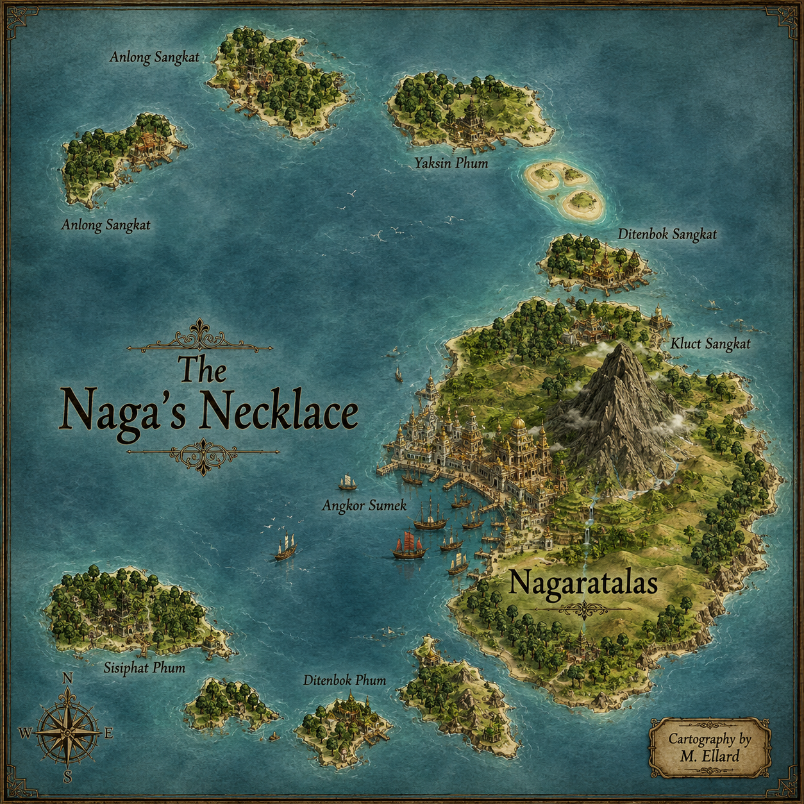
Far out in the Eastern Ocean, many hundreds of miles from the nearest mainland coast, lies a crescent-shaped chain of tropical islands known collectively as The Naga's Necklace. At its heart stands the great island of Nagaratalas, dominated by a towering volcanic mountain whose fertile lower slopes support one of the oldest civilisations in eastern Warlderia. Upon its western shore stands the magnificent city of Angkor Sumek, the greatest settlement of the Naga and the acknowledged centre of Serpent Folk civilisation. To visitors arriving by sea, Angkor Sumek is one of the wonders of the known world. Gleaming white stone arches span broad avenues lined with flowering trees, whilst magnificent temples crowned by gilded domes rise above elegant palaces decorated with colourful mosaics and intricate carvings depicting the history of the Serpent Folk. The harbour is perpetually crowded with vessels of every description, from simple fishing canoes and graceful river craft to broad-beamed merchant ships and powerful ocean-going galleys that carry goods between the islands of the Necklace. Few mainland travellers who have seen the city have forgotten its beauty.
Foreign visitors are welcomed with surprising warmth. Merchants and diplomats arriving from the mainland are treated with courtesy and hospitality, though never complete freedom. Guests are expected to remain within carefully designated districts surrounding the harbour and the great market, and discreet guards accompany them wherever they travel. The Naga make no attempt to conceal these restrictions, explaining simply that certain parts of the city are reserved for their own people and are not open to outsiders. Few visitors object, for the districts they are permitted to explore contain markets and workshops filled with goods found nowhere else in Warlderia. The harbour and great market occupy what the Naga call the Truce Quarter, ground considered sacred by every people of the Necklace. Many centuries ago the islands were consumed by a devastating series of wars between rival tribes of Serpent Folk. Famine, disease and repeated crop failures forced desperate peoples to raid one another simply to survive, until generations of bloodshed threatened to destroy the entire island chain. It was at Angkor Sumek that the leaders of the warring peoples finally met to negotiate peace. The Naga acted as impartial mediators, and when agreement was eventually reached they dedicated part of their city as neutral territory where every tribe could meet, trade and settle disputes without fear of violence. The ancient treaty remains in force today, and within the Truce Quarter even the bitterest enemies may conduct business side by side beneath the protection of Naga law.
Visitors to the market often find the experience astonishing. Naga, Yuan-ti, Lizardfolk and countless lesser breeds of Serpent Folk mingle freely amongst merchants and craftsmen from every island. Ancient rivalries appear forgotten, replaced by lively bargaining and constant trade. Yet beneath this outward harmony lies unmistakable vigilance. Well-armed guards are visible throughout the district, whilst experienced observers quickly realise that many more watch unseen from rooftops and towers. Peace in Angkor Sumek is carefully maintained, and few are foolish enough to challenge the authority of its guardians. Beyond Nagaratalas lie the other islands of the Necklace, each possessing its own customs, rulers and peoples. Some are home to prosperous towns and carefully cultivated plantations, whilst others remain covered by dense tropical forests where isolated villages cling to ancient traditions. Several tribes continue to live much as they did thousands of years ago, relying upon stone weapons and simple fishing canoes. Others have embraced more advanced techniques, constructing formidable coastal defences armed with ingenious siphons capable of projecting burning alchemical fire against hostile ships. The diversity of the islands reflects the many branches of Serpent Folk civilisation, each developing largely independently since the signing of the Great Peace.
Few outsiders are permitted to land upon these islands. Most vessels approaching their shores are warned away long before reaching the beaches, and those who ignore such warnings are often met with overwhelming force. As a result, little is known of the interior of the Necklace beyond the reports of a handful of fortunate explorers and merchants. Scholars believe many ancient temples and forgotten cities remain hidden beneath the forests, preserving secrets from ages before the rise of Human civilisation. Despite their considerable naval strength, the peoples of the Necklace have shown remarkably little interest in conquest beyond their own waters. Their ships visit the mainland only rarely, usually once or twice each year, bringing exotic spices, rare medicines, gemstones and finely crafted works in exchange for metals, timber and goods unavailable upon the islands. Some of the more adventurous Serpent Folk occasionally undertake the long voyage to the mainland in great ocean-going canoes, establishing small and often secluded communities along remote stretches of coastline. These settlements seldom seek contact with neighbouring kingdoms, preferring instead to live quietly according to their own traditions.
To most people of the mainland, the Naga's Necklace remains a land of mystery. Its people are courteous but secretive, wealthy but cautious, peaceful yet unmistakably well prepared for war. Few foreigners have travelled beyond the walls of Angkor Sumek, and fewer still have been invited into the hidden interior of Nagaratalas. Whether the islands conceal ancient wisdom, forgotten magic or simply a civilisation content to remain apart from the affairs of the wider world is known only to the Naga themselves, who have guarded their secrets for countless generations.
Created by M. Ellard