The Dwarves of Warlderia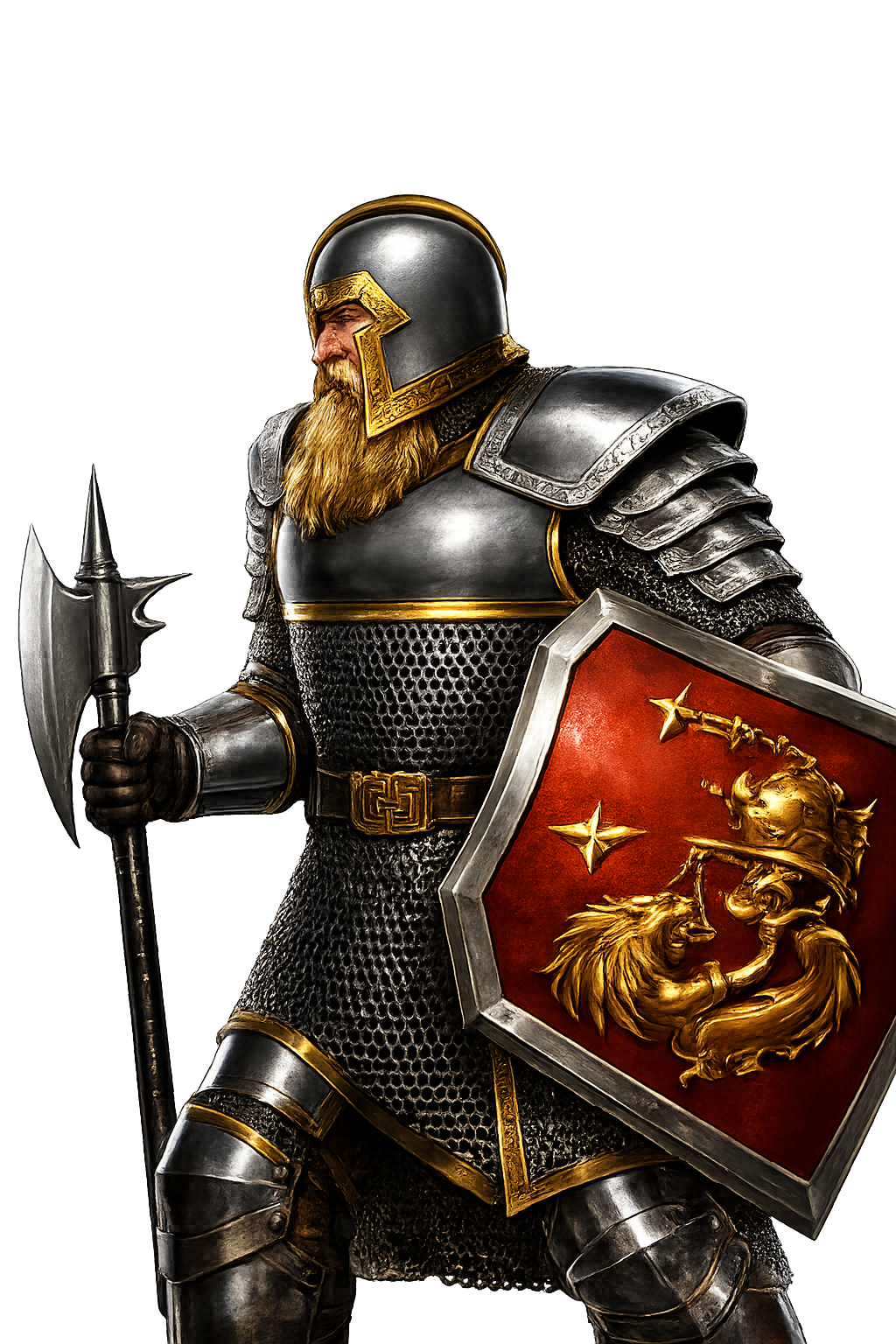
The Dwarves are amongst the oldest civilised peoples of Warlderia, renowned for their resilience, discipline and unrivalled mastery of stone and steel. Whilst many races sought greatness through conquest, magic or empire, the Dwarves chose a different path. They shaped the world through engineering, craftsmanship and patient endeavour, believing that kingdoms would rise and fall but that a well-built bridge or fortress could endure for a thousand years. Their greatest legacy is not measured in conquered lands, but in the countless roads, fortresses, mines and cities that still serve the peoples of Warlderia long after their builders have passed into legend. Unlike the Elves, who sought to guide the younger races through diplomacy and learning, the Dwarves rarely concerned themselves with the politics of the surface. They believed that lasting achievements were forged with hammer and chisel rather than words. Whilst kings argued over borders, Dwarven engineers raised the bridges that crossed them. Whilst empires fought over mountain passes, Dwarven masons carved roads through the mountains themselves. Even today, much of the infrastructure upon which civilisation depends was first laid by Dwarven hands.
Throughout history the Dwarves established a network of mighty Holds beneath the mountains of Warlderia. Each Hold was an independent kingdom, ruled by its own clans and traditions, yet united by a shared culture that valued craftsmanship, honour and endurance above all else. Vast underground cities were carved directly from the living rock, supplied by subterranean rivers, immense reservoirs and carefully tended fungal forests capable of sustaining entire populations through decades of siege. Towering audience halls, endless workshops and roaring forges stretched for miles beneath the mountains, whilst the greatest Holds rivalled the finest cities of any race upon the surface. The wealth of the Dwarves came not from conquest but from the mountains themselves. Their miners uncovered veins of iron, silver, gold and the precious metals that made their armour and weapons famous throughout the world. Their smiths learned techniques that have never been equalled, whilst their engineers devised methods of construction that still remain beyond the understanding of Human craftsmen. Bridges built by Dwarves continue to carry travellers centuries after neighbouring Human kingdoms have disappeared, and many fortresses constructed during the earliest days of civilisation have never fallen despite repeated sieges. Amongst scholars there is an old saying: "If it still stands after five hundred years, a Dwarf almost certainly built it."
The Dwarves regarded craftsmanship as a sacred duty rather than a profession. Every structure was expected to outlive its builder, every tool to serve generations, and every masterpiece to improve upon those that had gone before. To complete a task merely adequately was considered an insult not only to one's customer but also to one's ancestors. It is from this philosophy that the common Human expression "That's Dwarven work" originated, a phrase still used throughout Warlderia whenever something has been built to the highest possible standard. Unlike many races, the Dwarves never sought to establish a continent-spanning empire. Their influence spread instead through commerce, engineering and knowledge. Human kings competed for the services of Dwarven architects when building castles or cities, merchants paid fortunes for Dwarven steel, and rulers from every race sought advice from the great guilds of engineers before undertaking ambitious construction projects. The Great Roads of Warlderia, many of which still connect distant kingdoms today, were originally surveyed and constructed under Dwarven supervision, whilst countless harbours, aqueducts, bridges and mountain passes still bear the unmistakable mark of Dwarven design.
The greatest repository of that knowledge is found within the Great Towers of Moradin, where generations of Runemasters, engineers, historians and architects have gathered the accumulated wisdom of the Dwarven race. There, within miles of libraries and workshops, are preserved the plans of ancient Holds, records of forgotten kingdoms and engineering techniques that have long since vanished elsewhere. Kings, merchants and scholars from across Warlderia continue to seek the advice of the Towers, whose seal remains the highest mark of quality any engineer can possess.
The Higher Wars marked the greatest turning point in Dwarven history. As kingdoms collapsed and ancient alliances crumbled, the Dwarves gradually withdrew from the affairs of the surface world. Rather than exhaust themselves in endless wars that offered little reward, the great clans retreated behind the immense gates of their mountain Holds, preserving their people and their knowledge whilst much of the world beyond descended into chaos. It was not a defeat but a deliberate choice. Their civilisation survived where many others perished, though at the cost of much of the influence they had once enjoyed amongst the younger races.
Relations between Humans and Dwarves have generally remained cordial throughout history. Dwarves admire reliability, perseverance and practical ability, whilst Humans value Dwarven honesty and craftsmanship. Although they often consider Humans impatient, they also recognise an adaptability lacking in many older races. Numerous Human kingdoms owe their greatest fortresses, mines and roads to Dwarven engineers, whilst trade between the Holds and neighbouring realms has enriched both peoples for centuries. Trust, however, is never given lightly. A Dwarf's word is expected to last a lifetime, and betrayals are remembered for generations.
The Dwarven language is one of the oldest surviving tongues in Warlderia. Rich in technical vocabulary and remarkable precision, it remains the preferred language of engineers, architects, master smiths and stonemasons. A simplified dialect, commonly known as Trade Dwarven, or less respectfully as Dull-Dwarven, has spread far beyond the Holds and become the universal language of construction and engineering. Across the continent apprentices of every race learn its terminology, whilst many of the greatest technical works ever written continue to be studied in the original Dwarven script. To outsiders, Dwarven society appears deeply conservative. Tradition governs almost every aspect of life, from clan loyalties and inheritance to apprenticeship and military service. Oaths are sacred, reputations are earned over lifetimes and innovation is welcomed only after exhaustive testing. The Dwarves believe that a single poorly considered change can undo generations of careful work, and what others dismiss as stubbornness they regard simply as wisdom born of experience. Perhaps no difference separates Dwarves from the younger races more than their understanding of time. Humans think in years, kings in decades and even Elves often concern themselves with centuries. Dwarves think instead in generations. Mines are planned knowing that their richest seams may not be reached for a hundred years. Bridges are expected to carry travellers for a millennium. Apprentices begin projects that they know their grandchildren may one day complete. To the Dwarves, permanence is the highest expression of civilisation.
Empires have risen and fallen across Warlderia. The Higher Wars reshaped the continent, the Elven dominions retreated, the mighty Orc Kingdom of Gar'anash shattered and countless Human realms have flourished only to disappear into history. Yet behind the ancient mountain gates the Dwarven Holds endure. The Dwarves have never measured greatness by the size of the lands they ruled or the number of armies they commanded. Instead, they judge themselves by what remains after they are gone. In a world where kings become legends and kingdoms fade into memory, the bridges still carry travellers, the roads still bind nations together and the fortresses still guard the mountain passes. They remain silent monuments to a people who believed that true greatness was never found in conquest, but in building something worthy of being remembered.