World Overview
Warlderia is an old and troubled world. Kingdoms have risen, empires have broken apart and peoples who once ruled enormous territories now cling to fragments of their former domains. Old roads still cross lands where the authority that built them disappeared centuries ago. Fortresses guard borders that have moved half a dozen times, while ruined cities and abandoned settlements mark the passage of wars whose causes are sometimes barely remembered. Yet Warlderia is far from a dying world. Its towns remain crowded, merchants still travel the great roads, ships cross its seas and new settlements appear wherever sufficient peace can be found. Kingdoms expand, alliances are made and broken, temples gather worshippers and ambitious rulers continue to imagine that they might succeed where their predecessors failed. Warlderia's history has left it divided, but very much alive.
A World of Fractured Powers
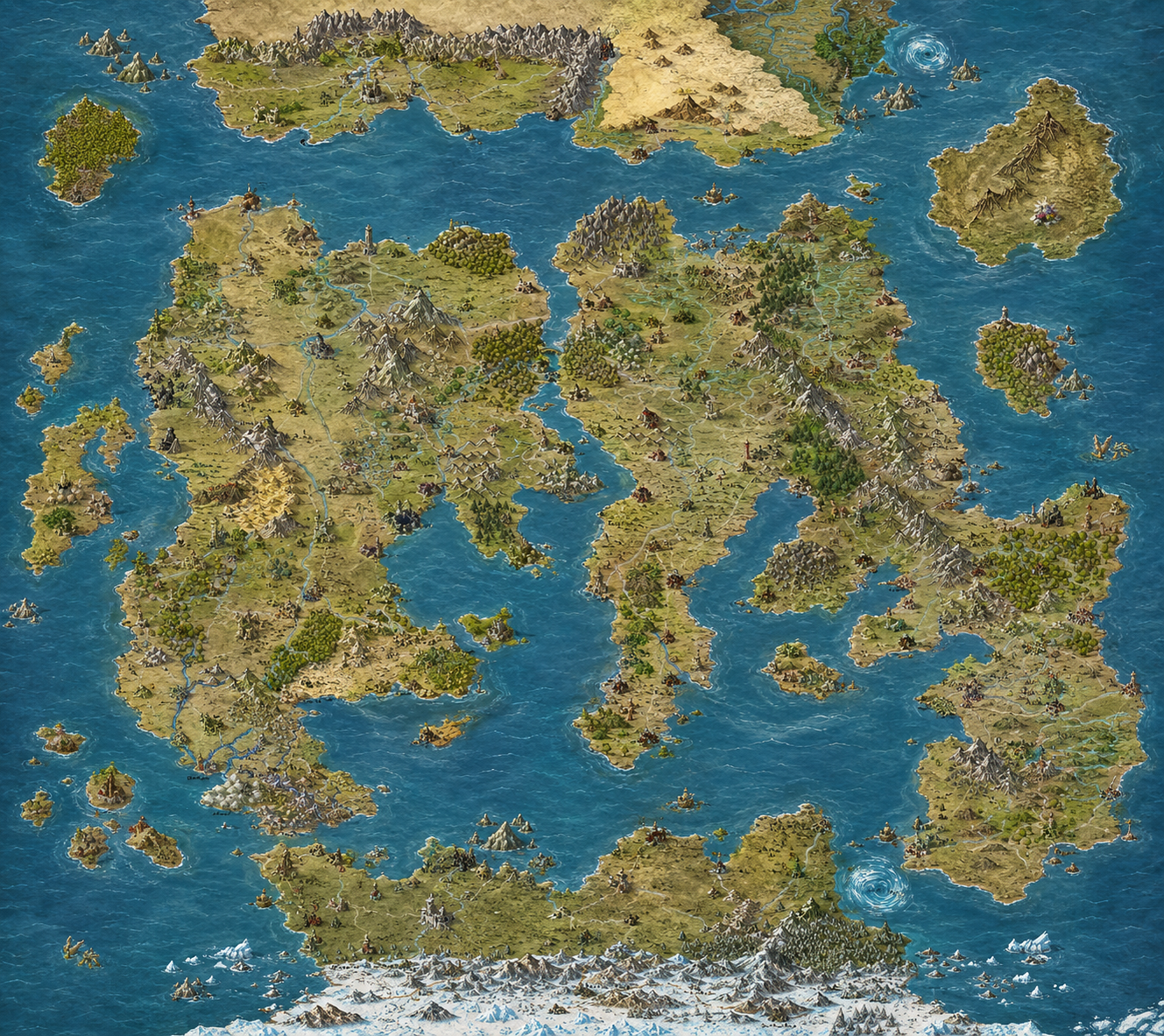
Much of Warlderia's present political landscape was shaped by the collapse, division or transformation of older powers. The greatest example is the old Empire, whose inheritance remains bitterly contested. Rival claimants possess different portions of its former territory and, more importantly, different ideas about what the Empire was and who possesses the right to continue it. Elsewhere the pattern repeats on a smaller scale. Ancient kingdoms have divided between heirs. Border lords have become independent rulers. Provinces abandoned by distant governments have learned to govern themselves, while other territories continue to acknowledge rulers whose authority becomes increasingly theoretical with every mile from their capitals. Consequently, maps of Warlderia can be deceptive. A line drawn neatly across parchment may represent a heavily fortified frontier, an agreed boundary marked by ancient stones, or merely the place where one ruler's tax collectors have learned not to travel any farther.
Peoples of Warlderia
Humans are widespread, but Warlderia has never been exclusively a human world. Elves, Dwarves, Orcs, Halflings, Goblins and numerous other peoples possess communities, territories and histories of their own. Some have lived beside one another for generations. Others remember wars, betrayals and dispossessions which occurred centuries before any living participant was born. There are few simple rules governing these relationships. An Orcish settlement may be a dangerous enemy in one country and an established neighbour in another. Elven communities range from isolated woodland settlements to sophisticated political powers. Dwarven Klans may trade peacefully with human neighbours for generations and still remember an insult committed against their ancestors three hundred years earlier. Culture, history and circumstance usually matter more than ancestry alone.
Beyond the Settled Lands
Even within established kingdoms, civilisation occupies less of the landscape than maps sometimes suggest. Between towns lie forests, moors, mountains, marshes and stretches of countryside in which organised authority is distant or entirely absent. Roads connect the larger settlements, but travellers leaving them may quickly find themselves beyond the protection of any lord. Some wildernesses contain nothing more remarkable than wolves, difficult terrain and unpleasant weather. Others do not. Ruined strongholds survive from forgotten wars. Roads lead towards settlements which no longer exist. Ancient tombs remain unopened beneath hills. Creatures driven from settled lands have established territories of their own, while stranger things endure in places sensible inhabitants have learned to avoid. For the people living along these margins, such dangers are not legends. They are neighbours.
Magic and the Old World
Magic is real in Warlderia, although it is neither commonplace nor comfortably understood. Priests perform miracles in the names of their gods. Wizards and sorcerers practise arts beyond the understanding of ordinary people. Magical objects survive from earlier ages, while some creatures possess powers which make the distinction between magic and their natural abilities largely meaningless. Nevertheless, most inhabitants of Warlderia live their entire lives without owning a magical object or seeing a powerful spell cast. Magic therefore retains its ability to inspire wonder, suspicion and fear. A village healer may be welcomed. A travelling wizard capable of throwing fire from his hands is another matter entirely. Nor is all magic part of the familiar world. Ancient ruins, forgotten civilisations and places touched by other realms occasionally preserve powers which even experienced spellcasters do not fully understand. Recent history has demonstrated particularly dramatically that the boundaries of Warlderia are not as secure as its inhabitants once believed.
Other Worlds
Warlderia does not exist entirely alone. Other worlds and realms lie beyond it, although travel between them is unusual and frequently dangerous. Goerath, Erdian — the Other Place, and the strange Fey realm of Anwyn have all touched Warlderia's history in different ways. Sometimes these contacts have involved individual travellers. On other occasions the consequences have been considerably larger. The Galsitanic Intrusion, in particular, demonstrated what can happen when the boundaries between worlds cease behaving as expected. Portions of Anwyn were left scattered across Warlderia while pieces of Warlderia vanished in return. The inhabitants of the Golden Woods of Anwyn now live beneath Warlderia's sky. They were not the only things that crossed.
Gods and Faith
The gods are an accepted part of life throughout much of Warlderia, although agreement about them ends remarkably quickly thereafter. Different peoples worship different pantheons, while individual gods may be understood very differently from one country to another. Temples can be centres of healing, learning and charity, but they may also possess land, wealth and considerable political influence. Religious disputes have occasionally produced wars. More commonly, faith is woven into ordinary life: births and deaths, marriages, harvests, journeys, oaths and the thousand uncertainties for which mortals have always sought divine favour. That the gods possess power is difficult to dispute. What they expect people to do with that knowledge is considerably less clear.
The Lands of Warlderia Today
There is no single conflict which defines modern Warlderia. The rival heirs of old empires watch one another. Frontier rulers attempt to secure vulnerable territories. Merchants seek new routes through dangerous country. Refugees establish homes where established peoples may not particularly want them. Ancient enemies occasionally discover common interests, while old alliances fail when circumstances change. Beyond all of this remain the quieter uncertainties. Something has begun taking livestock from an isolated village. A lord has stopped answering messages. An old road has become safe enough to travel again, although nobody knows why. Miners have broken into chambers that do not appear upon their maps. A ruined tower has acquired lights in its windows. Most such events will never trouble a king. They matter enormously to the people living beside them. A World of Stories. The history of Warlderia is shaped by emperors, armies and great migrations, but it is rarely experienced that way by the people who live through it. For most, history begins locally. A threatened village. A disputed inheritance. A missing traveller. A merchant needing guards. A ruin in the hills. A creature in the woods. A minor lord with a problem he cannot solve using the people already in his service. Some stories end there. Others lead to another town, another country, an old enemy, a forgotten war or something buried so deeply in Warlderia's past that nobody remembers why it was hidden. And occasionally a handful of otherwise unimportant people discover that something much larger has begun.