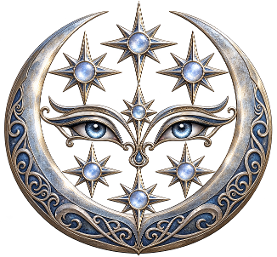
 Selûne, The Lady of the Moon
Goddess of the Moon, the Night Sky, Tides and the Turning of the Months
Selûne, known to the followers of the Old Faith as the Lady of the Moon, is the gentle but ever-changing goddess who watches over the world during the hours of darkness. Where Pelor brings warmth and life beneath the sun, Selûne governs the quieter rhythms of nature: the waxing and waning of the moon, the movement of the tides, the habits of nocturnal creatures and the mysteries revealed beneath the stars.
The Druids regard her as one of the great keepers of the Eternal Circle. Just as the seasons turn from spring to winter and back again, so the moon passes endlessly from darkness to fullness and returns to darkness once more. Its disappearance is not death, nor its return a resurrection, but another reminder that nothing in nature remains unchanged.
Selûne is commonly depicted as a beautiful, silver-haired woman wearing flowing robes of pale blue and white, with a crescent moon resting upon her brow. In older rural traditions, however, she is sometimes portrayed as three women: a young maiden beneath the waxing moon, a mature mother beneath the full moon and a silver-haired crone beneath the waning moon. The Druids teach that these are not separate goddesses, but three aspects of the same eternal power.
Although Selûne is generally considered benevolent, her worship is not entirely gentle. Moonlight illuminates the hunter as readily as the hunted, and the darkness between her appearances belongs as much to the wolf as to the frightened traveller. The Druids therefore regard her as a goddess of natural mysteries rather than simply a protector against the night.
Her relationship with Pelor is the subject of several ancient legends. Some traditions describe them as celestial companions who share the heavens but seldom meet, while others claim that Selûne follows the Sun Father across the sky, gathering the light he leaves behind. An eclipse is considered an extraordinary meeting of the two powers, and many Druidic circles observe such events with solemn ceremonies.
Selûne is particularly honoured at the new and full moons. Certain herbs are traditionally gathered by moonlight, divinations are performed beneath an unobstructed sky, and important ceremonies of cleansing, renewal and remembrance are often timed to coincide with the lunar cycle. Her worship is especially common amongst coastal communities, woodland Druids and those who must travel through the wilderness after sunset.
Unlike some other religions, the Old Faith does not regard the creatures of the night as inherently evil. Owls, bats, wolves and other nocturnal animals are considered part of Selûne's natural kingdom. Nevertheless, the Druids distinguish sharply between the ordinary darkness of nature and the unnatural corruption of undeath, which they regard as an offence against the Eternal Circle.
Sacred Times: The full moon, the new moon and lunar eclipses.
Favoured Offerings: Clear spring water, silver coins, white flowers and small bowls of milk left beneath the open sky.
