 Paeris Wynfaren
, a High-Elven wizard of noble birth, has made his home at Lant Tal, known in the Common tongue as Tal Bridge. Before the evacuation from Erdian, he enjoyed the advantages of an old family name, a sound magical education and a household in which most practical difficulties were resolved before they reached his attention. His ability was real, but his understanding of how other people lived was considerably less developed. The Wynfarens were a family of modest landed standing within the Perpetuity of Ilyr Vael. They valued scholarship, correct conduct and the careful preservation of their position. Paeris grew up among tutors, family portraits and books which visitors were permitted to admire but seldom borrow. His magical talent secured him further instruction, and he became a capable wizard with a particular interest in protective enchantments and the examination of magical objects. He expected, in time, to occupy a respectable position advising relatives, maintaining family wards and pursuing research at a comfortable distance from danger. The fall of the elven lands ended those expectations. During the flight to Letharion, Paeris discovered how little a distinguished surname could accomplish when a wagon axle broke or a frightened crowd blocked the road. His first attempts to organise strangers met with limited success. His spells proved more persuasive. He helped free a trapped cart, sheltered exhausted travellers and surrendered space in his baggage for possessions belonging to people he had scarcely noticed a few days earlier. He reached Warlderia with a travelling spellbook, a small collection of personal belongings and no reliable account of where several members of his family had gone. He speaks of them as being “elsewhere among the refugees”. He has yet to admit, even to himself, how much uncertainty that phrase conceals. Letters and enquiries leave with anyone travelling between the new elven settlements.
At Iant Tal, Paeris initially regarded his stay as temporary. He accepted modest accommodation while expecting that someone would shortly identify a role more suited to his education. Instead, Horith found him work. There were doors which needed securing, damaged possessions which could be repaired, stores which required protection and awkward tasks for which the right spell could save hours of labour. Paeris soon discovered that a settlement could provide an almost inexhaustible supply of such requests. He also learned to distinguish between work that deserved the expenditure of magic and work for which someone was simply hoping to avoid fetching a ladder.
He now assists Horith with magical matters and is becoming an important resource for the village. He examines unfamiliar objects, advises on the secure storage of anything potentially dangerous and helps assess reports of strange lights, unexplained disturbances or suspected enchantments. When work around the bridge uncovers old masonry or an object of uncertain origin, Paeris is usually summoned before anyone disturbs it further. He has begun keeping a record of these discoveries, together with accounts of local magical phenomena. His contribution is limited by the time, preparation and materials his spells require. He cannot repair every broken implement or stand ready whenever someone needs assistance. Establishing this has occasionally made him unpopular. Nevertheless, he is increasingly willing to alter his preparations when there is a pressing need, and he takes considerable satisfaction in finding an economical solution to a problem which others have declared impossible.
A room in his home serves as a study and an informal place of instruction. Paeris teaches letters, arithmetic and elementary magical theory to a handful of young people whose education was interrupted by the evacuation. He insists that these are temporary lessons until proper arrangements can be made. He has nevertheless acquired extra stools, prepared exercises suited to different abilities and begun enquiring after suitable books. A pupil who handles a difficult passage well may receive only a restrained word of approval, followed the next day by a carefully chosen text to borrow. Paeris remains proud, particular and occasionally tiresome. He corrects the misuse of magical terminology, dislikes people touching his books with dirty hands and can make a straightforward explanation unnecessarily elaborate. Requests delivered as commands are liable to receive a chilly response. A courteous appeal to his expertise generally works much better. Horith has learned that giving him responsibility, and allowing him to carry it out, secures far more cooperation than attempting to manage every detail.
Yet his neighbours are also discovering that he keeps his promises. He remembers who has lost tools, whose child is struggling with lessons and which household has been waiting longest for his attention. He is discreet about assistance which might embarrass its recipient. Having experienced the loss of his own household, he has become unexpectedly patient with those who are trying to preserve some small remnant of theirs. His relationship with Horith rests on growing mutual respect. Horith relies upon his judgement while expecting plain answers and practical advice. Paeris, who once assumed that authority should announce itself through ancestry and ceremony, is learning to recognise it in someone who can settle a dispute, organise a day’s work and ensure that everyone has eaten. For adventurers visiting Iant Tal, Paeris is a useful contact. He can offer informed opinions on magical discoveries and may be able to examine or identify an item, given suitable time and materials. He is particularly interested in old wards, inscriptions and evidence of how magic behaves following the Intrusion. He cannot afford to purchase every curiosity brought to his door, but books, copied inscriptions and news from other refugee communities can secure his attention.
He may also have work for a party he comes to trust: recovering equipment from an unsafe site, investigating a disturbance beyond the village or carrying an enquiry about his missing relatives. Such requests are made privately and with careful preparation. Paeris dislikes placing himself under an obligation, so he will try to offer something useful in return. He still intends to establish a proper library and workshop, with secure storage and space to teach. Where he once imagined these chiefly as the setting for his own research, he now discusses shelves for village records, books for pupils and a workbench where unfamiliar finds can be examined safely. He has even begun drawing up the costs. Life at Tal Bridge continues his education. His growing usefulness has not extinguished his pride. It has, however, given him something more substantial upon which to rest it.

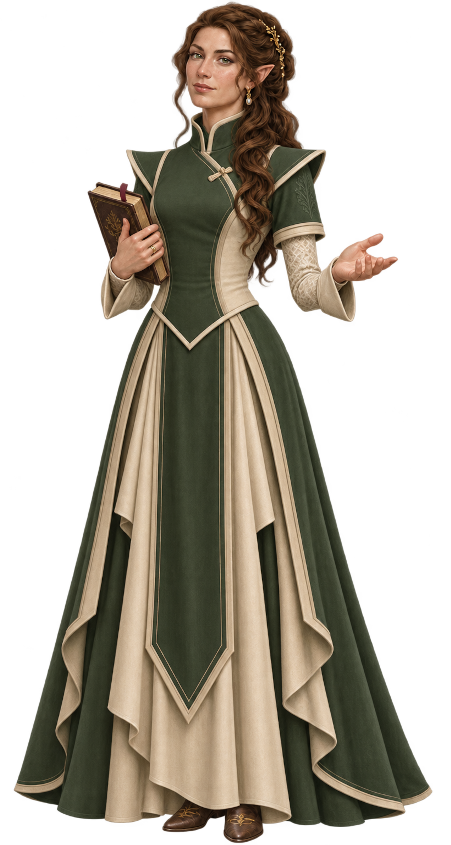
Gylledhia Adynore
Gylledhia Adynore, the acknowledged paramour of Horith Adtumal occupies an accepted place within his household and is frequently present when visitors are received. A Half-Elven woman of considerable beauty, she possesses the poise of someone accustomed to moving amongst people who consider themselves important. Her clothes are well chosen rather than extravagant, her manners attentive, and her conversation sufficiently easy that guests seldom feel they are being examined. Usually, they are. Before the flight from Erdian, Gylledhia managed the affairs of a prosperous household. The position involved considerably more than supervising servants. She dealt with merchants, leases, creditors, marriage settlements and the delicate business of persuading influential people to honour agreements they had begun finding inconvenient. She learned that a favour could prove more expensive than a purchase, that a generous offer usually answered somebody’s need, and that the person speaking most confidently was not necessarily the person whose consent mattered. These skills have survived the loss of the household which first required them. At Iant Tal, they have become increasingly useful.
Visitors often address Horith while paying comparatively little attention to Gylledhia. They recognise her beauty and understand her place beside him, then assume they have understood everything of consequence. Gylledhia seldom troubles to correct them. She receives their courtesy, remembers their preferences and occasionally asks an apparently innocent question. A merchant explaining some complicated arrangement to his host’s charming companion may reveal considerably more than he intended. Gylledhia does not possess an infallible understanding of people. Warlderia is unfamiliar, and local relationships, customs and obligations must be learned. She consequently listens carefully, asks questions and cultivates acquaintances amongst traders, visiting households and the people who perform the work others take credit for. Willow Elaxina’s common room provides useful conversation, although Gylledhia is sensible enough to understand that an innkeeper’s confidence must be earned.
After visitors depart, she helps Horith consider what their proposals might mean beyond their immediate usefulness. Who would control the grain supply? Why was an answer required so quickly? What obligation would accepting the gift create? Horith is exceptionally capable when a problem can be inspected, organised and resolved. Gylledhia helps him recognise those occasions when solving the visible problem might create a less visible one. Their affection is sincere. She admires his dependability, his willingness to hear ordinary complaints and the care with which he honours promises. He values her wit and judgement, but also the freedom to be uncertain in her company. Their private conversations contain disagreement, teasing and the occasional admission that one of them has handled something badly. Gylledhia has little interest in a companion who agrees with everything she says. She enjoys comfort, beautiful clothes and the standing her position affords her. Having lost a settled life once, she is determined to build another which cannot easily be taken away. This gives her a personal interest in Horith’s success, and sometimes makes her more cautious about generosity than he would prefer. She is particularly alert to arrangements which leave their household dependent upon someone else’s goodwill.
Lusserina Daeydark’s interest in Horith has therefore become a source of unease. Gylledhia recognised the priestess’s intentions early: the carefully timed visits, the requests which might conveniently require a private conversation, and the suggestions that someone of Horith’s standing ought to maintain certain standards within his household. Lusserina’s occasional remarks about ancestry and suitable companionship leave little doubt about whom she considers expendable. Gylledhia meets these advances with composed courtesy. She ensures that invitations are answered, that household arrangements remain clear and that Lusserina receives no opportunity to suggest she has been treated poorly. She refuses to turn every visit into a dispute over Horith’s attention. Nevertheless, she notices when he laughs at something the priestess says and dislikes how closely she listens for his answer when Lusserina asks a favour. The difficulty is sharpened by an attraction Gylledhia would much rather have been spared. She finds Lusserina beautiful, and knows that beauty alone does not explain the attention she pays her. The priestess’s voice, her self-possession and the rare moments when pride gives way to uncertainty have acquired an uncomfortable importance. Gylledhia sometimes remembers the details of their conversations long after their practical significance has been exhausted. She understands Lusserina’s faults perfectly well. Indeed, she can list them with particular precision after an encounter in which she has caught herself enjoying the woman’s company. Recognising the selfishness beneath the charm has done remarkably little to diminish the charm itself. She is irritated by Lusserina’s assumption that everyone should attend to her, then finds herself remembering some small discomfort which she could easily arrange to have remedied.
To Gylledhia, this attraction is forbidden by her affection for Horith and by the trust upon which their life together rests. Lusserina is actively seeking her place beside him. Allowing herself to become intimate with that same woman would expose feelings, confidences and vulnerabilities which she has good reason to guard. She has acted upon none of it, but occasionally catches herself prolonging a conversation she had intended to end. Whether Lusserina has noticed remains uncertain. A compliment, an unexpected confidence or the brief touch of a hand can leave Gylledhia wondering whether she is being courted, tested or simply treated with the careless warmth of someone accustomed to admiration. It troubles her that she cannot always judge the answer as clearly as she would for somebody else. Her sympathy for Ninthalor Chaewenys, whose unrequited devotion to Lusserina is easier to observe, has consequently become more tender and less comfortable. She dislikes seeing the priestess take advantage of him. She also recognises the excuses he makes on her behalf, having caught herself making several of them in private. Gylledhia’s position beside Horith remains public. The extent to which he relies upon her judgement is less widely appreciated. When an agreement is reached, he announces it and accepts responsibility for it. Gylledhia is generally content to watch the visitors depart, then ask whether he would like supper before hearing what she thought of them. Where Lusserina is concerned, she is becoming unusually careful about how she answers.
D&D 3.5 profile: Half-Elf Expert 6, True Neutral. Her strongest skills are Diplomacy, Sense Motive, Bluff, Gather Information, Appraise and Profession (household manager). Her intelligence, social judgement and experience make her an influential adviser within Horith’s household, although her attraction to Lusserina creates an uncomfortable weakness.
 Willow Elaxina
 is the Half-Elven keeper of The Lady of the Roses, the restored inn at the southern approach to Iant Tal. A widow from Quacroin, she ran a roadside inn before the evacuation from Erdian and arrived in Anwyn with her daughter, Tessa, her elderly Human father, Oswin Reed, and firm opinions about how a kitchen should be organised. Practical, observant and difficult to fluster, Willow has considerable experience of feeding travellers, managing staff and recognising trouble before it becomes expensive. She is welcoming without being easily imposed upon. Customers of every ancestry receive the same courteous treatment, provided they extend it to her household. Those who mistake her patience for uncertainty generally discover their error before finishing their first drink.
Willow accepted responsibility for reopening the inn on the understanding that she would be running a business. Having already contributed weeks of unpaid cooking during the refugees’ first days in Anwyn, she considered this a reasonable distinction. She keeps her prices fair, watches her supplies carefully and quietly finds work for neighbours who would be uncomfortable accepting charity. She named the inn The Lady of the Roses in Dîmeril’s honour and commissioned its sign without consulting her. Willow remains satisfied with the decision. Should Dîmeril wish to object, there is a table available and the discussion can take place over dinner.
Willow also possesses a modest gift for sorcery, which first appeared in her youth. She received little formal instruction and developed it chiefly through repeated use. A small gesture can light a candle, remove a stubborn stain or warm a plate before a meal is served. She can carry several objects across a room with an unseen servant, although she insists that magic is no excuse for leaving dirty crockery where someone might trip over it. Her repertoire includes prestidigitation, mending, mage hand and message, together with unseen servant and charm person. She uses the latter cautiously: she understands how much damage the discovery of magical influence could do to an innkeeper’s reputation. It is reserved for serious trouble, when persuading someone to accompany her outside might prevent a fight. Most disputes are settled with her own voice, supported when necessary by the announcement that Tessa is fetching help.
Tessa manages the accounts and serving room, allowing Willow to divide her attention between the kitchen, guests and suppliers. Oswin occupies his customary chair near the hearth, offering unsolicited opinions drawn from decades spent managing the affairs of an Elven household. Willow complains that he interferes. She also makes certain he hears about difficult proposals before she agrees to them. The evacuation has left its marks upon her. Willow checks the kitchen stores more often than she once did and dislikes seeing good food wasted. She keeps a little bread and dried fruit put aside for unexpected arrivals. When travellers bring news of other refugee communities, she listens closely and asks after people by name.
Visitors seeking local information will often find Willow helpful, particularly once they have purchased supper. She knows who needs workers, which roads have recently been travelled and who has been asking unusual questions. Private conversations remain private, however. An attempt to buy her confidence is likely to make her considerably less forthcoming.
D&D 3.5 profile: Half-Elf Expert 3/Sorcerer 2, Neutral Good. Her strongest skills are Profession (innkeeper), Sense Motive, Diplomacy, Gather Information and Appraise. Her magic is a useful household resource, while her judgement and experience are the foundation of her standing in Iant Tal.
 Lusserina Daeydark
 is a High-Elven priestess of Hanali Celanil, goddess of love and beauty, whose arrival at Iant Tal has done little to reconcile her to life after the evacuation. Born into a wealthy household in Erdian, she was raised among gardens, music and servants who could usually be relied upon to remove unpleasantness before she encountered it. She accepted these comforts as the proper circumstances of her life. Their loss remains, to her, an outrage which someone ought to remedy. Before the flight from Erdian, Lusserina served at a well-endowed shrine supported by families much like her own. She tended its flowers, assisted at ceremonies and offered counsel on courtship, marriage and reconciliation. She performed these duties gracefully and enjoyed being admired for them. Difficult cases could generally be referred to a more experienced priestess, leaving Lusserina to preside over occasions at which everyone was clean, appropriately dressed and pleased to see her.
She escaped with a few treasured possessions and rather fewer useful supplies. Her remaining clothes are beautiful, carefully maintained and increasingly unsuitable for the work going on around her. She spends considerable time repairing embroidery, arranging her hair and preserving the appearance of a woman whose household might arrive to collect her at any moment. Lusserina describes her accommodation as temporary. She has declined several opportunities to improve it because accepting them would mean acknowledging that she might be staying. Instead, she petitions Horith for rooms appropriate to her birth and religious office. The fact that other people also need sound roofs strikes her as an unfortunate complication, rather than an answer.
Her selfishness appears most clearly in small, persistent expectations. Someone should fetch water because she is preparing for worship. Someone should mend the shutter because the draught is affecting her sleep. Someone should surrender a sunny patch of ground for a flower garden because the village needs beauty, although she has no intention of digging it herself. She can express gratitude charmingly, but seldom considers what the favour has cost its giver. Her faith is sincere. Lusserina loves beautiful things, takes pleasure in affection and courtship, and believes that devotion deserves to be celebrated. Yet she has spent much of her life treating beauty as evidence of refinement and refinement as evidence of personal worth. Poverty, exhaustion and grief have left her surrounded by people whose appearance she finds distressing. She has considerable difficulty understanding why they do not regard correcting it as an immediate priority.
She remains a priestess with useful divine gifts. She can tend injuries, offer blessings and conduct marriages and other observances of her faith. Unfortunately, she is inclined to regard requests for healing as interruptions unless they arrive with suitable deference. She does usually help, but may first explain that she cannot possibly attend to every cut acquired through ordinary manual labour. This has earned her fewer admirers than she expected. Willow Elaxina has little patience with her demands, particularly when Lusserina assumes that a priestess of Hanali should receive the inn’s best meals without troubling herself over payment. Lusserina considers Willow’s manner regrettably commercial. She nevertheless returns to The Lady of the Roses, where there is warmth, decent food and a chance of conversation with someone who remembers the places she knew.
Lusserina has taken a considerable interest in Horith Adtumal. His birth, position and prospects make him, in her estimation, the most suitable company Iant Tal currently offers. She takes care to appear at her best whenever he is expected, finds reasons to seek his opinion and has offered to advise on the proper observance of Hanali’s festivals within his household. An invitation to dine would be accepted with carefully measured pleasure, as though she had several others to consider. Her interest combines attraction with a practical longing for comfort and status. A place beside him would provide much of what she has lost, and Lusserina finds it easy to imagine that such an arrangement would benefit them both. She is considerably less interested in imagining what he might actually want.
Gylledhia Adynore’s position as his mistress is therefore a source of particular irritation. Lusserina remains outwardly courteous, but occasionally allows a remark about ancestry, upbringing or appropriate companionship to escape beneath the cover of concern. She has convinced herself that Gylledhia’s influence must be temporary. Gylledhia’s beauty and intelligence make that conviction increasingly difficult to sustain. Lusserina would be offended by any suggestion that she was scheming. As she sees it, she is simply allowing the squire an opportunity to recognise a more suitable companion. She watches for disagreements between him and Gylledhia with an attentiveness she seldom brings to the difficulties of her other neighbours.
Beneath her entitlement, Lusserina is lonely and rather lost, although she would be appalled to hear herself described that way. She has lost the household which gave her a place in the world, the congregation which valued her and the familiar company against which she measured her importance. She speaks frequently of people who are absent and listens poorly when those around her describe their own losses. At night she sometimes unpacks her surviving ornaments simply to see them laid out as they used to be. She is particularly susceptible to attention from anyone who treats her as a person of consequence. A flattering visitor may secure an invitation, confidential gossip or an introduction she would otherwise withhold. Adventurers with fine manners and news of noble households will find her considerably more welcoming than villagers asking for practical assistance.
For all her complaints, Lusserina has an excellent memory for faces, family connections and the private affairs of the society in which she once moved. She may recognise a signet, identify the owner of a recovered possession or remember precisely why two apparently respectable refugees refuse to speak to one another. She understands vanity very well and can often recognise what someone hopes to hear. At present, she is waiting for her circumstances to improve sufficiently for her proper life to resume. Iant Tal is beginning to establish itself around her. Lusserina has yet to decide whether she belongs to it.
D&D 3.5 profile: High Elf Cleric 3 of Hanali Celanil, Chaotic Neutral. High Charisma, modest Wisdom; trained in Diplomacy, Knowledge (religion) and Concentration. Her selfishness chiefly takes the form of entitlement, withheld effort and an enduring conviction that her own discomfort deserves precedence.
 Ninthalor Chaewenys, Maethor of the Household
Ninthalor Chaewenys is the High-Elven knight responsible for the security of the squire’s household at Iant Tal. His title, Maethor of the Household, denotes his standing as its sworn warrior and protector. He served the family in Erdian long before the evacuation and regards his obligations as unchanged by the loss of its estates. There is still a household to protect, a lord to advise and work which requires someone dependable enough to see it finished. A younger son of a minor military family, Ninthalor earned his position through years of competent service. He escorted travellers, supervised guards and dealt with the numerous unglamorous duties upon which a comfortable household depended. He knows how to inspect a stable, organise a watch and discover whether a supplier has delivered what was paid for. He can also fight, although he considers having to draw his sword evidence that a situation has become considerably less satisfactory.
During the evacuation, Ninthalor remained with the household’s dependants and baggage. He surrendered his riding horse to carry two exhausted children and completed much of the journey on foot. He speaks little of this. Asked about the horse, he will explain that it was accustomed to carrying an unreasonable burden. At Iant Tal, he oversees the squire’s immediate security and the conduct of his household guards. He checks doors, arranges escorts and ensures that someone sober is awake when the rest of the household sleeps. He also assists with village watches and inspections of the bridge approaches, coordinating with those responsible for the settlement’s defence. The shortage of trained hands means that he frequently takes a watch himself.
Ninthalor is courteous, reserved and possessed of a dry humour which emerges once he knows his company. His clothes and equipment are carefully maintained, but show years of use. He wears a serviceable mail shirt beneath a dark green surcoat, carries a longsword and shield, and owns one good cloak which has been repaired often enough for several members of the household to recognise the stitching. His loyalty to the squire is personal and longstanding. He remembers the young Elf’s upbringing, knows his better qualities and is familiar with his faults. In public, Ninthalor supports his authority. In private, he will tell him when a promise is foolish, an expense cannot be justified or an apology is required. Having offered his advice, he expects to be heard, even when he is not obeyed.
He treats Gylledhia Adynore with respect. Her position as the squire’s mistress is clear to him, and her intelligence has made his work easier on more than one occasion. They share an interest in keeping the squire informed without allowing every irritation to become a household crisis. Gylledhia can usually tell when Ninthalor is worried, despite his assurances that matters are in hand. His judgement becomes less dependable where Lusserina Daeydark is concerned. Ninthalor is quietly captivated by her beauty, her graceful manners and the care she takes over ceremonies which remind him of their lost homeland. He recognises her selfishness, but finds himself making allowances for it. She has suffered considerable upheaval, he tells himself. She will settle in time.
His affection appears in small acts of service. A troublesome shutter is repaired before she needs to ask twice; an escort becomes available when she dislikes walking home in the dark. He remembers which flowers she prefers and occasionally leaves a few at her shrine, without a note. Compliments which would sound natural from another man emerge from Ninthalor as stiff observations about the suitability of her arrangements. Lusserina does not return his feelings. She regards him as a dependable household knight whose attentiveness is entirely appropriate to her position. Her interest remains firmly fixed upon the squire. When she praises Ninthalor, it is usually because she wants something, and a warm smile can sustain him through several days of otherwise thankless work. She has begun to suspect his attachment and sees little reason to discourage such useful devotion. She sometimes asks whether the squire has spoken of her, apparently unaware of what the question costs him. Ninthalor answers briefly and changes the subject. He knows whom she hopes to attract, although he continues to treasure moments of attention which he would advise anyone else to regard with caution. Gylledhia has noticed. She treats his feelings discreetly, although she is less indulgent when Lusserina takes advantage of them. Ninthalor finds her occasional kindness on the subject almost as uncomfortable as he would find open teasing.
His loyalty remains stronger than his hopes. He will convey Lusserina’s requests faithfully, but he will not disclose the squire’s private affairs or neglect his duties to please her. Refusing her is simply much harder than he allows anyone to see. Ninthalor respects Willow Elaxina, pays promptly at The Lady of the Roses and makes certain any guards drinking there understand that household service offers no protection from the consequences of bad behaviour. Oswin Reed is a valued acquaintance. Their conversations can sound like complaints about former employers, although both men remember names, obligations and arrangements which others have forgotten. He is reluctant to admit how much the evacuation has cost him. He has made himself responsible for so many people that accepting help feels like neglecting his duties. An injured shoulder troubles him after long watches, and he has quietly postponed replacing equipment so that household funds can meet more pressing needs. Adventurers will find Ninthalor cautious but fair. He values clear accounts, kept promises and sensible preparations. Those who earn his confidence may be asked to escort a vulnerable traveller, investigate a threat beyond the village or undertake a discreet enquiry which cannot conveniently be entrusted to someone wearing the household’s colours. He will explain the danger as accurately as he can and make every effort to provide the agreed payment. Ninthalor intends to help establish a household which can endure in Warlderia. That means maintaining good relations with its neighbours, keeping its word and ensuring that the people who depend upon it have reason to remain loyal. He takes these responsibilities seriously, even on days when much of his attention is occupied by a priestess who has scarcely noticed him.
Ninthalor commands eight surviving household men-at-arms, the remainder of a force which numbered twenty-four before the retreat from Erdian. They are experienced survivors, although several still bear wounds and all have lost companions. Their duties include guarding the squire’s residence, escorting members of the household and reinforcing the village watch. Their small number obliges Ninthalor to take his own turn on duty. He knows each of them well and is reluctant to risk lives which have already been preserved at such cost.
D&D 3.5 profile: High Elf Fighter 5, Chaotic Good. A disciplined sword-and-shield fighter with experience in riding, household security and supervising guards. Ninthalor’s loyalty is freely given to people he cares about. He will question orders and disregard convention when following either would cause needless harm.
 Eswin Elaxina
 is the elderly Half-Elven father of Willow Elaxina, keeper of The Lady of the Roses at Lant Tal. A gifted estate manager with decades of experience, he now occupies a familiar chair near the inn’s hearth, from which he observes the business of the village with considerable interest. Before the evacuation from Erdian, Eswin managed the estates and commercial affairs of an Elven household near Quacroin. His responsibilities encompassed tenant farms, woodland, rents, repairs, household expenditure and agreements whose original signatories had sometimes been dead for a century. He earned a reputation for sound judgement, accurate accounts and an ability to restore prosperity without leaving everyone involved resentful. Eswin understands that an estate depends upon the people who work it. A tenant unable to replace a plough will eventually become a landlord unable to collect rent. A neglected drainage ditch can consume the profits of an otherwise excellent harvest. He is equally attentive to less tangible difficulties: a capable worker humiliated by an overseer, an agreement remembered differently by two families, or an apparently generous concession which creates an obligation no one has properly considered.
Age has slowed his movements and left his fingers stiff, but his mind remains clear. He is sparely built, with silver-white hair, gently pointed ears and an attentive expression which can make a visitor suspect that their explanation has already revealed more than they intended. He dresses neatly in well-worn clothes and carries a walking stick which he occasionally forgets when a sufficiently interesting matter draws him out of his chair. He seldom offers an immediate verdict. Instead, he asks a few mild questions. Who will maintain the new building? Where will the livestock drink? Has anyone spoken to the family using that path? People sometimes mistake this manner for uncertainty, only to discover that Eswin has identified the difficulty upon which their entire proposal depends. At The Lady of the Roses, he leaves the running of the inn to Willow and the accounts to his granddaughter, Tessa. This restraint requires occasional effort. Willow has made it clear that advice is welcome, provided it does not become instructions to her staff. Eswin respects the boundary, although he can usually find a conversational route by which a concern reaches her attention.
He is quietly proud of both women. He recognises how much Willow has accomplished since the evacuation and takes particular pleasure in Tessa’s growing confidence with the business. Their evening discussions over the accounts have become something of a family ritual. Tessa is encouraged to defend her conclusions, and Eswin is quite willing to concede when she has found a better answer. Horith has begun seeking his counsel on matters affecting Iant Tal. Eswin can examine a proposal for allocating land, arranging supplies or restoring cultivation and identify expenses which have escaped its author. He is particularly cautious about plans for Tal Crook, where old drainage works and abandoned banks must be understood before anyone promises a profitable harvest. He has no wish to assume another demanding appointment. Nevertheless, he has agreed to inspect records, hear difficult cases and advise where his experience may help. His recommendations often involve modest measures undertaken promptly: recording an agreement, repairing a culvert or settling a boundary while both parties are still willing to speak.
Ninthalor Chaewenys values his company. Both men spent years carrying responsibilities which others noticed chiefly when something went wrong. Eswin is also perceptive enough to recognise Ninthalor’s feelings for Lusserina Daeydark. He has never embarrassed him by mentioning them directly, although a conversation about generosity once concluded with the observation that affection cannot be earned by completing an ever-longer list of errands. Eswin receives Lusserina herself with unfailing courtesy. Her ancestry does not impress him greatly; during his career, he encountered enough distinguished families to develop a practical understanding of their limitations. He will listen patiently to her complaints, then ask what contribution she proposes to make towards the remedy. The evacuation cost him the records, familiar places and relationships of a lifetime. He misses knowing the history of every field he could see from his window. At Iant Tal, he has begun learning names again: who can be trusted with tools, who understands the river and who needs encouragement before admitting what they know.
Adventurers may find Eswin a valuable source of advice about property, employment, contracts and the obligations attached to apparently generous offers. He also remembers households, merchants and estate officers from the country around Quacroin. His help is usually offered over a meal or a cup beside the hearth, with the expectation that his visitors will give him an honest account of their circumstances. Eswin hopes to see Iant Tal become prosperous enough that its inhabitants can make plans extending beyond the next shortage. He would particularly like Willow to take an occasional day away from the inn. He has so far found the former ambition easier to advance.
D&D 3.5 profile: Half-Elf Expert 8, Neutral Good. High Intelligence and Wisdom, with particular strengths in Profession (estate manager), Sense Motive, Diplomacy, Appraise, Knowledge (local) and Knowledge (nobility and royalty).
 Tobren Reedbarrow
 is a Halfling carter and trader whose familiarity with wagons, animals and the movement of goods has made him an increasingly useful figure at Lant Tal. Cheerful, inquisitive and persistent where payment is concerned, he is usually found near the inn yard, inspecting a load or explaining why a journey will take longer than somebody sitting indoors has estimated. Before the evacuation from Erdian, Tobren carried goods between farms, villages and the markets around Quacroin. His business was modest but dependable. He knew where a wagon could turn, which bridges required caution and whose assurance that a road was passable ought to be tested on foot. He traded on his own account when an opportunity arose, filling unused space with purchases he expected to sell farther along the route. During the flight, his wagon became transport for several households’ possessions and, increasingly, their owners. Tobren repeatedly rearranged the load to accommodate another exhausted passenger while complaining that everyone seemed determined to bring the heaviest object they possessed. He abandoned most of his own trading stock before surrendering anything entrusted to him.
He reached Warlderia with his wagon, a surviving draught pony and a collection of debts which he has largely stopped expecting to recover. He remembers them nonetheless. Some have become friendships; others remain matters he intends to raise when the person concerned next purchases something expensive. At Lant Tal, Tobren carries timber, grain, tools and household goods, arranges collections and makes trading journeys as roads become dependable enough to use. He is gradually learning the markets and settlements of his new homeland. Prices, tolls, coinage and local expectations all require attention, and he dislikes committing himself to a route until he has spoken to someone who has recently travelled it. His wagon is carefully maintained and packed with an assortment of useful objects: spare rope, wedges, canvas, axle grease, harness fittings and lengths of timber which have survived several attempts to throw them away. Tobren knows where everything is. Anyone borrowing a tool without returning it will receive a surprisingly precise account of when it was last seen. He has a good eye for an honest profit and little embarrassment about earning one. He will explain his charges, bargain within reason and refuse work which cannot cover the expense of doing it properly. He is particularly suspicious of people who promise ample payment after a venture succeeds while expecting him to provide the wagon immediately. His concern for his neighbours makes him more generous than his conversation suggests. A sack of meal may arrive with a claim that it was surplus to a customer’s order. A struggling household might be offered a small delivery job which scarcely needed doing. Tobren prefers arrangements which allow everyone to retain their dignity, including his own reputation for commercial sense.
Horith Adtumal relies upon him for practical assessments of transport and supply. Tobren will readily explain that a proposed delivery requires another cart, better access or somewhere dry to unload. He expects these observations to influence the arrangements. Being asked to perform the same impossible journey after everyone has politely heard his objections makes him considerably less cheerful.
Gylledhia Adynore takes an interest in his accounts of prices, merchants and local agreements. Tobren respects her questions and has learned to bring the details she is likely to request. He also knows that a pleasant conversation with her can result in his remembering something he had not considered worth reporting.
Willow Elaxina is both a customer and a valued friend. He helps keep The Lady of the Roses supplied and considers its yard a convenient place to hear news, find work and judge whether a visiting merchant’s goods deserve closer inspection. Willow permits very little exaggeration concerning his expenses, while Tessa has developed an inconvenient habit of remembering his previous quotations.
Tobren frequently consults Eswin Elaxina before entering an unfamiliar agreement. He has considerable faith in the old steward’s judgement, particularly where a proposed partnership seems unusually attractive. Eswin, in turn, values Tobren’s knowledge of what things actually cost once they have been purchased, loaded and brought to the place where they are needed.
He gets along well with Ninthalor Chaewenys, whose willingness to help with a difficult load counts for more with Tobren than his title. Their discussions of road security are practical and direct. Tobren wants to know where trouble has been reported, how reliable the report is and whether an escort will arrive before the wagon is supposed to leave.
For adventurers, Tobren can arrange transport, obtain ordinary supplies and pass on recent reports from the roads. He may also offer paid work escorting a valuable load, recovering an overdue wagon or investigating why a familiar route has suddenly become dangerous. He dislikes vague instructions and insists upon knowing whether a supposedly harmless cargo is liable to bite, burn or attract pursuit. Tobren hopes eventually to own a second wagon and employ someone dependable enough to take it out without his supervision. Until then, he continues building his business one journey at a time, learning the roads of Warlderia and making certain that Iant Tal receives the things it needs.
D&D 3.5 profile: Halfling Expert 4, Neutral Good. His strongest skills are Profession (teamster), Appraise, Gather Information, Handle Animal, Survival and Diplomacy. His knowledge of transport, trade and road conditions makes him a valuable supplier and a useful contact for travellers visiting Iant Tal.