The Great Towers of Moradin
Official Name: Great Towers of Moradin
Ruler: High Loremaster Durik Runebinder
Government: Council of Guild Masters
Resources: Knowledge, Engineering, Rune Lore & Fine Craftsmanship
Capital: The Towers of Moradin
Major Settlements: Stonewatch, Hammerbridge & Scholar's Rest
Population: 38,000 (70% Urban) - 75% Dwarven, 10% Human, 10% Gnome, 5% Other
Languages: Dwarven & Common
Common Alignment: Lawful
Major Religions: Moradin (LG), Boccob (N)
Allies: Marrak, Glitterborg & most civilised kingdoms
Enemies: None officially
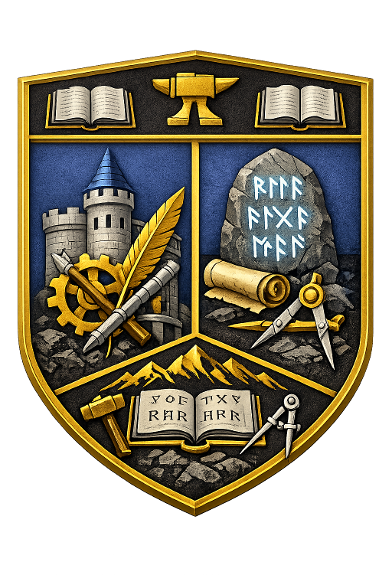
The Great Towers of Moradin are unlike any other Dwarven Hold in Warlderia. Whilst the other great kingdoms measure their strength by the richness of their mines or the size of their armies, the Towers have devoted themselves to the pursuit of knowledge. For over two thousand years they have gathered the accumulated wisdom of the Dwarven race, preserving countless books, maps, engineering plans and historical records that would otherwise have been lost during the upheavals of the Higher Wars. Amongst the Dwarves there is a saying that "Stone remembers, but only the Towers remember why."
The Hold itself is built into a broad mountain overlooking several fertile valleys. Unlike the vast underground cities of Marrak or Glitterborg, much of the settlement rises above the mountain in the form of immense stone towers connected by bridges, galleries and enclosed walkways. Each tower houses one of the great guilds or colleges, whilst the lower halls contain libraries, workshops, lecture chambers and archives. From a distance the mountain appears crowned with dozens of slender towers reaching into the sky, giving the Hold its famous name.
The origins of the Towers date back to the earliest days of Dwarven settlement in eastern Warlderia. As the first Holds expanded, it became increasingly difficult to preserve the growing body of engineering knowledge, mining records and rune lore accumulated by generations of craftsmen. Rather than allow each Hold to maintain incomplete collections, the greatest Runemasters proposed the creation of a single repository where every significant discovery could be recorded and preserved. King Morgran Stonehelm granted them a mountain and sufficient resources to begin construction, establishing what would eventually become the greatest centre of learning in Dwarven history.
Over the centuries the Towers grew into far more than a library. Entire guilds relocated their headquarters there, each maintaining its own tower devoted to a particular discipline. The Tower of Stone became renowned for architecture and fortification, the Tower of Iron for metallurgy and smithing, whilst the Tower of Runes attracted scholars from every Dwarven kingdom to study the ancient arts of rune magic. Cartographers mapped the known world from the Tower of Measures, historians compiled the great chronicles of the Dwarven kingdoms, and generations of engineers refined techniques that transformed construction throughout Warlderia.
Although founded by Dwarves, the Towers have never completely isolated themselves from the outside world. Human architects, Gnomish inventors and even the occasional Half-Elf have been permitted to study within the lower colleges, provided they are willing to accept the strict discipline demanded by the guilds. Many of the greatest bridges, fortresses and aqueducts found throughout Warlderia were designed by engineers who studied at the Towers before returning to their own kingdoms. Even today a certificate bearing the seal of the Towers of Moradin is regarded as the highest qualification an engineer or master builder can possess.
The greatest treasure of the Hold is not its wealth but its archives. Hidden beneath the mountain lie miles of vaulted libraries containing plans for ancient cities, records of forgotten kingdoms, detailed surveys of mines long since exhausted and engineering texts dating back thousands of years. Some scholars claim that complete plans still exist for every major Dwarven Hold ever constructed, including those now lost beneath Orc rule or sealed by catastrophe. The archives also contain one of the largest surviving collections of rune lore in existence, much of which can no longer be fully understood even by the greatest Runemasters.
The Towers played little direct part in the Higher Wars, choosing instead to preserve knowledge whilst the kingdoms around them fought for survival. As refugees fled across the continent they brought with them books, maps and records that were copied and added to the archives before the originals were returned where possible. It is largely because of this work that historians today possess any reliable account of many events from that turbulent age. Had the Towers fallen, much of the early history of Warlderia would almost certainly have been lost forever.
Today the Hold is governed by the Council of Guild Masters, each representing one of the ancient colleges. Presiding over the council is High Loremaster Durik Runebinder, a scholar whose understanding of rune magic is said to rival that of the legendary masters of old. Unlike most rulers, Durik commands no great army and seeks no political influence. His duty is simply to preserve the accumulated knowledge of the Dwarven race and to ensure that each generation adds to it rather than allowing it to diminish.
The Great Towers of Moradin are respected throughout Warlderia as a place of learning rather than power. Kings consult their scholars before constructing great fortresses, merchants seek their advice when planning roads and canals, and adventurers often visit in search of forgotten maps or ancient records. Whilst the Dwarves of Marrak guard the eastern mountains and Glitterborg safeguards the traditions of their people, the Towers preserve something even more precious—the knowledge upon which every future generation will build. In a world where kingdoms rise and fall with the passing centuries, the scholars of the Towers believe that wisdom, once lost, is far harder to recover than stone or gold, and it is this belief that has guided their labours since the earliest days of Dwarven civilisation.