The White Carnival
Amongst the many strange legacies left behind by the Galsitanic Intrusion, none is more mysterious than the White Carnival. Unlike the enchanted forests, crystal isles, or hidden valleys that remain fixed upon the map, the White Carnival has no permanent home. It appears without warning, usually beneath a full moon, upon lonely meadows, ancient crossroads, deserted beaches, or even within the grounds of noble estates. Where only empty land stood the evening before, travellers awaken to find a magnificent encampment of gleaming white tents, silver lanterns, colourful banners, and the distant sound of music carried upon the wind. By the following dawn it has vanished again, leaving behind no trace save flattened grass and bewildered witnesses. Most scholars believe the Carnival is a fragment of the Fey Court itself, somehow left behind when Queen Aelithriel and her followers were forced back into the Other Place. Others insist it is a travelling embassy, sent periodically into the mortal world for purposes known only to the Sidhe. The oldest Elven tales suggest that the Carnival exists in both realms simultaneously, explaining why it can never be found twice in the same place.
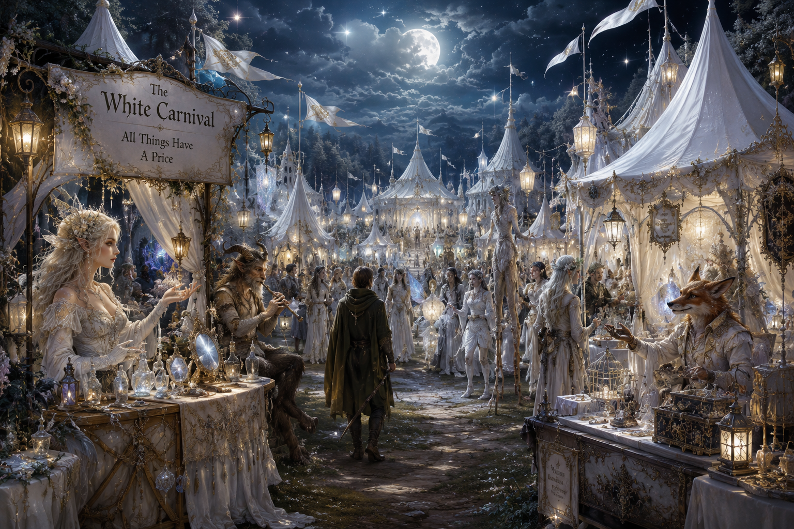
Those fortunate, or unfortunate, enough to visit the Carnival describe a place of impossible beauty. White pavilions stretch further than seems physically possible, whilst graceful Fey nobles mingle with satyrs, dryads, talking beasts, sprites, and stranger creatures whose names have long since been forgotten. Music seems to drift through the air without visible musicians, flowers bloom in impossible colours, and performances of astonishing skill continue throughout the night. Every visitor is welcomed warmly, and no violence is permitted within the Carnival's bounds.
Its greatest attraction is the Moon Market, where merchants offer wonders beyond imagining. Enchanted weapons, living jewellery, impossible wines, books that rewrite themselves, seeds that bloom into ancient trees overnight, and artefacts of unmistakably Fey origin may all be found for sale. Yet no merchant accepts gold. Instead, payment is demanded in stranger currencies: a cherished memory, the colour of one's eyes, a year of life, the sound of a loved one's laughter, a promise freely given, or even one's own shadow. The Fey never deceive their customers, but neither do they volunteer the full consequences of a bargain. Many leave believing themselves greatly enriched, only to discover years later the true value of what they surrendered.
Despite countless tales of misfortune, the White Carnival remains a source of endless fascination. Nobles quietly dispatch agents to seek it out, scholars devote entire careers to studying its appearances, and adventurers willingly risk its bargains in search of treasures unavailable anywhere else in the world. The churches urge caution rather than outright condemnation, recognising that the Carnival is neither wholly benevolent nor malicious. Like the Fey themselves, it simply obeys laws older than those of mortals.
Throughout Warlderia, parents now warn their children never to wander towards mysterious music heard beneath a full moon, whilst merchants and adventurers secretly hope to hear exactly those same melodies.
An new proverb captures the wisdom of it: "If you leave the White Carnival richer than when you entered, you simply have not yet discovered what it truly cost."