The County of Combel
Official Name: The County of Combel
Ruler: Count Sunder Ironcleft
Government: Feudal
Capital: Combel
Major Towns: Bazhak's Culverhouse
Resources: Iron & Trade
Population: 65,000 (15% Urban) - 60% Human, 20% Dwarves, 10% Elven, 5% Gnome, 5% Mixed
Languages: Common, Dwarven
Common Alignments: Neutral, Lawful Neutral, Neutral Good
Major Religions: Moradin (LG), Pelor (NG)
Allies: Dwarves of Marrak
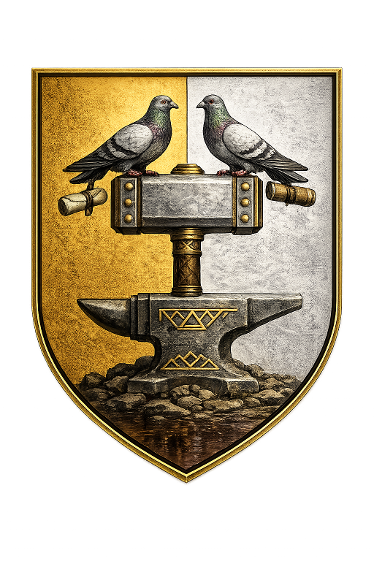
The County of Combel occupies a vital crossroads between the Human kingdoms of the south and the ancient Dwarven realms of the north. For centuries it prospered as the principal stopping point upon the great north–south trade road, where merchants, pilgrims and caravans exchanged goods before continuing their journeys across the continent. Although the decline of overland trade following the rise of the Necropolis greatly reduced its wealth, Combel remains one of the closest and most enduring examples of cooperation between Humans and Dwarves anywhere in Warlderia. Unlike most Human settlements, Combel was not founded by kings or nobles. It was built by the Dwarves.
During the great age of Dwarven expansion the settlement served as a protected home for the Humans who lived and worked alongside the mountain folk. Although the relationship reflected the paternal attitudes common amongst the elder races of the time, the people of Combel were generally treated with fairness and shared in the prosperity generated by the trade flowing through the Iron Road. When the Higher Wars engulfed the continent, Combel escaped much of the devastation that consumed neighbouring lands. That changed when an Orc host marching towards Roseguard detached a large force to seize the prosperous town. The battle that followed became one of the defining moments in Combel's history. Outnumbered and fighting largely alone, the Human inhabitants held the settlement long enough for a Dwarven relief army from Marrak to strike the Orcs in the rear. Trapped between the defenders and the advancing Dwarves, the invaders were destroyed almost to the last warrior. The Dwarven Lords never forgot the courage shown by the people of Combel.
In recognition of their loyalty and sacrifice, the town was granted its independence, becoming one of the first Human communities to gain its freedom peacefully rather than through rebellion. The alliance forged in battle has endured ever since, and relations between Combel and the Dwarves of Marrak remain among the strongest in Warlderia. When Kaegor's revolt swept across the continent, Combel chose a different path. The city declared that it had already won its freedom and had no desire to turn upon friends who had honoured their word. Throughout the centuries that followed, the county consistently pursued neutrality, avoiding the great wars that reshaped the Successor States whenever possible. Some neighbouring rulers dismiss Combel as timid. Its citizens simply reply that they have buried enough soldiers to understand the true cost of war. Today Count Sunder Ironcleft, a Human whose family proudly acknowledges distant Dwarven ancestry, continues this long tradition of diplomacy. Under his careful leadership the county enjoys friendly relations with nearly every neighbouring realm, acting as an honest broker where others see only rivals.
Combel
Combel (Small City), Alignment: NG, Population: 9,500 (60% Human, 25% Dwarf, 5% Gnome, 5% Elf, 5% Mixed) ,Authority Figure: Count Sunder Ironcleft (Male Human Fighter)
Few visitors describe Combel as beautiful. Its low, square stone buildings, broad streets and sturdy construction owe far more to Dwarven practicality than Human elegance. Rather than graceful towers or ornate palaces, the skyline is dominated by solid warehouses, guild halls and workshops whose thick walls have changed little for centuries. The true character of the city lies beneath its streets. Much of the original Dwarven settlement survives as an extensive network of tunnels, storage vaults and underground passages connecting many of the principal buildings. Originally intended for trade and defence, these hidden routes proved invaluable during the Orc siege and remain carefully maintained today. Visitors often remark that Combel appears almost as large below ground as it does above it.
Remarkably, the city possesses no great curtain wall. Instead a broad defensive ditch protects the ancient inner settlement, whilst the formidable construction of the individual buildings makes each capable of acting as a strongpoint during times of war. Military scholars still study the failed Orc assault upon Combel, where attackers were forced to capture the city building by building whilst defenders moved unseen beneath their feet. The people of Combel rarely define themselves by race. Humans, Dwarves, Gnomes and Elves live side by side throughout the city, with mixed neighbourhoods far more common than racial districts. The only notable exception is the Gnomish Quarter in the southern district, whose workshops produce some of the finest precision instruments in the eastern Successor States. Count Sunder Ironcleft enjoys widespread respect amongst his people. Quiet, practical and steadfast, he has devoted much of his rule to preserving Combel's neutrality whilst strengthening its commercial ties with both Human and Dwarven neighbours.
Bazhak's Culverhouse
Bazhak's Culverhouse (Large Town), Alignment: LN, Population: 3,500 (40% Dwarf, 40% Human, 10% Elf, 10% Mixed), Authority Figure: Orri Bazhakson (Male Dwarf Cleric of Ulaa)
Perhaps no settlement better illustrates Dwarven practicality than Bazhak's Culverhouse. Before the Higher Wars, the Dwarven lord Bazhak established the settlement as the centre of an ambitious communications network linking the mountain holds of eastern Warlderia. Hundreds of specially bred messenger pigeons were housed within its vast dovecotes, allowing news to travel between distant fortresses in a fraction of the time required by mounted couriers. Initially the system proved remarkably successful. During the early years of the Higher Wars, Dwarven armies relied heavily upon Bazhak's birds to coordinate troop movements and report enemy activity. Eventually, however, Elven spies learned to intercept the messages, altering their contents before releasing the birds to continue their journeys. Conflicting orders and disastrous misunderstandings followed until the deception was finally uncovered.
Although no longer trusted for military communication, the Culverhouse survived. Following Combel's independence, the Dwarves gifted the settlement to their Human allies, who expanded the network into a commercial messenger service serving much of eastern Warlderia. Today merchants, nobles and governments alike rely upon Bazhak's famous pigeons to carry contracts, letters and official correspondence across the continent. The enormous dovecotes dominate the skyline, housing thousands of carefully bred birds whose daily departures have become one of the defining sights of the town. Travellers often pause simply to watch great flocks circling overhead before vanishing towards every corner of the eastern lands. The settlement remains under the stewardship of Orri Bazhakson, a direct descendant of its founder. Although lacking the brilliance of his famous ancestor, Orri is an honest and dependable administrator whose greatest pride lies in ensuring that every message entrusted to Bazhak's birds reaches its destination.