County of Southwatch 

Formal Name:  County of Southwatch
Ruler:  Count Tiberius Balatin
Government:  Feudal within Divine Empire
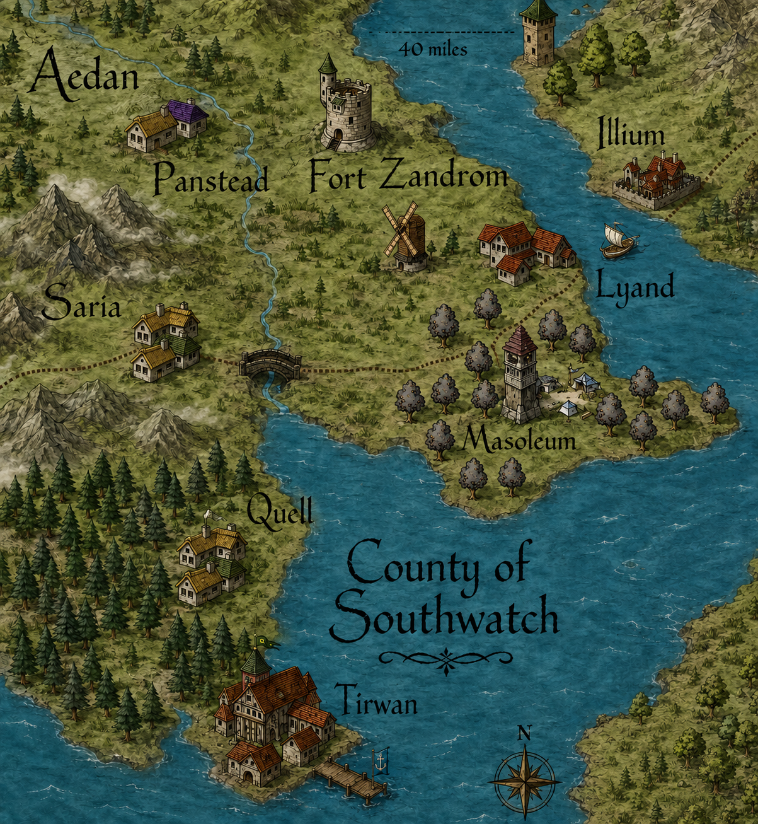
Capital:  Tirwan
Major Settlements:  Quell, Lyand, Saria and Fort Zandrom
Resources:Trade & Agriculture
Population:  200,000 (5% urban) ~ 70% Human, 15% Half-Elven, 10% Elven, 3% Halfling, 1% Dwarven, 1% Other.
Languages:  Common & Elven 
Common Alignment:  Lawful, Any 
Major Religions: Pelor (NG), Kord (CG), Thanus (LN) 
Allies / Enemies:  None 

The County of Southwatch is one of the oldest and most stable provinces of the Divine Empire. Situated along the southern frontier of the former Elven realms, it has changed remarkably little since Kaegor I conquered the region during the Liberation Wars. Unlike many provinces that have been shaped by centuries of conflict, Southwatch has enjoyed over two hundred years of relative peace and prosperity. The northern and eastern regions of the county are fertile and heavily cultivated, producing grain, fruit, and livestock in abundance. To the west lies the ancient Forest of Quell, a vast wilderness that has never been fully tamed. Local legends speak of fey courts, wandering elementals, and stranger things lurking beneath its canopy. Though the roads remain safe, few sensible travellers venture far into the forest without good reason.

The jewel of the county is Tirwan, a city of white stone towers, gardens, fountains, and broad avenues. Built by the Elves during the height of their power, it remains one of the most beautiful cities in the Empire. Remarkably, Tirwan has no defensive walls. During the Higher Wars it was spared destruction, and throughout most of its history the city relied upon diplomacy, prestige, and geography rather than fortifications.

Its only great trial came during Kaegor's Revolt. As Kaegor advanced south, the Elven defenders fought with fanatical determination. Fey allies, summoned elementals, and powerful magic were unleashed in an attempt to halt the advance. For months the Forest of Quell became a battleground of ambushes, skirmishes, and magical warfare. Eventually Kaegor's veterans emerged victorious. In one of the few acts of mercy for which he is remembered, Kaegor accepted the surrender of Tirwan and spared the city from sack or destruction. The Elven nobility, however, were ordered into exile and never returned to positions of power.

Today Southwatch remains prosperous, but beneath its tranquil surface tensions are beginning to emerge. Count Tiberius Balatin grows older with every passing year and has neither wife nor heir. Noble families throughout the county quietly prepare for the possibility of succession, whilst old rivalries between the great houses are becoming increasingly difficult to conceal.

Tirwan, Large City: Alignment LN, Population 15,000 (75% Human, 15% Half-Elven, 10% Other), Authority Figure: Count Tiberius Balatin (Human male, fighter)

Tirwan serves as both the capital and cultural heart of Southwatch. Though now largely human in population, the city retains much of its Elven character. Elegant architecture, public gardens, and ancient monuments dominate the skyline, whilst merchants from across the Empire fill its busy docks and markets.

Count Tiberius Balatin is both respected and feared by his subjects. Once a renowned adventurer, he emerged from his travels with a deep distrust of arcane magic. Though he does not outlaw spellcasting entirely, he maintains harsh penalties for those who use magic for criminal, selfish, or destructive purposes. The punishment for such offences is often death.

To enforce these laws, the Count maintains the Templars of the Veil, an elite order dedicated to monitoring magical activity throughout the county. Contrary to popular belief, the Templars are not opposed to magic itself. Many are accomplished spellcasters, trained from childhood to identify magical corruption and abuse. Their members specialise in counter-magic, magical investigation, and the hunting of rogue sorcerers. Senior members wear breastplates forged from rare Starfall Ore, making them formidable opponents even for powerful wizards.

The Count's advancing age and lack of an heir have become the subject of endless speculation. Every noble family in Southwatch understands that the future of the county may soon depend upon who succeeds him.

Quell, Small Town: Alignment CN, Population 1,900 (50% Half-Elf, 20% Human, 15% Elf, 10% Halfling, 5% Other), Authority Figure: Alderman Narin (Half-Elf male ranger)

Quell was once a thriving fey settlement hidden within the western forests. Following Kaegor's conquest it gradually evolved into a frontier town inhabited primarily by Half-Elves, wanderers, hunters, and those who prefer life beyond the reach of noble authority.

Governed by an elected council chosen every three years, Quell possesses a fiercely independent character. The surrounding forest remains both its greatest blessing and greatest threat. Fey creatures are common, elementals occasionally emerge from forgotten magical battlefields, and tales of undead lurking amongst the deeper woods persist despite official denials. The people of Quell have learned to live alongside such dangers and possess a practical understanding of the supernatural rarely found elsewhere in the Empire.

Saria, Large Town: Alignment LN, Population 3,900 (80% Human, 10% Elf, 5% Halfling, 5% Other), Authority Figure: Baron Ludivico Maltino (Human male, fighter)

Saria is the agricultural powerhouse of Southwatch. Surrounded by fertile farmland and prosperous estates, the town supplies much of the food consumed in Tirwan and exported throughout the region. This prosperity has enriched its merchants and nobles alike.

The town's aristocracy closely follows the fashions and customs of the Imperial Capital, often with amusing enthusiasm. Baron Ludivico Maltino is perhaps the most ambitious of them all. Through his wife he possesses a credible claim to the County and many believe he hopes to succeed Count Tiberius should the old ruler die without issue. While publicly loyal, Ludivico has spent years quietly cultivating allies throughout Southwatch.

Lyand, Large Town: Alignment LG, Population 3,500 (75% Human, 15% Elf, 10% Other), Authority Figure: Lord Theodrum Amali (Human male, fighter)

Nestled amongst orchards, vineyards, and woodland estates, Lyand is famed for its fruit, cider, and beer. For centuries it was regarded as one of the most peaceful settlements in the Empire, a reputation its inhabitants still cherish.

Recent decades, however, have brought new concerns. Pirate raids from the western seas and occasional incursions by Elven warbands from the north have reminded the people that peace can never be taken for granted. The ancient Amali family has traditionally ruled the region, but their influence has steadily declined as rival noble houses have expanded their power. Lord Theodrum remains respected by his people, though many wonder how long his family's dominance can endure.

Fort Zandrom, Small Town: Alignment N, Population 1,800 (85% Human, 10% Half-Elf, 5% Other), Authority Figure: Baron Giovanni Caseragi (Human male, ranger)

Fort Zandrom was originally constructed to defend Radiant Melthurian during the Higher Wars. Its immense walls, towers, and defensive works made it one of the strongest fortresses ever built by the Elves. During Kaegor's Revolt, however, the garrison declared for the rebels and transformed the fortress into a major obstacle to the Elven war effort. For over a year the Elves besieged Zandrom without success. By the time Kaegor arrived to relieve the fortress, the siege had cost them thousands of lives and perhaps any realistic hope of victory. Since then the fortress has remained one of the most important military sites in the Empire.

Today much of the vast interior has been converted into a thriving town. Even so, large sections of the fortress remain empty, their barracks and storehouses waiting for a war that may never come. Baron Giovanni Caseragi, the current lord of Zandrom, is an ambitious and capable noble whose desire to absorb the remaining lands of House Amali is one of the county's worst-kept secrets.

The People of Southwatch

Southwatch possesses one of the most diverse populations in the Divine Empire, a legacy of its long history under both Elven and Human rule. Humans form the majority of the population and dominate the agricultural estates, merchant houses, military orders, and noble families. Unlike many provinces, however, they coexist alongside substantial Half-Elven and Elven communities whose ancestors remained after Kaegor's conquest.

Half-Elves are particularly common throughout the county and are often regarded as a bridge between the two cultures. Many serve as merchants, foresters, craftsmen, and local officials, whilst some of the county's oldest families possess both Human and Elven ancestry. The largest Half-Elven communities are found in Tirwan and Quell, where Elven traditions remain strongest.

The Elven population is concentrated in Tirwan, Lyand, and the settlements surrounding the Forest of Quell. Most are descendants of those who remained after the exile of the Elven nobility following Kaegor's victory. While they no longer hold significant political power, their influence upon the county's architecture, culture, and traditions remains considerable. Elven is still widely spoken throughout the province, particularly amongst educated citizens.

Halflings are common in the agricultural districts of Saria and the fertile lands surrounding Tirwan, where they are renowned as farmers, orchard keepers, brewers, and traders. Small Dwarven communities can be found in the ports and markets of the county, though few settle permanently.

Nearly ninety-five percent of the population lives in villages, hamlets, isolated farmsteads, and small market communities scattered across the countryside. The county's urban population is concentrated in Tirwan and the larger towns of Saria, Lyand, Quell, and Fort Zandrom. This overwhelmingly rural character has helped preserve Southwatch's reputation as one of the most peaceful and prosperous regions of the Divine Empire.

Despite occasional tensions between Human and Elven communities, particularly amongst the older generations, centuries of coexistence have created a distinct Southwatch identity. Most inhabitants consider themselves Southwatchers first and members of any particular race second, a fact that has contributed greatly to the county's remarkable stability.

Shield of House Amali