Settlements
 Fey Ruins (Village): Alignment: NG, Population: 420, (92% human, 8% half-elf) Authority figure: Greenawl (half-elf, male, publican)
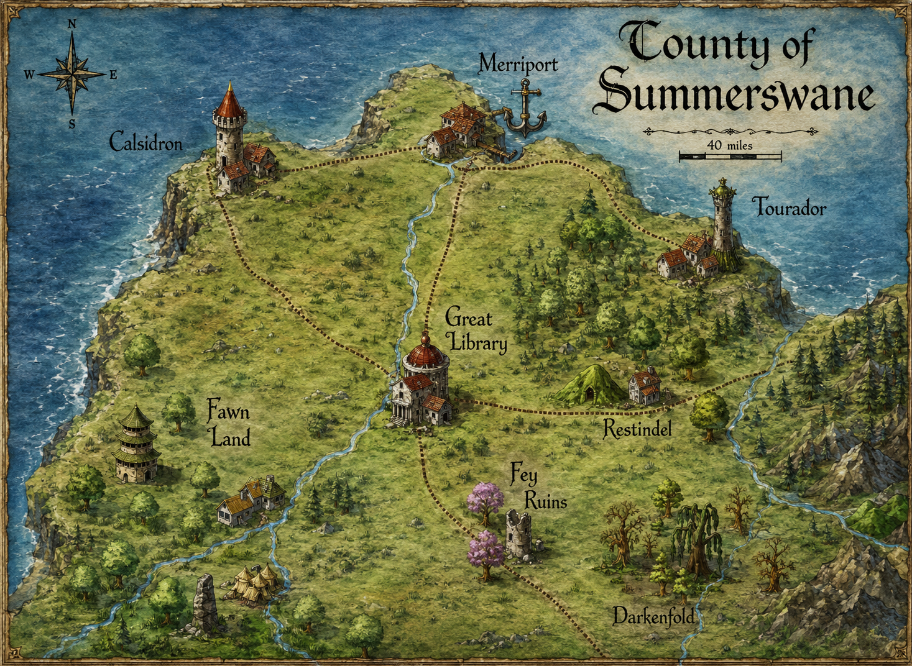
The Fey Ruins lie a short distance south of the Great Library and are amongst the oldest known structures in Summerswane. Little is known of their builders, though most scholars believe they predate both the Divine Empire and the arrival of the Sea Elves upon the coast. The surviving ruins consist of several broken towers, fragments of pale stone walls, and a number of standing arches arranged in patterns that appear to have no practical purpose. The stone itself is unlike any commonly found in the region. Even after untold centuries of exposure to the elements it shows little sign of weathering, while carvings upon the surviving structures remain remarkably sharp. Attempts to translate the inscriptions have met with only limited success, as many seem to change subtly between observations or appear different depending upon the time of day.
Local folklore claims that the ruins once stood at the heart of a gateway between the mortal world and the lands of the Fey. While most scholars dismiss such tales as exaggeration, few can explain the unusual events associated with the site. Travellers occasionally report hearing distant music when no musicians are present, whilst others claim to have glimpsed figures moving amongst the ruins only to find no trace of them upon investigation. The ruins are particularly active during the spring and autumn equinoxes. At these times strange lights are often seen amongst the standing stones and animals are known to behave erratically. Several recorded incidents describe individuals disappearing for hours or even days only to return believing that mere moments have passed. In a few cases those affected were unable to account for their absence and retained only fragmentary memories of feasting halls, moonlit forests, and voices speaking in unfamiliar tongues.
The County authorities do not consider the ruins dangerous, though visitors are advised not to remain there after dark. Druids from the Fawn Lands occasionally travel to the site to conduct ceremonies and maintain that the ruins still possess a connection to the Fey Realm. They claim that the barrier between worlds is thinner there than elsewhere in Summerswane and that certain paths can still be opened under the proper conditions. Whether these stories are true remains uncertain. What is known is that no one has ever successfully excavated the site. Every attempt has ended in failure, equipment mysteriously disappearing, workers abandoning the project, or unexpected accidents halting progress. As a result, much of the ruins remain buried beneath the earth, leaving scholars to speculate about what may still lie hidden beneath the gentle hills of Summerswane.
Great Library (Small Town): Alignment: LG, Population: 1,700, (70% human, 15% half-elf, 10% elf, 5% other) Authority figure: Lady Bronti (half-elf, female, librarian)
Beyond the ruins a traveller will come to the site of the Great Library. It was once a temple to Labelas Enoreth, the Elven god of time, knowledge and history, but was taken by Kaegor in the wars. He decreed it should be his Great Library and had all the great works to be moved to it. Sadly he died soon afterwards and his wishes were never fulfilled. It is still a fine structure with an impressive collection of literature and science tomes within but it is not the library dreamed of. It has a mixed staff of human, half-Elves and even a few Elven academics who maintain the library. There is a town based around it with a temple to Delleb, the LG god of reason, intellect, and study. The towns folk have access to the library and are a surprisingly well read bunch though they also have an opinion on near anything and everything.
Although the Great Library is regarded as one of the greatest repositories of knowledge in the western provinces, not all of its collection is freely accessible. Several wings remain sealed, either because their contents are considered dangerous or because no one now possesses the authority to open them. Scholars occasionally speak of lost catalogues, forgotten archives, and entire collections that vanished during the turmoil following Kaegor's death. One persistent rumour claims that a hidden vault exists somewhere beneath the library, containing books and records personally commissioned by Kaegor himself. Numerous expeditions have searched for evidence of this chamber, but none have yet succeeded in locating it.
Merriport (Small City): Alignment: NG, Population: 10,050, (80% human, 10% half-elf, 5% elf, 5% other) Authority figure: Count Aelfred Maltasian (half-elf, male, noble)
The major city of the county is Merriport which an old provincial one founded by Elves and expanded by Man. It is a popular holiday spot for wealthy merchants and affluent nobles. It has an elegant centre with broad boulevards and sun drenched squares. It has a modest harbour with, mainly, fishing vessels and some merchant ships. It is also a home of learning and the arts with both a temple to Delleb and a shrine to Lirr, the CG goddess of prose, poetry, literature, and art. There is also a large and impressive but also largely unused temple to the warrior god Heironeous whose preceptory here was abolished decades ago. The passive nature of the folk of Summerswane and the peacefulness of the County means few worship the valorous war god.
Merriport is best known throughout the Empire for the Festival of Lantern Tides, held each midsummer when thousands of lanterns are set afloat upon the harbour and surrounding waters. The tradition is said to date back to the Sea Elves who once inhabited the coast, though its original meaning has long been forgotten. Visitors travel from across the region to attend the celebrations, which are accompanied by music, feasting, and markets. Beneath the modern town stand the remains of older sea-elven structures. Most have long since been incorporated into warehouses, cellars, and foundations, but from time to time ancient chambers are uncovered during building works. While most contain little more than crumbling stonework, rumours persist of sealed vaults beneath the harbour containing relics from before the departure of the elves.
Tourador (Small Town): Alignment: CG, Population: 1,800, Mixed (79% human, 9% half-elf, 5% elf, 3% dwarf, 4% other.). Authority figure: Miriam Loir (human, female, mayor)
Tourador is home to a temple complex and tower to Myhriss the neutral good goddess of love, romance, and beauty. It is a beautiful location and is the most famously romantic spot within the Empire. Young lovers often elope to Tourador, while fashionable noble marriages take place here. There is also a more hedonistic feel with several shrines to Olidammara, the chaotic god of music, revelry, wine and tricks. Away from the tower are often the locations for wild parties and celebrations being thrown by some of the more decadent visitors. The road north to Merriport winds along the coast and links many a fashionable villa. To the south and west of town near the rolling moors are small suburbs of Halflings.
The lighthouse of Tourador has guided ships safely along the coast for generations, yet local fishermen tell a darker tale. On certain nights, particularly during autumn storms, a pale light is said to appear offshore beyond the normal reach of the lighthouse beam. Those who follow it are rarely seen again. Most dismiss such stories as superstition, but records preserved in Merriport mention disappearances stretching back centuries. The keepers of the lighthouse refuse to discuss the matter publicly, though many are known to leave offerings of flowers and wine at a small shrine hidden amongst the rocks beneath the tower.
Calsidron (Small City): Alignment: NG, Population: 8,500, (70% human, 20% half-elf, 5% elf, 5% other) Authority figure: Lord Waeltar Maltasian (human, male, noble) and Mother Vohis of Berei (Human, female, cleric)
Calsidron is an ancestral home of the Maltasian house. It is a heavily Elven influenced settlement with a high number of the residents possessing some Elf blood. It is much less fashionable than Merriport for visitors and is a lot more homely in nature. There is an old but serviceable Elven lighthouse built before Kaegor’s time and a sprawling palace within which the extended Maltasian family reside.
At the city’s heart is a large market square and with its old winding streets, getting lost is easy for those unfamiliar with them. Calsidron has a fishing fleet and thriving merchant quay from which wine is exported from its extensive cellars. There are numerous small shrines and a temple to Berei, the NG agricultural goddess, like many settlements in Summerswane.
Restendel (Village): Alignment: TN, Population: 700, (95% human, 5% others), Authority figure: Bruno (human, male, publican) and Father Mingand of Pholtus (human, male, cleric)
The small settlement of Restendel lies just off the road between Tourador and the Great Library. It is a quiet sleepy place being a small agricultural community with a cluster of buildings around the crossroads. It is near to the ancient burial mound of the old savage dead king which is meant to be highly steeped in old lore magics and the like.
The heart of the village is the Inn, the Saucy Turnip. It was once called the Plough & Pixie but the unfortunate impregnation of a guest noblewoman by a wandering Satyr from the Fawn Lands led to such a scandal that the Inn changed its name. A solid built affair with a decent kitchen serving high quality meals for passing nobles and more reasonable simpler fayre for the other sorts. Run by Bruno, a retired adventurer, and his wife Willow. Bruno was a fighter and has seen plenty of action in the Divine Legion before retiring. He is a big beefy fellow in his late fifties.
The old faith was popular till a Pholtus, the god of Resolution, Law, Order, Inflexibility, Temple was built by the father of the impregnated noblewoman. This beautiful building is to ensure the locals did not slip back in to old lore barbarian ways and to keep at watch on the Barrow. It is a lovely temple of limestone stone imported from the south with a white marble altar on which burns the eternal light of Pholtus. Father Mingand holds services here for the faithful and apparently faithful.
There is a well stocked but chaotic shop run by Erskine the Gnomish proprietor. He has lots of items of varying levels of usefulness and is well known as an honest trader and keen follower of Pholtus.
Fawn Lands (Village): Alignment: CG, Population: 900, (65% fey, 25% half-elves, 10% human), Authority figure: Faybel (satyr, male,noble)
The Fawn Lands occupy the western reaches of Summerswane and are amongst the oldest settled regions of the county. Unlike the cultivated vineyards and villages of the coast, the Fawn Lands remain a patchwork of ancient woodland, wildflower meadows, hidden streams, and scattered homesteads. Many of the inhabitants claim descent from the first settlers of the region, whilst others trace their ancestry to elves who remained behind when the Sea Elves departed the coast centuries ago. The authority of Aelfred Maltasian is recognised throughout the region, but is rarely felt directly. Most communities govern themselves through custom and tradition, with disputes often settled by village elders, druids, or respected local families. The people of the Fawn Lands are generally friendly towards outsiders, though they possess a strong independent streak and little patience for excessive laws or bureaucracy.
The region is famed for its unusually close relationship with the Fey. Satyrs, sprites, dryads, and stranger creatures are occasionally encountered within the woods, particularly during the spring and autumn months. While tales of revels beneath moonlit trees are often exaggerated by travellers, there is little doubt that the barrier between the mortal world and the Fey Realm is thinner here than elsewhere in Summerswane. Several ancient standing stones and forgotten pathways can be found throughout the Fawn Lands. Local folklore maintains that some roads do not always lead to the same destination twice and that certain glades should never be entered after sunset. Such stories are treated with a mixture of amusement and caution by the inhabitants, who have long learned that the wisest approach to the Fey is one of respect rather than fear.
The largest settlement is little more than a collection of inns, cottages, and market stalls surrounding an ancient tower of uncertain origin. Travellers are welcomed warmly, provided they respect local customs and avoid offending the woodland folk. Those who do otherwise may find themselves the subject of pranks, enchantments, or less easily explained misfortunes.