
Nestled deep within the eastern mountains stands the Kingdom of Glitterborg, the last surviving Dwarven realm in Eastern Warlderia. Surrounded by Human kingdoms and isolated from the other great Holds, Glitterborg has endured centuries of war, political upheaval and Orc invasion to become one of the most prosperous realms upon the continent. To Humans it is known as Glitterborg, or sometimes Silverwall, names inspired by the remarkable sight of its vast underground halls whose walls shimmer with countless crystals and polished gemstones. The Dwarves themselves originally regarded these Human names with some amusement, and more than a little irritation, but over the centuries they have become accepted, another sign of the kingdom's unusually close relations
hip with its neighbours. Today Glitterborg stands alone. Its sister kingdom of Xuthzan fell centuries ago to the Orcs, leaving Glitterborg as the final bastion of Dwarven civilisation in the north-east.
The Alliance of Three Peoples
Unlike most Dwarven realms, Glitterborg has never lived in isolation. During the Higher Wars the Dwarves of Glitterborg and Xuthzan formed an extraordinary alliance with the neighbouring Elven kingdoms against the growing threat posed by Dragons, Orcs and the barbarian tribes of the eastern plains. Dwarven engineers strengthened Elven fortresses, whilst Elven scouts protected the mountain passes leading to the Holds. It was an alliance born of necessity. When the Elven kingdoms finally withdrew from the frontier, command of the border gradually passed into the hands of Half-Elves and Human lords who continued the struggle alongside their Dwarven allies. Those friendships endured.
When Kaegor began his great rebellion against Elven rule, King Durgan Stonefist made a decision that would change the history of Glitterborg forever. Although he refused to commit his army openly to Kaegor's cause, he secretly provided shelter, food, weapons and safe passage for the Human resistance whenever fortune turned against them. Dwarven forges supplied thousands of weapons during the war, whilst hidden mountain roads allowed Kaegor's forces to evade pursuit more than once. When victory finally came and the Kaegorian Empire was founded, Glitterborg found itself not merely tolerated but honoured as one of Humanity's oldest and most trusted allies.
The Fall of Xuthzan
The peace that followed proved deceptive. Whilst Glitterborg continued to strengthen its ties with the Human kingdoms, the neighbouring Dwarven kingdom of Xuthzan gradually grew complacent. Confident in the strength of its ancient walls, its rulers failed to recognise the growing danger beyond their borders. The Orc assault, when it came, was devastating. Legends speak of treachery from within and secret tunnels opened by Drow and Duergar agents beneath the mountain. Whether those tales are true remains uncertain, but the result is beyond dispute. Xuthzan fell. Few escaped. Those who reached Glitterborg brought stories of slaughter, burning halls and the loss of one of the greatest Dwarven kingdoms ever known. For almost twenty years Glitterborg, aided by the Kaegorian Empire, launched repeated attempts to recover the fallen Hold. Every expedition failed. Eventually the mountain was abandoned to the Orcs. It remains in their hands to this day.
The Glittering Halls
Glitterborg differs greatly from almost every other Dwarven Hold. Its mines contain extraordinary deposits of crystal and precious gemstones. Whilst the finest gems are traded across Warlderia, countless lesser stones are polished and built directly into the walls and ceilings of the city. Carefully positioned mirrors, crystal lenses and shafts carrying natural daylight reflect light deep into the mountain until entire avenues appear to sparkle like fields of stars. It is this spectacle that earned the city its Human name. Visitors expecting a gloomy underground fortress instead discover broad halls filled with music, fountains and bustling marketplaces. Many conservative Dwarves consider Glitterborg almost extravagant. The people of Glitterborg simply consider it beautiful.
A Different Kind of Dwarf
Centuries of friendship with Humans and Elves have left their mark upon the kingdom. Music echoes through taverns that would be silent in other Holds. Libraries flourish alongside armouries. Poets enjoy almost as much respect as master smiths. Public festivals attract merchants from every neighbouring kingdom, whilst Human and Half-Elven craftsmen are far more common than elsewhere in Dwarven society. Traditionalists sometimes mock Glitterborg as having become "too Human." The people of Glitterborg reply that friendship has made them stronger, not weaker. Despite these cultural differences, their craftsmanship remains second to none. Their armouries produce magnificent weapons, intricate jewellery and some of the finest suits of Mithril and Adamantine armour known in Warlderia.
The Stonefist Dynasty
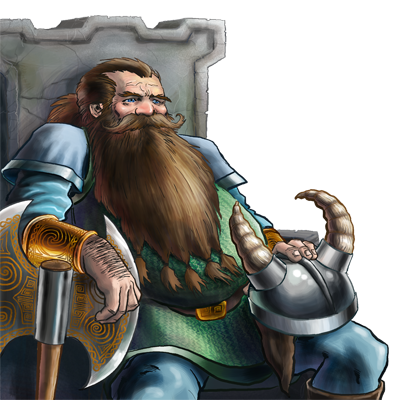
For nearly four centuries the Stonefist Clan has ruled Glitterborg. They inherited the throne after the extinction of the ancient Goldcrown Dynasty during the Higher Wars and have since guided the kingdom through some of the darkest periods of its history. The Stonefists have long favoured diplomacy before warfare and cooperation before conquest. To many Dwarves this appears dangerously idealistic. To the people of Glitterborg it is simply good sense. King Ivan Stonefist continues that tradition today. He maintains close relations with Kaldar, frequently dispatching engineers, advisers and soldiers to assist in defending the frontier against barbarian incursions.
The Ironhelm Exiles
Not every Dwarf shares the King's vision. Nearly three thousand survivors of the ancient Ironhelm Clan, former rulers of Xuthzan, now dwell within Glitterborg's eastern districts. Though welcomed as kin, they have never truly accepted exile. Their hearts remain with their lost homeland. Each generation renews calls for a great campaign to reclaim Xuthzan from the Orcs, arguing that no Dwarven kingdom can truly prosper whilst one of the greatest Holds ever built remains in enemy hands. King Ivan has consistently resisted such demands, believing the cost would be catastrophic. Yet public opinion is slowly changing.
Small-scale warfare continues throughout the abandoned tunnels of the Great Eastern Road, where Dwarven patrols, Orc warbands and darker creatures battle endlessly beneath the mountains. Every year more young Dwarves volunteer to join these dangerous expeditions, and every year fewer return. Many believe it is only a matter of time before Glitterborg marches to war once more.