Ice Orcs of Kylma

The southern continent of Kylma stretches from the warmer northern shore off far to the winter wastes. The Orcbane Mountains cut the Hugond Plains off from the much colder lands to the south in which are known to live a wide range of creatures adapted to the harsh environment. Those few adventurers foolish and lucky enough to cross the mountains and return talk of hordes of Orcs adapted for the bitter cold. These Ice Orcs have rarely been seen north of the mountains save for the time when the Hugond holy site of Kruan was desecrated and true winter returned to the Hugond Plains and the Crimson Coast. Then and only then did growing numbers of Ice Orcs start entering the lands north of the mountains. Where the Ice Orcs originated from and what their aims are remain a mystery but their presence in numbers is a well understood fact. Many of the Ice Orcs worship Khashaba.

Lore of Kima (Kylma)

Before the arrival of the Higher Races, the southern continent was sparsely populated, its vast lands lightly touched by man. Humanity existed then as scattered peoples who tended forests, plains, and waterways, living in harmony with the natural world. These lands were known simply as Kima, a name shaped by their harsh, guttural dialects. At this early age, mankind was primitive, guided by instinctive druidic practices long before the structured teachings introduced by the Higher Races.

Ancient songs tell of small communities dwelling in the lower hills of the northern mountain range. These peoples had begun to grasp the earliest concepts of order and society. They worked stone, understood the veins of colour within exposed rock faces, and learned from the open scars carved by the mountains themselves.

The emergence of the Higher Races brought with it the Ice Orcs, beings driven by conquest and enslavement. They sought to dominate mankind, forcing them into servitude to meet their needs and spare themselves the burdens of labour, so they might focus solely on war. The enslaved were treated with cruelty, and few survived long under Orcish rule. In time, the Ice Orcs enacted near-total genocide upon the people of Kima. Had it not been for the Indersta Sea, known to the Ice Orcs as Vras Nen, the Death Water, they may have spread their devastation even further. The Ice Orcs possessed neither the desire nor the courage to cross open seas, and so eventually turned inward, warring endlessly amongst themselves.

With the passing of mankind, the lands north of the Orcbane Mountains became as frozen and desolate as those to the south. The druidic rituals once practiced by humanity had held the creeping cold at bay, nurturing balance in the land. In later ages, this same unseen stewardship would be mirrored by the Hugond who now inhabit the region, though they remain largely unaware of this ancient continuity. Lore and song speak of survivors who escaped the Ice Orcs by sailing westward, knowing their enemies would not follow. Some settled islands several hundred miles offshore, these were said to be the mountain folk, who would later become known as the Blood Islers. Others sailed even farther west, those who had once tended the forests and open plains.

It is believed that around -300 Imperial Timeline, the westernmost exiles returned. They came transformed, bearing greatly enhanced druidic powers that would become the foundation of their culture. These people would come to be known as the Hugond. Through their rituals, winter was pushed back, restoring plains and forests to the land. Upon their return home, they flourished, founding temples and embracing a nomadic way of life. Cities held little importance to them, though they established Kruan, their most sacred and revered site. For a long age, the Hugond lived untouched, even by the Ice Orcs, who shunned the warmth of these restored lands. This peace endured until the invasion, or return, depending on one’s perspective, of the Blood Islers, and the corruption of Kima into Kylma.
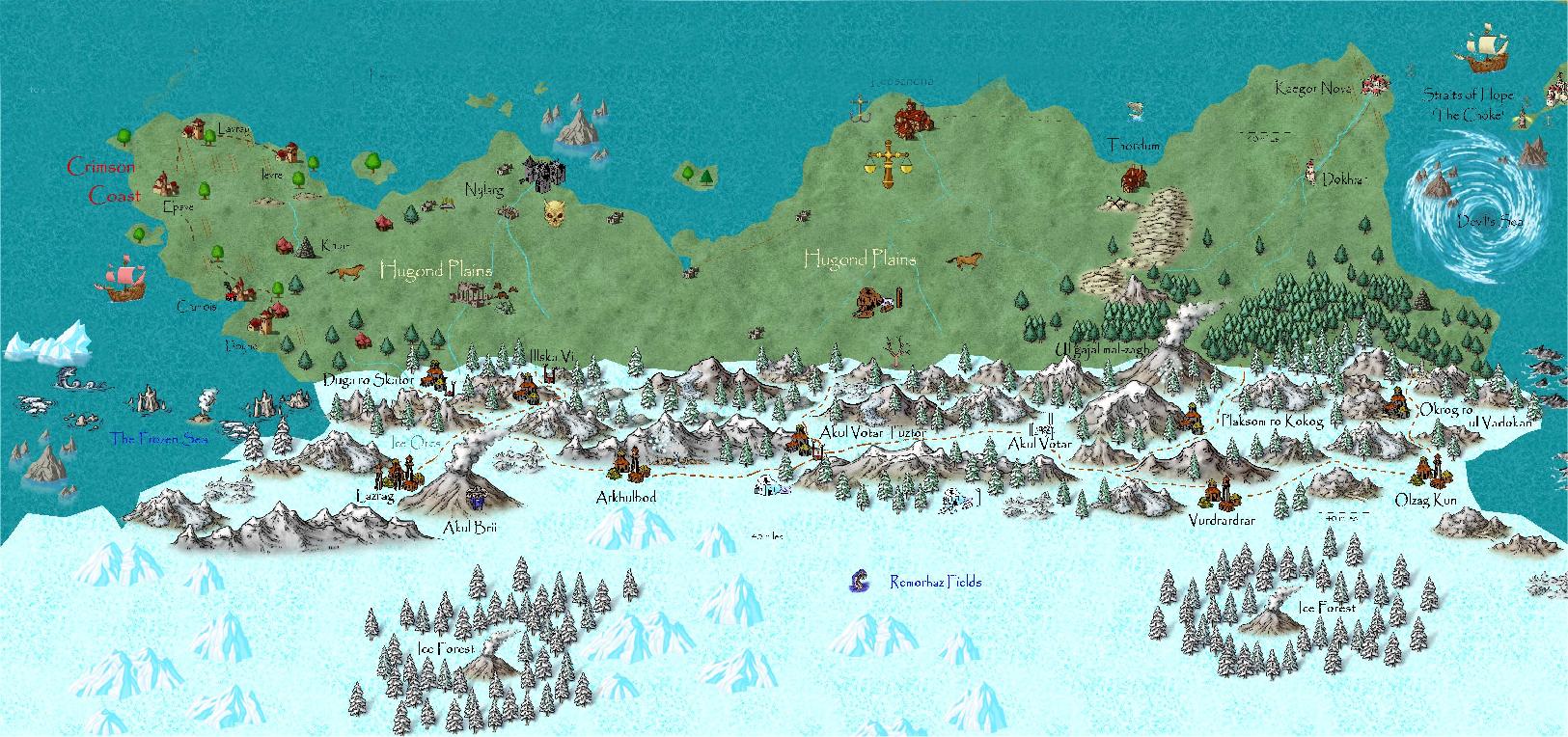
Illustration by Pino44io- please do not use without permission 

The Ice Wastes

The Orcbane Mountains form a stark natural boundary between the Hugond Plains to the north and the Ice Wastes to the south. Carved into this jagged range are five natural passes, each serving as the only viable routes through the mountains. Every pass is heavily fortified, guarded by an Ice Orc stronghold positioned on the Ice Wastes side to prevent any incursion from the north. Each castle dominates its respective passage, standing as both a military bastion and a symbol of Ice Orc dominion over the frozen south.

Passage Name

Duga ro Skator

Illska Vi

Akul Votar Tuztor

Plaksom ro Kokog

Okrog ro Ul Vadokan

Translation

“Wind of Hell”

“Evil Channel”

“Ice Home Way”

“Gorge of Smoke”

“Canyon of the Dead”

Castle

Kashnar Castle

Bharkrugga Castle

Agkur Castle

Wrukag Castle

Dhazgrog Castle


Travel through these passes is perilous at the best of times. Even without Orc patrols, violent winds, sheer drops, and perpetual ice make passage deadly. With the castles manned, the routes are all but impassable—ensuring the Ice Wastes remain isolated, hostile, and firmly under Ice Orc control.

Temperatures in the Ice Wastes vary wildly, ranging from 10 °C to −45 °C under normal conditions. During the core winter months, averages hover around −12 °C, while summer temperatures rarely rise above 3 °C. On rare occasions, extreme anomalies have been recorded, reaching as high as 31 °C in summer and plunging to −63 °C in winter.

Adventurers who enter the Wastes without proper protection are at constant risk of exposure and death. Even those who come prepared are not immune to the dangers. It is not uncommon to encounter the remains of less fortunate travelers—entire parties preserved where they fell, frozen solid within the ice, serving as silent warnings to those who press onward.

Ice Forests

Deep within the tundra lie immense stretches of Ice Forests, grim, silent woodlands frozen into permanence. The trees are blackened and petrified by cold, their trunks rigid and their leaf-spines hardened until they are as unforgiving as stone to the touch. No wind moves them, and no creature passes through without leaving a mark. These forests provide the ice orcs with two resources essential to their survival and warfare.

The first is the wood itself. Denser and harder than oak, it is utterly inflexible. Once cut and shaped it never bends, making it ideal for beams, weapon hafts, fortifications, and any structure that must never yield. Improperly worked, however, it will shatter rather than warp. The second resource is far more valuable: tree sap. This resin takes years to accumulate and requires vast, carefully maintained networks of collectors spread throughout the forests merely to meet the most basic needs of the ice orcs. Harvesting is slow, dangerous work, carried out in brutal cold and often under threat from the forest itself.

When refined, the sap sets into a material that is both hardened and flexible, an otherwise impossible combination in the frozen north. It forms the backbone of ice orc armour and shields, absorbing blows that would splinter lesser materials. In siege engines, the resin is harvested while semi-hardened and woven into thick cords and bands. Once fully set, these provide the elasticity required to generate immense power, allowing ice orc war machines to hurl projectiles with terrifying force. In the Ice Forests, nothing grows quickly, nothing is wasted, and everything is paid for in time.

The Volcanoes

Ul gajal mal-zagh; “The living mountain”; thought to be dormant, which must be so as it is still has snowy caps and upper slopes, however smoke does bellow from its summit. Tremors are regularly felt from this mountain, often causing avalanches around the volano and surrounding mountains. Ice Orc lore believes that an ancient white dragon lives deep within the mountain, with the tremors being when he moves in his slumber and the smoke his breath. It is ordained by Shamans that the day he awakens is the day the Ice Orcs will perish.

Akul brii “Ice horn” – this is the largest peak in the Orcbane mountains and near the summit it curves around looking like a gigantic horn reaching for the skies. The slopes are perilous and though it is known that rich veins of ore lie within no ice orc dares approach to mine, as this is the territory of Yarl Alosam, ruler of the Frost Giants.

Places of Note

Vorog (Burial) Hills serve as an ancient burial ground and are claimed as territory by the Ettins. The region is steeped in old death rites and is fiercely defended, making travel through the hills both dangerous and unwelcome.

Akul Brii – Frost Giant Settlement are known to inhabit the Ice Wastes, though their primary community is established upon Akul Brii. They are ruled by the elderly yet formidable Yarl Alosam, whose age has done little to diminish his strength, cunning, or authority. His leadership has maintained the giants’ dominance in the region for generations.

The Remorhaz FieldsSouth of the Wastes lies an immense tundra stretching for countless, uncharted miles. It is deep within these frozen expanses that scouts venture to locate frost worm hatchlings, sought either for training by the Edzar ro Akul or to serve as living defenses for certain villages—typically those of significant importance, such as sites rich in vital resources. Much of the tundra bears the scars of immense violence: shattered stone, upheaved ice, and vast tracts of distorted land. Rumors persist that these devastated regions are the ancient or ongoing battlegrounds of Frost Worms and Remorhaz, colossal and near-mythical beasts whose clashes reshape the land itself.

The Arachne Caverns, Along a southern stretch of the Orcbane Mountains, near Vurdrardrar, lies an immense network of caverns believed to be interlinked—though no definitive mapping exists. Their origin remains a mystery; no one can say whether they were carved by natural forces or shaped by some forgotten hand. Known as the Arachne Caverns, these depths are home to the Hunter Ice Spiders, creatures prized by the highest ranks of society. For generations, specialist trainers have passed down the dangerous art of spider-handling from father to son. Retrieval parties are sent into the caverns to harvest spider eggs, which are then raised and trained from birth. The process is exceptionally perilous. Mortality rates among both handlers and spiders are high, but the rewards are equally great—trained spiders command enormous prices, with their value increasing significantly with size and lethality.