Elention
Large City: Alignment: TN/LN, Population: 15,500 (72% human, 9% halfling, 9% Dwarven, 5% Elves, 5% other), Languages: Common & Halfling, Religion: Beory, Merikka, Obad-Hai, Xerbo, Zilchus and Pelor. Authority figure: Imperial Governor Dravos Keln (human male, rogue)
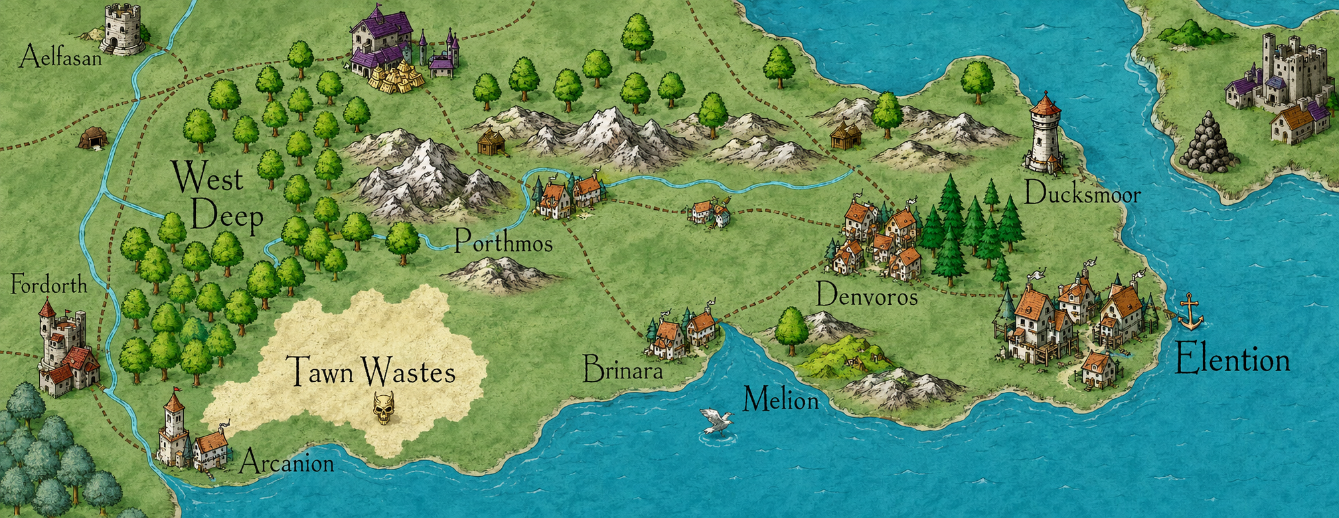
Elention is the principal port city of the Province of Invain, a bustling settlement of some 15,500 souls where the sea and roads converge. Serving as the main gateway into the province, it is a place of constant movement, its docks crowded with merchant vessels and fishing boats. The city’s prosperity rests upon timber drawn from the Riparen Forest, agricultural produce from the inland farms, and the steady yield of coastal and river fisheries. Sawmills and timber yards line the waterfront, while markets trade in grain, livestock, and salted fish. Despite its size, Elention retains a practical and industrious character, shaped more by commerce and necessity than by grandeur.
The city is governed by the imperial-appointed administrator Dravos Keln, whose steady and measured rule has brought a degree of stability to this vital port. Supported by local officials and mercantile interests, Keln oversees both the economic flow of the city and its wider security. Law and order are enforced by the city watch, reinforced by a strong presence of the Provincial Watch, whose authority extends across Invain. Elention’s strategic importance as a trade hub is a major strength for both the city and the province. Religious life reflects the needs of its people, with worship of Beory, Merikka, Obad-Hai, Xerbo, Zilchus and Pelor all present. Though outwardly prosperous, the city remains watchful, its fortunes tied not only to trade, but to the uncertain lands that lie beyond its borders.
Northwest of Elention lies the ancient Riparen Forest, a once-vast woodland that has, over time, begun to recede beneath the steady advance of settlement and industry. What was once an unbroken expanse of towering trees and deep shadow now stands diminished, its borders pressed back year by year by the demands of the growing city. Along its southeastern fringe, a line of logging camps has taken hold, their presence marked by the sound of axes and the slow but relentless clearing of the treeline. From these camps flows a constant supply of timber, feeding Elention’s need for construction, trade, and expansion, even as the forest itself yields ground with quiet, unresisting inevitability.
Elention is home to a number of inns and taverns suited to the varied folk who pass through its streets. Along the harbourfront, places such as The Salted Gull, The Broken Mast, and The Net & Anchor cater to sailors and dockworkers, offering lively common rooms, strong drink, and sturdy fare. Further inland, more dependable establishments like The River’s Rest, The Three Lanterns, and The Wayfarer’s House provide quieter lodging for merchants and travellers seeking comfort away from the noise of the docks. In the districts closer to the timber yards, inns such as The Axe & Hearth and The Timberwright’s Inn serve labourers and foresters, while the fishing community favours taverns like The Silver Hook and The Old Trawler, where the day’s catch is often brought directly from boat to table. Together, these establishments form an essential part of the city’s life, places where news is shared, bargains are struck, and the constant movement of Elention finds its rest.
Elention is well protected, though its defences are shaped as much by practicality as by strength. Stone walls enclose the central districts and harbour front, reinforced by watchtowers that overlook the sea approaches. The docks themselves are guarded by patrols and signal posts, ensuring that vessels entering or leaving the port are observed and, when necessary, inspected. The city watch maintains order within the streets, while detachments of the Provincial Watch are stationed at key gates and along the outskirts, ready to respond to disturbances or threats from beyond. Though not built as a fortress, Elention’s greatest defence lies in its vigilance, constant patrols, controlled access, and a readiness to meet danger. Sadly, long years of inactivity have made the defenders of Elention complacent and even indolent.
Denvoros
Small City: Alignment: NG, Population: 9,550 (85% human, 6% halfling, 4%Dwarven, 2% Elves, 3% other), Languages: Common & Halfling, Religion: Beory, Merikka, Obad-Hai, and Pelor. Authority figure: Mayor Edric Halven (human male, expert/aristocrat)
Denvoros is a quiet inland town of approximately 9,550 inhabitants, set amidst broad fields and gently rolling farmland within the Province of Invain. Lacking the bustle of Elention or the dangers found nearer the Tawn Wastes, Denvoros is defined by its steady, predictable rhythm of life. Surrounding estates and smallholdings produce grain, livestock, and produce in reliable quantities, much of which is transported outward to supply the province’s larger settlements. The town itself is unremarkable in appearance, low stone and timber buildings, well-kept roads, and orderly fields stretching in all directions, but it is precisely this lack of distinction that has earned it a reputation for stability. Travellers often describe Denvoros as dull, yet few would dispute that it is among the safest places in the region.
Administration is handled by local officials under provincial oversight, with a modest but disciplined watch ensuring that order is maintained. Crime is rare and swiftly dealt with, and the surrounding lands are largely free of the disturbances that trouble Western parts of Invain. Religious life is centred on practical concerns, with worship of Beory and Pelor most prominent among the farming communities. Inns and markets serve local needs rather than outside trade, and while Denvoros offers little in the way of excitement or opportunity, it provides something far rarer in the province: a place where life continues undisturbed, and where the concerns of the wider world feel distant and, for a time, unimportant.
Denvoros supports a small number of inns and taverns suited to its modest needs, catering primarily to local farmers, traders, and the occasional traveller passing through. Establishments such as The Ploughman’s Rest and The Golden Sheaf offer simple but dependable lodging, with hearty meals drawn from local produce and a quiet atmosphere that reflects the town’s steady character. The Hearth & Field is favoured by labourers and farmhands, its common room serving as a place for evening drink and conversation after long days in the fields, while The Wayfarer’s Acre provides a more subdued stop for travellers seeking rest along the inland roads. None of these inns are particularly notable, but all are well-kept and reliable, embodying the same unassuming safety and predictability that defines Denvoros itself.
Denvoros is overseen by Mayor Edric Halven, a practical and unassuming man who has held the position for several years with little fanfare. Formerly a landholder of modest means, Halven was chosen more for his reliability than any great ambition, and he has governed the town in much the same manner; steady, cautious, and without unnecessary complication. He is known for maintaining good order, keeping careful accounts, and ensuring that the needs of the surrounding farms are met without disruption. Though not a particularly inspiring figure, he is widely respected for his fairness and consistency, and under his guidance Denvoros has remained as it has long been: quiet, orderly, and largely untouched by the troubles of the wider province.
Porthmos
Small Town: Alignment: TN, Population: 1,000 (85% human, 5% halfling, 5%Dwarven, 5% other), Languages: Common & Halfling, Religion: Beory and Obad-Hai. Authority figure: Steward Bastian Morvane (human male, sorcerer)
Porthmos stands at the southern end of the Gryphon Pass, spanning the Glenshal River, and is the first true settlement encountered by travellers descending from the north. Nearby lie the weathered ruins of what was once an impressive dwarven bridge, now long fallen into disrepair and partially collapsed. Were the pass more heavily travelled—or of greater economic importance—the bridge might have been restored, but such efforts have never been deemed worthwhile. In its place, a ferry service operates across the river, maintained by the Dyle family for several generations. The town itself is modest but dependable. The Griffin’s Crown provides sturdy lodging and decent fare at reasonable cost, serving the needs of merchants, travellers, and the occasional adventurer drawn by tales of griffins in the surrounding heights. Porthmos is also home to a small temple dedicated to Beory, a shrine to Obad-Hai, and a healer who tends to the sick and weary in the name of Pelor. With a population of little more than a thousand souls, Porthmos remains a quiet and unassuming town, its livelihood tied to the steady trickle of travellers passing through the Gryphon Pass and the occasional enthusiast in search of the creatures for which the region is known.
The town is administered by Steward Bastian Morvane, a holdover from the days of the old Earldom. A capable and charismatic official, Morvane has long governed with quiet efficiency, ensuring that affairs run smoothly and without incident. His steady hand and lack of ambition have made him a reliable presence, and in the absence of any pressing concerns, there has been little reason to replace him.
Brinara
Large Town: Alignment: CN/TN, Population: 4,800 (85% human, 5% halfling, 5%Dwarven, 5% other), Languages: Common & Halfling, Religion: Procan and Pelor. Authority figure: Harbour Master Corvin Hale (human male, fighter) and Elder Lysa Marr (female, half-Elf Wizard)
Brinara is a large coastal town of some 4,800 inhabitants, situated along the southern shores of the Province of Invain. Though modest in size, it serves as an important fishing port, its livelihood drawn almost entirely from the sea. The harbour is rarely quiet, with boats departing before dawn and returning with the day’s catch to be salted, traded, or sent inland. The town itself is shaped by this rhythm—weathered buildings, salt-stained docks, and a population accustomed to hard work and uncertain tides. While not wealthy, Brinara is self-sufficient and dependable, supplying fish and coastal goods to nearby settlements, particularly the larger markets of Elention.
Governance in Brinara is practical rather than formal, centred on the authority of the Harbour Master and a small council of senior fishermen and merchants. A modest presence of the Provincial Watch ensures order and maintains a careful eye on the surrounding region. This vigilance is not misplaced, for to the west lies the influence of the Tawn Wastes, whose proximity is felt more often than openly acknowledged. On occasion, strange things are carried along the coast—unfamiliar creatures, warped remnants, or debris that bears no clear origin. Though such occurrences are rare, they are enough to keep the people of Brinara cautious. Life continues much as it always has, governed by tide and trade, but with the quiet understanding that the sea—and what lies beyond it—cannot always be trusted.
Brinara supports a handful of inns and taverns suited to its working coastal character, most of them clustered near the harbour where sailors and fishermen gather at the end of the day. Establishments such as The Saltwind Haven and The Broken Net provide sturdy lodging and simple, filling meals, their common rooms often alive with the sound of crews recounting their day’s work. The Gull’s Rest is a slightly quieter house, favoured by traders and travellers seeking a more restful stay, while The Brine Cup is known more for its strong drink than its comfort, drawing a rougher crowd from the docks. Further inland, The Lantern Shore offers modest but reliable accommodation for those passing through the town. None of these inns are refined, but all are dependable, reflecting the same resilience and practicality that define Brinara itself.
Religion in Brinara is shaped by the sea and the uncertainties that come with it. The most prominent place of worship is a shrine to Procan, where fishermen and sailors offer prayers for calm waters, safe passage, and a fruitful catch before putting out to sea. Nearby stands a modest chapel dedicated to Pelor, tended by a small clergy who provide healing and comfort to the sick and injured, particularly those brought in from the docks. There are also simple offerings made to Beory, acknowledging the broader forces of nature that govern both land and sea. While faith in Brinara is sincere, it is also practical. Worship is often brief and tied to daily life, with few elaborate ceremonies. In recent years, however, there has been a subtle shift in tone. With the proximity of the Tawn Wastes and the occasional strange occurrences along the coast, some have taken to leaving quieter, more cautious offerings, as though seeking protection not just from storms and misfortune, but from things less easily named.
Melion
 Large Town: Alignment: NG, Population: 4,500 (90% halfling, 5% human, 2%Dwarven, 3% other), Languages: Halfling and Common, Religion: Yondalla and Beory. Authority figure: Elder Tobin Bramblefoot (halfling, male, rogue) and Elder Lysa Marr (female, half-Elf Wizard)
Melion is a halfling settlement nestled into a low coastal range of rolling hills, where the land rises gently from the sea before folding into a patchwork of terraces and narrow valleys. Built into the hillsides rather than upon them, the settlement is composed of well-kept burrows, stone-fronted homes, and winding paths that follow the natural contours of the land. From a distance, Melion is easy to miss, its presence marked more by curling chimney smoke and carefully tended fields than by any imposing structure. The surrounding slopes are given over to cultivation, most notably the rich, dark-leaf tobacco for which the settlement is widely known, alongside small orchards and herb plots that thrive in the mild coastal climate.
The halflings of Melion are patient and meticulous farmers, taking great pride in the quality of their produce. Their tobacco is considered among the finest in the region, cured with care and often traded at a premium, while their distilling traditions have produced a range of well-regarded spirits; smooth, aromatic, and deceptively strong. Trade is steady rather than bustling, with merchants arriving by road or small coastal craft to collect goods for sale elsewhere. Life in Melion is quiet, communal, and largely undisturbed, governed by tradition and mutual cooperation rather than strict authority. Though unassuming, the settlement is prosperous in its own way, sustained by craftsmanship, fertile land, and a reputation that ensures its goods are always in demand.
Melion has but a single establishment intended primarily for outsiders, known as The Traveller’s Pipe. Unlike the low, earth-set homes and burrows of the halflings, the inn is built above ground in a more conventional human style, with a timber frame and broad, welcoming porch overlooking the lower slopes. It serves as the main point of contact between Melion and the outside world, catering to merchants, traders, and the occasional curious traveller drawn by the settlement’s reputation for fine tobacco and spirits. The inn is run by a human proprietor, Marek Durn, someone who has lived among the halflings long enough to earn their trust and reflects a careful balance between outside expectations and local custom. The fare is simple but of excellent quality, with meals often accompanied by the settlement’s own spirits, and pipes filled with Melion’s finest leaf are readily available to guests. While welcoming, the atmosphere is subtly distinct from the rest of the settlement; conversation is polite but measured, and it is clear that while outsiders may rest here, they are never fully part of the community beyond.
Melion is guided by Elder Tobin Bramblefoot, a halfling of advanced years and steady disposition, whose presence is as familiar and reassuring as the hills themselves. Tobin is not a ruler in any formal sense, but rather a caretaker of tradition, settling disputes, offering counsel, and ensuring that the rhythms of village life continue without disruption. Once a respected grower and distiller in his own right, Tobin now leaves the day-to-day work to younger hands, though his knowledge of tobacco curing and spirit-making remains widely sought. He is known for his patience and quiet wisdom, rarely raising his voice, yet commanding respect all the same. Visitors often remark that he seems to know more than he says, and that little occurs in Melion without his awareness. Under his guidance, the settlement has remained peaceful and prosperous, its people content to live as they always have, working the land, tending their craft, and avoiding the troubles of the wider world. Though gentle in manner, Tobin is not without resolve, and when the well-being of Melion is at stake, he proves as firm as the hills in which the village is set.
Religion in Melion is quiet, personal, and closely tied to the rhythms of daily life rather than grand ceremony. The settlement is devoted primarily to Yondalla, whose presence is felt in nearly every home and field. Small shrines, often no more than carved stones or well-tended garden corners, are common, and offerings are simple—fresh bread, flowers, or the first leaves of the tobacco harvest. Yondalla is honoured as a protector of hearth, family, and community, and her influence is seen in the strong bonds and cooperative spirit that define Melion. Alongside this, there is a quiet reverence for the land itself. Many halflings make offerings to Beory, particularly at planting and harvest, acknowledging the fertility of the soil and the gentle coastal climate that sustains their crops. A small shrine to Pelor serves as a place of healing and seasonal thanksgiving, though it is modest and rarely the centre of attention. Worship in Melion is seldom formal or public; instead, it is woven into daily routines—shared meals, careful cultivation, and the quiet satisfaction of a well-tended life.
Arcanion, Tower of Vaelorian the Magnificent
 Among the great arcanists of recent memory, few names carry the same weight, or provoke the same mixture of admiration and scepticism, as Vaelorian the Magnificent. A wizard of undeniable talent and equally undeniable ego, Vaelorian has long cultivated a reputation as both a master of the arcane arts and a performer of them. Little is known of his early life, though he is believed to have risen from humble beginnings through a combination of natural aptitude, relentless ambition, and an unwavering belief in his own destiny. By the time his name began to circulate amongst learned circles, Vaelorian had already distinguished himself not only through his mastery of spellcraft, but through his flair for presentation. Where other wizards cast with restraint, Vaelorian wove light, colour, and force into displays bordering on the theatrical. Critics often dismissed such spectacles as vanity, yet even his detractors admitted that beneath the performance lay genuine genius, particularly in the fields of illusion, energy manipulation, and arcane theory.
For nearly two decades he travelled between the courts and cities of the Divine Empire, serving as an advisor, lecturer, and occasional court wizard. During this period he amassed considerable wealth, acquired a collection of rare magical artefacts, and built a network of influential patrons. Yet those who knew him well often remarked that admiration never seemed sufficient. Every accomplishment merely led him to seek a greater one. In recent years Vaelorian has withdrawn from public life, turning his attention instead to the Tawn Wastes. There, on the very edge of that blighted and unstable land, he has raised a solitary tower known as Arcanion. Elegant yet unsettling, the structure appears to shimmer under certain conditions, as though not entirely anchored to the world around it. Some claim its position shifts subtly from year to year, while others insist its upper floors are larger than the foundations could possibly support.
From this tower Vaelorian studies the strange arcane forces that permeate the Wastes. He has publicly stated that he seeks to understand the catastrophe that created them and, if possible, discover a means of controlling or even reversing its effects. Many scholars initially applauded the effort, believing that if any wizard possessed the skill to unravel the mysteries of the Wastes it would be Vaelorian. Over time, however, concern has begun to replace admiration. Travellers report strange lights moving through the desert at night. Hunters speak of creatures altered in unusual ways wandering close to the tower before disappearing once more into the wasteland. Local farmers have complained of odd weather, unexplained magical disturbances, and dreams that leave them unable to sleep. Vaelorian dismisses such stories as superstition and ignorance. Indeed, he has become increasingly critical of those who question his work. In private correspondence he has argued that the rulers of the Empire lack the vision required to confront the dangers gathering beyond the frontiers of civilisation. According to some former associates, he has grown convinced that only a handful of truly enlightened minds are capable of understanding the threats facing the world.
Several members of the Provincial Watch have privately expressed concern that the wizard now seems more interested in communicating with whatever lies beneath the Wastes than merely studying it. Patrol reports speak of deep excavations around the tower and mysterious figures arriving under cover of darkness. Officially, no evidence of wrongdoing has been found. Unofficially, many officers have begun avoiding the area entirely. Visitors to Arcanion are rare. Those who approach speak of shifting pathways, illusory landscapes, invisible barriers, and magical wards designed to confuse rather than simply repel intruders. The few guests admitted within describe a place filled with wonders: floating observatories, self-writing books, enchanted servants, and laboratories devoted to experiments few can fully comprehend.
Whether Vaelorian's work will ultimately bring him the mastery he seeks or unleash consequences beyond his control remains unknown. For now he remains one of the most brilliant minds of his generation, a scholar, showman, and visionary who believes that history reserves a special place for men such as himself.
His admirers call him a genius. His critics call him dangerous. The Provincial Watch simply keeps watching the tower.