Principality of Tumkur
| Formal Name: | Principality of Tumkur | |
| Ruler: | Prince Bayazid Al-Wasari | |
| Government: | Feudal within Divine Empire | |
| Capital: | Tumkur | |
| Major Settlements: | Hassan | |
| Resources: | Beef and Silk | |
| Population: | 180,000 (20% Urban) -95% Human, 5% others | |
| Languages: | Common, Elven, Tumuri | |
| Common Alignment: | Neutral | |
| Major Religions: | Fharlanghn (TN), Wee Jas (LN) and Boccob (TN) | |
| Allies: | None | |

The Founding of Tumkur
 The Principality of Tumkur traces its origins to the first year of the Imperial Calendar, when a great fleet of refugee vessels arrived upon the southern shores of Warlderia. These ships carried nearly twenty thousand souls, men, women and children, who had fled an unknown calamity upon the far northern continent of Helltenen. Their journey had been long and perilous, and many had perished before the fleet finally reached the shores of what would become Tumkur. Upon their arrival, the exiles found themselves in the midst of war. General Aelar Mereth, one of Kaegor's commanders, was engaged in a desperate struggle against the Elves who dominated the forests and hills of the region. Outnumbered and in danger of defeat, the rebellious forces were fighting for their survival when the newly arrived refugees intervened.
Seeing fellow Humans hard-pressed by a common enemy, the fighting men of the fleet marched directly from their ships and fell upon the flank of the Elven host. The sudden appearance of thousands of fresh warriors threw the Elves into confusion. What had seemed a certain victory became a rout as the surprised army broke and fled into the forests. The victory forged a lasting alliance between the newcomers and the emerging Empire. In recognition of their courage and timely aid, General Aelar Mereth gave his daughter, Lady Elara, in marriage to the leader of the exiles, Hassan al-Wasari. Acting in Kaegor's name, he granted the newcomers the lands surrounding the growing settlement that would eventually become the city of Tumkur. Over the following decades, the exiles became an important part of the rebels' war effort. Charged with securing the northern frontier and containing the Elven tribes that still inhabited the forests, they proved remarkably successful. Though they suffered losses, they achieved their task with far greater ease than many rebel commanders had expected.
Much of their success stemmed from their unusual methods of warfare. The exiles had brought with them beasts unknown to most of Warlderia: great war elephants, whose appearance alone often unnerved their enemies. The Elves, accustomed to fighting Human infantry and cavalry, had never faced such creatures before and struggled to counter them effectively. Equally important was the determination of the exiles themselves. Having lost their homeland and crossed the sea in search of refuge, they fought with the grim resolve of a people who had nowhere left to retreat. Despite later generations referring to them collectively as the Tumkuri, the exiles were never a single people. They were drawn from several nations, tribes and kingdoms of the far northern continent, united not by common ancestry but by a shared disaster. Whatever catastrophe drove them from their homeland was so terrible that ancient rivalries were set aside in order to survive.
What exactly befell their homeland has become one of the great mysteries of Tumkur. The records of the earliest years are fragmentary, and many were lost during later wars and upheavals. Popular tales speak of forbidden sorceries, ancient evils or a war that consumed entire kingdoms. Others claim that the truth was deliberately hidden by the founding noble families. To this day, rumours persist that certain ancient houses maintain sealed archives containing the true history of the exodus, though if such records exist they have never been made public. Over the centuries, the descendants of the exiles gradually intermixed with the peoples of the Empire, though traces of their origins can still be seen. The people of Tumkur are often noted for their dark hair, olive or dusky complexions and a tendency towards taller stature than is common in many neighbouring regions. These features are by no means universal, however, and generations of intermarriage have produced a population that shares much with both its ancestral forebears and the wider Imperial peoples.
While certain noble families take pride in tracing their lineage back to the original refugee fleet, most Tumkuri now see themselves as both heirs to the Exile Fathers and loyal subjects of the Empire. Their culture, customs and traditions reflect centuries of exchange between the newcomers and those they encountered upon their arrival, creating a society that is neither wholly Helltenen nor wholly Imperial, but distinctly Tumkuri.

Prince Bayazid Al-Wasari
Prince Bayazid Al-Wasari is the current ruler of Tumkur and a direct descendant of Hassan al-Wasari, leader of the exile fleet that founded the Principality. A scholarly and thoughtful man, Bayazid is far more interested in learning, trade and good government than in warfare or military glory. Educated at the celebrated Academy of Knowledge, he has spent much of his reign encouraging commerce, patronising scholars and strengthening Tumkur's relationship with the Divine Empire, whilst remaining fiercely protective of the traditions and history of the exile peoples. Though married to Princess Samira of House Veyran, the marriage has produced no children. The union is regarded as amicable, but Bayazid has always shown little interest in romance or the elaborate intrigues of courtly life. He greatly prefers the company of scholars, merchants and his lifelong friend and confidant, Lord Aurel Mereth.
The two men have been close since their days together at the Academy and are frequently seen in one another's company, both at court and whilst travelling throughout the Principality. Inevitably, the closeness of their relationship has long been the subject of speculation amongst Tumkur's notoriously inquisitive courtiers, though neither man has ever considered such rumours worthy of public comment. The Prince's greatest political rival is First Rider Temafin of the Kessir. Although the two maintain outwardly cordial relations, they represent very different visions for the future of Tumkur. Bayazid believes that the Principality's continued prosperity depends upon trade, education and cooperation with the Empire. Temafin advocates stronger leadership, greater military preparedness and a considerably larger role for the Nomad Tribes in the affairs of the Principality.
Widely respected for his intelligence, patience and sense of justice, Bayazid is nevertheless criticised for his caution. He prefers discussion and deliberation to swift action and is notoriously reluctant to commit himself until every option has been carefully considered. His supporters regard this as wisdom. His critics call it indecision. The absence of an heir has only added to these concerns. Although few openly question Bayazid's rule, the question of who will eventually succeed him has become an increasingly popular subject of conversation amongst the noble houses and tribal leaders.
For the moment, however, such concerns seem distant. Bayazid's reign has been marked by peace, prosperity and the continued growth of Tumkur as one of the great centres of learning and trade in southern Warlderia. To Prince Bayazid, there appears little reason to believe that this fortunate state of affairs will not continue.
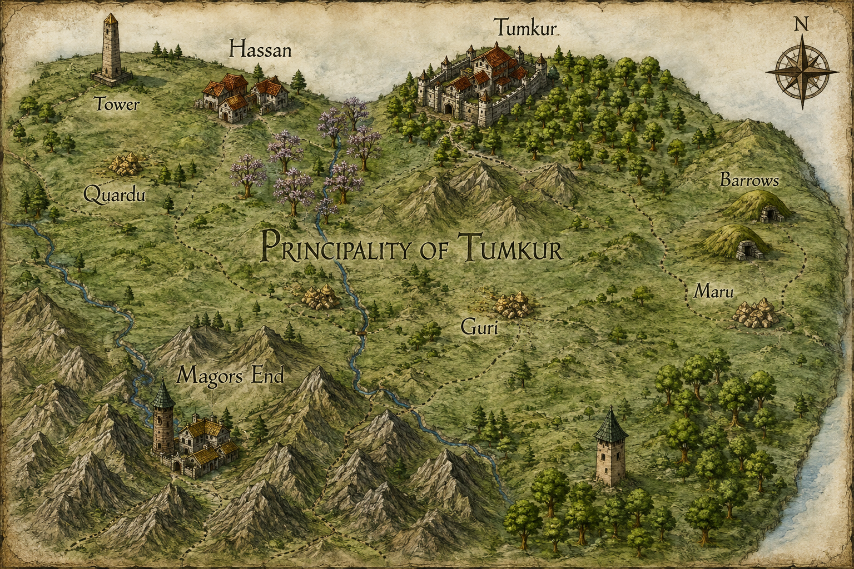
Settlements
Tumkur (Large City): Alignment: LN, Population: 23,750 (85% human, 10% half-elf, 5% others.) Authroity Figure: Prince Bayazid Al-Wasari (human male, fighter)
Originally little more than a frontier settlement on the edge of contested lands, Tumkur was transformed by the arrival of the exiles in Year 1. What began as a place of refuge soon grew into one of the wealthiest and most sophisticated cities in southern Warlderia. Over the centuries, successive generations expanded the settlement far beyond its original boundaries. Markets, gardens, workshops and wealthy residential districts spread around the old city until Tumkur became the undisputed centre of political and commercial life within the Principality.
The city's architecture reflects its unusual origins. Its oldest quarter lies around the harbour and docks, where stone warehouses, quays and narrow streets dating from the earliest years of settlement still survive. Many were constructed by the first refugees using architectural traditions brought with them from Helltenen. Beyond the old quarter rise broad avenues, shaded courtyards, fountains and elegant buildings blending Tumkuri and Imperial styles. Domes, graceful arches and slender towers stand alongside the more familiar halls and fortifications of the Divine Empire, giving Tumkur an appearance quite unlike any other Imperial city.
At its heart stands the Palace of the Prince, a sprawling complex of gardens, audience chambers, fountains and private courtyards. Nearby is the celebrated Academy of Knowledge, renowned throughout Warlderia for its scholars, historians, mathematicians and philosophers. Together, the Palace and Academy have become symbols of Tumkur's wealth and confidence. Their white stone walls, intricate carvings and graceful towers dominate the city centre, monuments to a people who arrived upon these shores as homeless refugees and now regard themselves as heirs to one of the most sophisticated cultures in the Empire.
Tumkuri citizens are immensely proud of their city. Visitors are frequently informed of the superiority of its Academy, the beauty of its architecture, the quality of its silk and the antiquity of its noble houses — usually whether they have expressed any interest in these matters or not. For all its splendour, Tumkur has never entirely forgotten that it was founded by strangers from across the sea. It has, perhaps, become rather better at forgetting that great cities do not remain safe merely because their inhabitants believe they should.
Hassan (Large Town): Alignment: N, Population: 4,500, (90% human, 10% other) Authority Figure: Satrap Yulan (human, male, merchant)
Hassan, often referred to by Imperial merchants and cartographers as Hassanmarsh, is one of the oldest settlements in the Principality. Local historians believe it was founded by some of the first refugees who followed Hassan al-Wasari into exile. Situated amongst the marshes and waterways surrounding the great river, the town has always looked towards the wetlands rather than the open country beyond. While outsiders often regard the region as inhospitable, the people of Hassan have spent centuries adapting to its unusual environment and are as comfortable navigating its waterways as other folk are travelling roads. The inhabitants of Hassan are generally darker-skinned than many of their neighbours and retain a number of customs believed to have originated amongst the peoples of Helltenen. Although centuries of intermarriage have tied them closely to the rest of the Principality, the people of Hassan remain fiercely proud of their heritage and possess a distinct local identity.
The town itself is particularly notable for its architecture. Unlike many settlements in the region, Hassan was built almost entirely in the architectural traditions brought across the sea by the original exiles. Its stone buildings are decorated with intricate carvings, geometric patterns and elegant arches. Covered courtyards and shaded walkways are common, while many wealthier homes are constructed around enclosed gardens. Travellers frequently remark that Hassan appears less like a town of the Divine Empire than a surviving fragment of some distant land. For much of the year, the surrounding marshes make overland travel difficult. Roads become muddy and unreliable, and many smaller communities can only easily be reached by boat. During the winter months, however, the ground becomes firmer and the waterways more predictable, allowing merchants and traders easier access to the town.
It was these extensive wetlands that gave rise to the common Imperial name of Hassanmarsh, a title now found upon many maps and increasingly used by outsiders. The townsfolk themselves generally continue to use the older name of Hassan, though few take offence at the newer title. During the winter season, Hassan hosts a series of markets attracting traders from Summerswane, Tumkur and numerous smaller communities throughout the region. These markets are particularly famous for river fish, reeds, dyes, medicinal herbs and finely crafted textiles. The seasonal influx of merchants provides much of the town's wealth and serves as its principal connection with the wider world.
Politically, Hassan has never been particularly influential. Its inhabitants concern themselves far more with local affairs than with the intrigues of princes and nobles. Though loyal to the Principality, they generally prefer to be left alone and rarely involve themselves in disputes beyond the marshes. The town contributes taxes and soldiers when required, and many young men and women seek service with the Prince's forces. The hardy marsh folk have earned a particular reputation as scouts and light infantry, their familiarity with difficult terrain making them especially valuable in country where conventional troops struggle to operate.
Hassan's relative isolation has inevitably given rise to numerous stories and superstitions. Travellers tell of strange lights moving through the marshes at night, mysterious ceremonies conducted beneath the full moon and hidden shrines concealed deep amongst the waterways. Rumours that the people of Hassan secretly worship demons or devils have circulated for generations, particularly amongst those who have never actually visited the town.
Most scholars dismiss such claims as the fanciful stories that inevitably gather around isolated communities. The people of Hassan certainly preserve unusual customs and ancient folk traditions, some perhaps descended from practices brought from Helltenen, but there is little evidence that they are any less devoted to the recognised gods than their neighbours. The people of Hassan themselves generally meet such rumours with amusement. They have long grown accustomed to outsiders regarding their homeland with suspicion and occasionally encourage the more ridiculous stories for their own entertainment. They also point out that the marshes provide something most settlements must spend considerable fortunes constructing: a remarkably effective wall.
Maegor’s End (Small Town) Alignment: TN, Population: 1022, (70% human, 20% Gnome, 5% Elven, 5% other.), Authority Figure: Selurin Elffriend (human male, Mayor)
Maegor's End is a small and isolated settlement located in the far south of the Principality. Though nominally subject to the Prince of Tumkur, the town has long existed on the fringes of the Principality's authority. The local people pay little attention to the politics of Tumkur and, in return, receive little interference from the Prince's officials. For most of its history, this arrangement has suited both parties well. At first glance, the settlement appears unremarkable. A collection of stone and timber buildings clusters around a narrow road leading inland, while fishing boats and small trading vessels occasionally visit the rocky shoreline below. Yet the town is overshadowed by a far more imposing landmark.
Upon a cliff overlooking the settlement stands the ruined Tower of Maegor, a dark and weathered structure whose silhouette dominates the surrounding landscape. The tower is ancient, even by Imperial standards. Built from black stone of uncertain origin, its walls have withstood centuries of storms and neglect. Though much of the structure has fallen into ruin, its upper reaches still stand defiantly against the sky. No permanent resident has occupied the tower for almost two centuries, ever since the death of the sorcerer Maegor. Maegor was a Half-Elven mage of immense power who lived during the early centuries of the Empire. Gifted, ambitious and increasingly consumed by forbidden studies, he eventually rebelled against Imperial authority and fled southwards. Seeking a place beyond the easy reach of Imperial justice, he settled in a remote valley deep within the Heron Hills. The location was not chosen by chance.
Long before the founding of the Empire, the valley had been the site of one of the final battles of the Higher Wars. Here an Elven host made its last stand against the advancing hordes of Orcs and their dragon allies. For two days the Elves resisted with desperate courage before their lines were finally broken. Although an allied army arrived to relieve them, it came too late to save the defenders. The Orcs and dragons withdrew before the approaching reinforcements, leaving behind a battlefield littered with the dead. Thousands had perished. The fallen were buried where they lay, and even today travellers can see the long burial mounds lining the valley road. To the untrained eye they resemble natural hills, but the local people know them for what they truly are: vast graves containing warriors who died centuries before the Empire existed.
It is said that Maegor chose the valley precisely because of these ancient dead. A master of necromancy, he believed the lingering echoes of the battlefield strengthened his dark arts. Over the years he delved ever deeper into forbidden magic, gathering followers, undead servants and dangerous lore. By the time the Empire finally moved against him, his tower had become a place feared throughout the region. When Imperial forces eventually surrounded the valley, Maegor unleashed the full extent of his power. Hundreds of skeletal warriors and other undead horrors rose from the burial mounds and marched beneath his banner. For a time, it seemed as though the Empire might fail.
Yet while Maegor's undead army occupied the besieging forces, a band of adventurers slipped through the defences and entered the tower itself. What occurred within its halls remains uncertain, but by dawn Maegor was dead and his rebellion broken. His servants crumbled and the siege ended, but the tower was never reclaimed. The surviving adventurers departed soon afterwards, carrying whatever treasures they had recovered, and no lord or prince has subsequently attempted to establish residence there. The structure remains abandoned to this day. Stories concerning the tower are common throughout southern Tumkur. Shepherds speak of lights appearing in the upper windows during moonless nights. Travellers claim to hear distant voices carried upon the wind. Others insist that undead guardians still patrol the ruins and the ancient battlefield below.
Many dismiss such tales as superstition. Nevertheless, enough explorers and treasure hunters have vanished over the years to ensure that the tower retains its sinister reputation. A handful of adventurers are known to have entered its gates seeking riches or forbidden knowledge. None are known to have returned. The hills surrounding Maegor's End are also home to several scattered Gnome communities. Unlike the Human inhabitants of the town, these Gnomes prefer lives of quiet independence amongst the high valleys and rocky slopes. Most settled in the region generations ago, seeking refuge from the growing cities and busy roads of the Empire. They make their living through small-scale mining, extracting iron, copper and other ores from the hills. They also keep hardy mountain goats whose wool, milk and meat are highly valued in local markets.
Once or twice each week, the Gnomes descend into Maegor's End to trade their goods, purchase supplies and exchange news. As a result, the town serves as an important meeting place for the isolated communities scattered throughout the surrounding countryside. Despite the dark reputation of the tower above the , the people of Maegor's End have grown accustomed to living in its shadow. To outsiders it is a place of ancient graves, haunted ruins and unsettling legends. To its inhabitants, it is simply home; a quiet frontier town where the past is never entirely dead.
The Nomad Tribes
To the south and east of Tumkur, beyond the cultivated lands and settled villages of the Principality, stretch the broad plains occupied by the descendants of the exile tribes. Though collectively known as the Nomad Tribes, each possesses its own traditions, rivalries and distinctive identity. The ancestors of these peoples arrived with the great exile fleet from Helltenen. Unlike many of their kin, who settled around Tumkur and the other growing communities of the Principality, they chose to preserve the wandering way of life their ancestors had followed before the Exodus. Over the centuries, the tribes have become an important part of the wider life of Tumkur whilst retaining a remarkable degree of independence. The Prince claims authority over their lands and the tribes acknowledge their allegiance to the Principality, but in practice their internal affairs remain largely governed according to tribal custom.
Imperial chroniclers still record their ancient names, Martu, Guti, Kisir and Quardu, but these are increasingly being replaced by the names by which they are commonly known throughout Warlderia: the Martmen, Guthers, Kessir and Westfolk. The nomads are famed for their horsemanship and are widely regarded as some of the finest riders in the Divine Empire. Their warriors have served in Imperial armies since the days of Kaegor, and the tribes continue to provide much of the Principality's cavalry. The great war elephants may be the most spectacular legacy of the original exiles, but it is upon horseback that their descendants have earned their greatest military reputation. Though often portrayed by the inhabitants of Tumkur as unruly, quarrelsome and excessively proud, the tribes place enormous importance upon hospitality, loyalty and personal honour. A guest accepted beneath a tribal tent is placed under the protection of his host, whilst friendships and obligations may endure across generations.
Unfortunately, the same is often true of insults. Feuds between families and tribes can survive long after everyone involved has forgotten precisely what caused them, and horse theft, disputed grazing rights and wounded pride have occasionally produced conflicts wildly disproportionate to the original offence. Nevertheless, when the Principality itself is threatened, the tribes have traditionally set aside their differences and answered the summons of the Prince. They may argue endlessly amongst themselves over who should lead, who owns which horse and whose grandfather insulted whose grandmother, but outsiders who mistake such rivalry for weakness generally discover their error rather quickly.
The Martmen (Martu)
Alignment: CN, Population: 11,500, Population: 95% Human, 5% Other, Leader: Chieftain Subatin
The Martmen occupy the coastal plains east of Tumkur, between the forests of the north and the wooded lands farther south. Of all the Nomad Tribes, they maintain the closest relationship with the city, and many prominent families possess long-established trading connections with Tumkuri merchants and noble houses. The Martmen are renowned as traders, caravan masters and livestock dealers. Their herds, horses and control of important coastal routes have brought considerable prosperity, and they possess a reputation for negotiation that borders upon the legendary. Amongst the other tribes, this reputation has inevitably produced a considerable number of jokes. A common nomad saying warns: “Count your rings before rising from a Martman's table.”
The Martmen themselves generally regard the expression as a compliment. The most remarkable feature of their territory, however, has nothing to do with trade. Near the eastern seashore rises a sprawling collection of ancient burial mounds, believed to predate both the Divine Empire and the arrival of the exiles. Their builders are unknown, and even the oldest Martmen traditions describe the barrows as ancient. The tribe consequently treats the site with considerable caution. The mounds are not forbidden, but deliberately opening one is regarded as exceptionally foolish. Stories tell of strange lights moving amongst the barrows after sunset and pale riders crossing the grasslands before disappearing as suddenly as they appeared. More disturbing are the stories concerning what lies beneath them.
Old tribal tales claim that some burial chambers descend far deeper than any tomb should. Shepherds occasionally speak of hollow echoes beneath the ground, whilst other stories describe stone passages continuing into darkness long after the burial chambers themselves have ended. Some claim these forgotten passages lead into the Deep Realms beneath the earth. Others insist that ancient doors concealed below the barrows are actually gateways to Hell.
No reliable expedition has ever proved such stories true, and the Martmen show remarkably little enthusiasm for investigating them. As Chieftain Subatin is reputed to have observed when questioned by an Imperial scholar: “Our ancestors left them closed. I see no reason to become cleverer than our ancestors.” out what secrets may lie hidden within its silent walls.
The Guthers (Guti)
Alignment: CG, Population: 8,500, Population: 90% Human, 10% Other, Leader: Chieftain Nepel Shouyon
The Guthers roam the broad southern plains between Tumkur and the border woods. Olive-skinned and generally shorter than many of their neighbours, they are widely regarded as the finest natural horsemen amongst the Nomad Tribes. Almost every Guther learns to ride as a child, and amongst them horsemanship is regarded less as a specialised skill than an ordinary part of life. Children accompany the herds from an early age, and a youngster who can barely walk may already be perfectly comfortable sitting upon a horse. The horses bred by the Guthers are smaller and lighter than the powerful animals favoured by the Kessir, but possess remarkable endurance, agility and speed. They are particularly prized by Imperial messengers, scouts and light cavalry, who value their ability to cover enormous distances across difficult terrain whilst surviving upon relatively poor grazing.
Guther territory consists of vast rolling grasslands broken by occasional streams, shallow valleys and low hills. To an outsider, much of the country appears almost indistinguishable. The Guthers, however, possess an intimate knowledge of every watering hole, seasonal stream and grazing ground. Their camps move throughout the year according to ancient patterns determined by the availability of water and pasture. Although these migrations may appear casual to outsiders, grazing rights are taken extremely seriously, and every family knows precisely which lands tradition permits them to use during each season. The Guthers possess a reputation for being cheerful, impulsive and considerably less formal than their Kessir neighbours. Hospitality is generous, celebrations are noisy and horse races are a feature of almost every significant gathering. Gambling upon such races is extremely popular, although accusations of cheating have been known to transform otherwise friendly meetings into spectacular arguments.
The tribe maintains a particularly long-standing rivalry with the Kessir. Horses and cattle are occasionally “borrowed” between the two peoples, usually because somebody has decided that a particular animal would make an excellent addition to a breeding herd. The missing livestock is almost always returned eventually, frequently accompanied by one or more offspring. To the Kessir, this constitutes theft. To the Guthers, it is a perfectly harmless tradition which the Kessir have inexplicably failed to appreciate for several centuries.
Despite this rivalry, the two tribes have fought alongside one another countless times. In battle their contrasting styles complement each other remarkably well. Guther riders excel at scouting, skirmishing, raiding and harassing enemy formations, whilst the heavier Kessir cavalry provides the devastating charge once an enemy has been weakened. The Guthers consequently regard themselves as the eyes and ears of Tumkur's armies. The Kessir occasionally suggest that they are merely very accomplished horse thieves. The Guthers generally consider this further evidence that the Kessir possess no sense of humour whatsoever.
The Kessir (Kisir)
Alignment: LN, Population: 12,750, Population: 95% Human, 5% Other, Leader: First Rider Temafin
The Kessir are the largest and most influential of the Nomad Tribes. Their territory stretches between Tumkur and Maegor's End and encompasses some of the finest grazing lands in the south. The tribe is renowned throughout the Divine Empire for breeding large, powerful horses highly prized by nobles, military officers and wealthy merchants. Many cavalry mounts serving in Imperial armies can trace their bloodlines back to Kessir stock. The modern character of the tribe has been heavily influenced by its current leader, First Rider Temafin. Unlike many tribal chiefs, Temafin is as much a product of the Empire as he is of the plains. His mother was Lady Aurelia Vane, a noblewoman from an old Imperial family, whilst his father was a respected Kessir horse-lord. Raised between the tribal camps and the courts of the Empire, Temafin inherited both worlds.
Unlike most of the Kessir, he inherited many of the physical features of his Imperial mother. Fair-haired and blue-eyed, he stands out amongst the darker-haired horse-lords of the plains. Although openly proud of his tribal heritage, there are times when he appears neither entirely a man of the tribes nor wholly a nobleman of the Empire. Some older Kessir quietly regard him as too Imperial, whilst many Imperial nobles continue to regard him simply as a tribal chieftain regardless of his ancestry. Temafin is acutely aware of this divide and has spent much of his life attempting to bridge it. He sees no contradiction between loyalty to the traditions of the Kessir and admiration for the institutions of the Empire, although not everyone on either side shares his confidence that the two can be comfortably combined.
As a young man, Temafin served alongside Imperial cavalry regiments and fought in several campaigns beyond the borders of the Principality. These experiences left him with a deep admiration for Imperial organisation, discipline and administration. They also convinced him that the ancient rivalries between the Nomad Tribes leave them considerably weaker than they need to be. Under his leadership, the Kessir have therefore adopted a more structured way of life than their neighbours. Muster rolls are maintained, grazing rights formally recorded and warriors expected to train regularly rather than assembling only when war approaches. Temafin has repeatedly argued that the tribes would be stronger if united beneath a single authority and bound more closely to the Divine Empire. Unsurprisingly, he also believes that he is the ideal man to lead such a union.
This ambition has brought him into political conflict with Prince Bayazid Al-Wasari. Their relationship remains outwardly cordial, and neither man regards the other as an enemy, but they possess markedly different visions for Tumkur's future. Bayazid favours trade, scholarship, diplomacy and the gradual development of the Principality. Temafin believes Tumkur has grown wealthy and comfortable whilst neglecting the military traditions that secured its survival in the first place. He advocates stronger central leadership, greater military preparedness and a much larger voice for the tribes in the government of the Principality.
The Kessir themselves possess the most formal military tradition of any of the Nomad Tribes. Their warriors frequently wear mail or scale armour, and their cavalry can operate in disciplined formations rarely seen amongst the other nomads. In war, they form the heavy striking arm of Tumkur's forces. Where the Guthers scout, raid and harass, the Kessir seek the decisive moment, launching massed charges with powerful horses capable of breaking infantry formations and driving enemy cavalry from the field. Some of the other tribes regard the Kessir as pompous, overly disciplined and increasingly influenced by Imperial customs. Few, however, question their effectiveness in battle. And fewer still question Temafin's ambition. The real question is what he might eventually decide to do with it.
The Westfolk (Quardu)
Alignment: CN, Population: 6,750, Population: 80% Human, 10% Half-Elven, 10% Other, Leader: Speaker Zanibia
The Westfolk, known in the oldest records as the Quardu, occupy the broad plains between Hassanmarsh and Summerswane. Though descended from one of the original exile tribes, most outsiders now know them simply as the Westfolk, a name reflecting both their location and their increasingly close relationship with the wider Divine Empire. More than a century ago, a devastating plague came close to destroying the tribe. Faced with extinction, the survivors did something that would have been almost unthinkable amongst some of their neighbours: they opened their communities to outsiders.
Settlers, refugees, wanderers and displaced families from many different backgrounds were welcomed into the tribe. Over the following generations these newcomers married into Westfolk families, adopted many of their traditions and eventually became indistinguishable from the older tribal population. As a result, the Westfolk are considerably more diverse than the other Nomad Tribes. Humans remain the majority, but Half-Elves and people of numerous other ancestries are commonplace. To the Westfolk, belonging is increasingly determined by loyalty to the tribe rather than ancestry. This willingness to adapt has affected almost every aspect of their society.
Unlike the Martmen, Guthers and Kessir, the Westfolk are gradually abandoning the completely nomadic existence of their ancestors. Many families still move their herds between seasonal grazing grounds, but increasing numbers have established permanent farms, villages and small market settlements. Some tribal elders view this development with considerable concern, fearing that within a few generations the traditions of the Quardu may disappear altogether. Others argue that adaptation saved the tribe once before and remains the reason it continues to prosper. Imperial influence is consequently more visible amongst the Westfolk than amongst most of their neighbours. Their children are more likely to learn letters, their leaders regularly correspond with neighbouring lords and merchants, and many young men and women seek employment or military service elsewhere in the Empire. Women may also hold positions of authority without controversy. The current leader, Speaker Zanibia, exercises considerable influence amongst her people, and female warriors, elders, merchants and landholders are unremarkable within Westfolk society.
The plains they inhabit are shared with numerous farming communities, and in some districts it has become difficult to determine precisely where the tribe ends and the settled population begins. Relations between farmers and herders are generally cordial, strengthened by trade, mutual defence and generations of intermarriage. Some Imperial scholars believe that within another century the Westfolk may cease to be considered a Nomad Tribe at all. The Westfolk themselves seem considerably less concerned about the question. To them, customs may change, settlements may grow and strangers may become family, but they remain Quardu. There is, however, one feature of their territory which has resisted every attempt at change or understanding. A short distance from the coast stands an enormous smooth stone tower, rising more than two hundred feet above the surrounding plains.
The structure possesses no visible entrance, windows or markings. Its stone is extraordinarily smooth, and no scholar has ever satisfactorily determined either its age or its purpose. It was already ancient when the ancestors of the Westfolk first arrived in the region. Over the centuries, adventurers, wizards, priests and treasure hunters have attempted to enter it. Some have tried magic. Others have attempted excavation, climbing or simply attacking the stone itself. None has succeeded.
The Westfolk largely ignore the structure. To them, the tower is simply another feature of the landscape, little more remarkable than a hill, river or ancient standing stone. Herds graze beneath its shadow and travellers routinely use it as a landmark. Scholars from elsewhere find this attitude profoundly frustrating. They continue to speculate about forgotten kingdoms, imprisoned creatures, lost magical civilisations and fabulous treasures supposedly concealed within its silent walls. When asked what they believe lies inside, most Westfolk give much the same answer: “If whoever built it wanted us to know, they would have put in a door.”