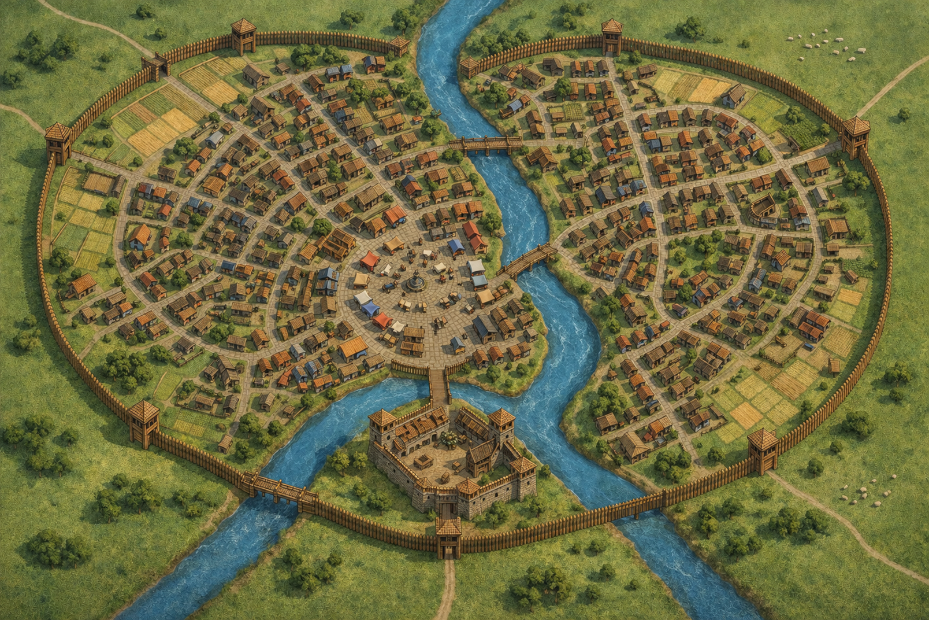
 Long ago, the True Emperor Kaegor XIII dreamed of expansion and glory upon the Kylma Steppe. From Kaegor Nova he sent his standard inland, to the place where two rivers met, and there ordered the construction of a fort. His ambitions were vast, recorded in plans, models, and charts but they consumed his attention and drew him away from other affairs of court. Following his assassination, his successor, Kaegor XIV, was too preoccupied with securing his own fragile claim to the throne to concern himself with the Steppe. The fort, named Dokhtar, became a relic of abandoned ambition. Yet it would not do for the true sons of Kaegor to openly relinquish territory. Dokhtar therefore endured: lonely, half-forgotten, and politically convenient. It became a place to exile troublesome officers and disgraced relatives, close enough to be watched, far enough to be ignored.
Bohram (pictured) is one such officer. Too professional to be liked and insufficiently ruthless to advance, he relied on competence alone rather than cruelty or intrigue. His posting to Dokhtar was presented as a promotion, but in truth it was an exile quietly approved by both his family and the Men of War. For years he has commanded the fort’s garrison of misfits and incompetents. Still, Bohram is skilled in his trade, and over time he forged them into a passable fighting force, unhesitatingly replacing losses with the half-Hugond offspring of earlier drafts.
Dokhtar possesses a modest marketplace, home to a shrine of Zahak, the Kaegorian demi-god of trade, and an abandoned temple to Bralm, goddess of Industriousness and Community. From time to time, an exiled priest of Bralm arrives and attempts to organize the settlement, but the disparate mix of outcasts, Hugonds, and mixed-blood inhabitants never fully rise to the task. Somayeh, priestess of Zahak, oversees a thriving horse market held three times a year, where local Hugond tribes trade for goods from beyond Kylma. In quieter seasons she indulges her true passion: the trade in artefacts dating from before the coming of the High Races. Somayeh is highly knowledgeable in local geography and customs, and speaks fluent Gond.
The largest and most prominent inn in the settlement is The Happy Mayweather, a well-established and widely respected hostelry run by Proteo Manganaro. Proteo’s family arrived in Dokhtar two generations ago, having fled the fractured Successor States under a cloud of alleged financial misconduct, accusations that, according to local understanding, were never substantiated. Whatever the truth of their past, the Manganaro family has since built a solid and reputable life here. Proteo himself is known as a practical, even-tempered innkeeper who takes pride in maintaining a clean, orderly, and welcoming establishment. His prices are fair, his standards consistent, and his reputation strong enough that the inn is frequently at or near full capacity. Travellers of all kinds; merchants, messengers, minor officials, and the occasional wanderer, tend to gravitate toward The Happy Mayweather for its reliability rather than any pretense of luxury.
In contrast, The True Emperor presents itself as a more refined and exclusive alternative. It is a noticeably more expensive establishment, styled to evoke sophistication and status, though its claims of selectivity are somewhat overstated. While it aspires to cater only to a distinguished clientele, in practice it accepts any guest who can meet its higher prices and comport themselves accordingly. It does, however, serve as the preferred lodging for the small number of visitors from the True Empire, lending it an air of prestige that it works hard to cultivate. The inn’s owner, Rostom Humani, is a pragmatic businessman beneath the veneer of exclusivity. He is less concerned with pedigree than with payment, and his doors remain open to anyone able and willing to indulge in a more affluent experience. As a result, the clientele is an eclectic mix: Hugonds mingle with Kaegorians, merchants with minor dignitaries, and opportunists with those seeking to project importance. The atmosphere is therefore less exclusive than advertised, but livelier for it as an intersection of cultures and ambitions wrapped in a thin layer of polished aspiration.
A discreet establishment lies tucked along a narrow side street, half-hidden between a cooper’s yard and a shuttered storehouse: The Quiet Basin. Outwardly, it is a modest bath house, with whitewashed walls and a simple sign of a steaming bowl, drawing a steady flow of patrons at all hours. Inside, it offers clean but unremarkable facilities, a heated pool, a few private rooms, and a lightly scented steam chamber, maintained with quiet professionalism and a strong emphasis on discretion. For those willing to pay extra, the private rooms provide more than simple bathing. Attendants offer companionship and personal attention beyond basic service, always handled with subtlety and never openly discussed. The Basin is run by Lysa, a reserved half-Elven proprietor who asks no questions and permits no trouble. Its clientele ranges from weary merchants to cautious officials, and even the occasional guest from The True Emperor seeking anonymity. Though modest, it serves a clear role in Dokhtar: a place of privacy, quiet indulgence, and unspoken understanding. There are even rumours of an underground entrance for the most discerning and discreet of visitors.
Now well into his fifties, Bohram continues to command with a blend of vigour, experience, and practical judgment that has earned him lasting respect. He is neither a distant nor overly harsh leader; instead, he governs through steady authority and a clear understanding of both his warriors and the people among whom they live. His fifty Kaegorian soldiers, long settled in Dokhtar, have been permitted, by custom as much as decree, to take local wives, a practice spanning more than thirty years. The result is a community that is no longer purely foreign in character, but something more rooted and enduring. Alongside these veterans serve thirty mounted youths of mixed heritage, raised between cultures and trained in the Hugond fashion with sword and bow. They are quick, adaptable riders, equally at home on the steppe as within the settlement’s walls, and increasingly form the backbone of Dokhtar’s mobility and local knowledge. Bohram has taken a particular interest in their training, seeing in them not just soldiers, but the future stability of the region.
Under his leadership, Dokhtar has grown into more than a garrison, it is neutral ground, a place where Hugond tribes can meet without immediate fear of violence. Here, trade is conducted, disputes are aired, and uneasy agreements are forged. Bohram enforces this neutrality firmly; any who come in peace are protected, and any who break that peace are dealt with swiftly, regardless of origin. At the centre of it all stands the old fort, its tall tower rising above the settlement and its stone walls kept in solid repair. Though it has never faced a true siege, its readiness is beyond doubt: stores are maintained, weapons kept in order, and watches carefully observed. In truth, Dokhtar’s strength lies as much in its reputation as in its defences. It is too valuable, too useful as a hub of trade, diplomacy, and quiet negotiation, for any faction to risk destroying it.
