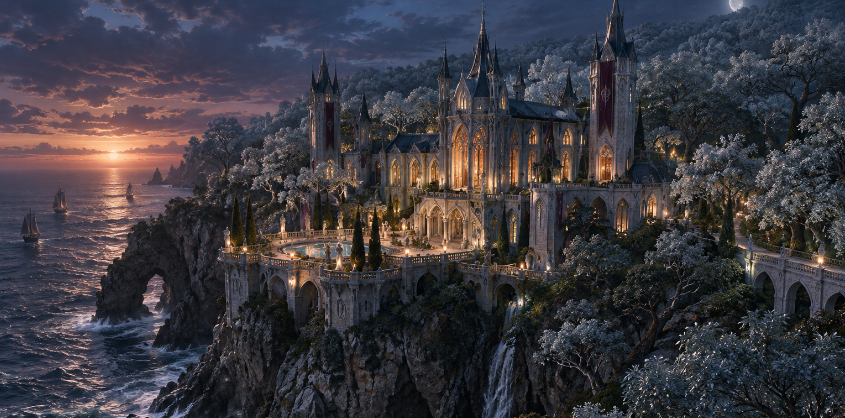
On the westernmost shores of the Silver Woods, where wooded cliffs fall steeply into the sea, stands a place that did not exist there a year ago. The pale towers and illuminated terraces of an elegant château now rise above the water, surrounded by ancient-looking gardens and silver-leafed woodland. By night its windows blaze with golden light and music drifts far across the sea. Ships passing offshore can sometimes hear laughter upon the wind. By day, however, the château is rarely seen clearly. Banks of pale mist roll in from the sea and gather amongst the trees and cliffs, concealing much of the estate. Towers emerge briefly through the fog before disappearing again, and paths through the Silver Woods have developed an inconvenient habit of leading travellers somewhere other than where they intended. The inhabitants call the place simply: La Cour des Plaisirs, The Court of Pleasure.
The Court has occupied the western Silver Woods for less than nine months. Nobody is quite certain how the château appeared. There was no great construction project, no army of labourers and no procession of wagons carrying stone or timber. One season the cliffs were wooded and largely empty; shortly afterwards sailors began reporting lights upon the shore. Within weeks there were towers, gardens, terraces, fountains and roads. The surrounding vegetation appears equally impossible. Mature flowering vines climb walls supposedly only months old. Great trees grow through courtyards and chambers as though the architecture had been designed around them centuries before. Whether the château was constructed, transported from elsewhere, or somehow persuaded into existence is unknown. Its master has never considered the matter worth explaining.
 Lord Luceran Argentrose
At the centre of the Court stands Lord Luceran Argentrose (pictured), an ancient fey noble of considerable power, charm and appetite. Luceran is cultured, intelligent, generous and utterly amoral by ordinary human standards. He enjoys beauty in almost every form: music, food, art, conversation, wine, dance, fashion, adventure and attractive company. Gender means little to his romantic interests, and relationships within his court are governed far more by attraction and personal agreement than by mortal expectations of propriety. Luceran does not consider himself wicked. Indeed, he can be extraordinarily hospitable. Visitors who interest him may find themselves seated at his table, drinking wines of impossible vintage and listening to music that could make a hardened mercenary weep. The difficulty is remembering when it is time to leave.
Gaybriella Moonbriar
Luceran's daughter, Gaybriella Moonbriar, provides a striking contrast to much of the Court. Where others indulge themselves, Gaybriella trains. She is the Knight-Commander of Luceran's household forces, a formidable warrior responsible for the defence of the château and the surrounding territory. Gaybriella is disciplined, proud and considerably more practical than either her father or younger brother. She is perfectly comfortable with the morality of the Court, but she has little patience for foolishness that threatens its security. She is often seen riding her great black Moonsteed, a powerful fey warhorse whose mane glimmers with pale light and whose hooves shine silver when it gallops. To most outsiders, Gaybriella is probably the safest member of the Argentrose family to negotiate with. She understands rules.
Prince Maelith Argentrose
Luceran's younger son, Prince Maelith Argentrose, is rather different. Handsome, intelligent and effortlessly charming, Maelith has spent most of his existence surrounded by people willing to forgive his mistakes. He enjoys wine, companionship, wagers and intrigue, although he sometimes enjoys the excitement of a scheme considerably more than its consequences. Maelith is not stupid. He understands court politics perfectly well and is capable of considerable charm and cunning when motivated. His weakness is that he is impulsive, spoiled and accustomed to assuming that somebody else will deal with any resulting inconvenience. Quite often that somebody is Gaybriella.
The Dowager-Lady Melisande Silkenbloom
Few people understand the Court better than the Dowager-Lady Melisande Silkenbloom, Mistress of Revels. Elegant, observant and extremely difficult to deceive, Melisande oversees much of the social life of La Cour des Plaisirs. She decides who is invited, who is seated beside whom, which musicians will perform, what entertainments will be presented and which individuals might benefit from becoming acquainted. Luceran may rule the Court. Melisande frequently decides how the evening unfolds. She has known the Argentrose family for many years and is one of the relatively few people able to disagree openly with Luceran without causing offence. Prince Maelith treats her with considerably more caution than he does most people. She remembers him as a child.
Lady Cecily Hammerford
Among the fey nobles and strange creatures of the Court is one unmistakably human figure. Lady Cecily Hammerford was born into an aristocratic human family and encountered Luceran's travelling court many years before its arrival in the Silver Woods. She stayed. Cecily still appears to be a young woman, although considerably more time has passed outside the Court than her appearance would suggest. Her relationship with La Cour des Plaisirs is complicated. She is not chained, imprisoned or openly mistreated. She wears beautiful clothes, sleeps in luxurious rooms and moves freely throughout the château. Yet she is clearly ensnared.
Years amongst the fey have left Cecily tired, sophisticated and increasingly jaded. The wonders which astonish newcomers have long since become ordinary to her. She loves some members of the Court, resents others, and perhaps no longer entirely understands where affection ends and dependency begins. The thought of returning permanently to the mortal world now frightens her almost as much as the idea of remaining forever. Visitors occasionally receive one piece of advice from Cecily: “Enjoy yourselves. Just don't enjoy yourselves so much that you forget why you came.”
The Château
The château itself appears to blur the distinction between civilisation and wilderness. Trees grow through ballrooms. Vines wind around marble columns. Small streams cross tiled chambers before disappearing beneath carved stone bridges. Flowers bloom indoors regardless of season. Birds occasionally fly through dining rooms without anyone seeming to find this unusual. Yet nothing feels abandoned or overgrown. Everything is carefully maintained. The effect is not that nature has invaded the château. Rather, the château and forest appear to have agreed to occupy the same space.
The heart of La Cour des Plaisirs is its enormous ballroom. A vast living tree rises directly through its centre, surrounded by flowers, candles and polished marble. Beyond it stretch galleries, sweeping staircases and tall windows overlooking the sea. On nights of celebration the room fills with music, dancers, nobles, adventurers and creatures from half a dozen races. Elves dance beside goblins. Gnomish musicians perform from balconies. Goblin servants in immaculate silver livery carry platters of food and wine between the guests. At times the whole place resembles an aristocratic palace. At others it feels like somebody has allowed the Feywild to organise a party.
Celebrations at the château are frequent and may continue long after mortal guests have lost track of the hour. Entertainment includes dancing, musicians, elaborate dinners, storytelling, magical displays, games, wagers and performances brought from many lands. Visitors are not normally required to participate. They are merely encouraged. Adventurers are particularly welcome. Luceran finds them interesting. A group arriving with mud on its boots, scars from some forgotten ruin and an unusual story to tell may receive a warmer welcome than a visiting duke. Weapons are not necessarily confiscated. A good sword can make an excellent conversation piece.
The château employs an unusual collection of retainers. Goblin servants in silver-and-ivory livery carry food, tend fires and attend to guests with remarkable efficiency. Some are dignified. Others appear to consider service itself a form of performance. Gnomes provide much of the Court's music, with flutes, lutes, viols and pipes being heard throughout the château at almost every hour. Goblin dancers and entertainers are particularly popular at Luceran's revels, their earthy exuberance providing an intentional contrast with the elaborate elegance of the fey nobility. Nobody at the Court considers this contradiction unusual.
The Fey Knights
Protection of the estate falls to Gaybriella's fey knights. They wear elegant green and silver armour, combining fitted cloth and mail with beautifully worked plates shaped like leaves, feathers and overlapping scales. Many fight with slender swords or long spears. They are graceful enough to appear ceremonial until somebody makes the mistake of testing them. Their armour is beautiful. It is also entirely functional.
Visitors
The sailors who pass the western Silver Woods have already learned to keep their distance. Adventurers are another matter. The very stories that convince sensible fishermen to remain offshore are precisely the stories that persuade adventurers to investigate. Those who reach the château are rarely attacked. More often they are greeted by servants and asked whether they would care to join the festivities. Some leave the following morning. Some leave considerably later. And occasionally somebody leaves convinced that only a single night has passed, only to discover otherwise.
By Day and By Night
During daylight, the château appears distant and elusive. Mist clings to the cliffs and spreads beneath the trees. Paths become uncertain, sounds strangely muffled and even large towers may disappear entirely behind drifting banks of white fog. After sunset the character of the place changes. The mist withdraws. Hundreds of windows illuminate the cliffs. Lanterns appear amongst the trees. Music carries across the water. From several miles offshore, sailors can see the lights of La Cour des Plaisirs shining against the darkness. Most keep sailing. Others occasionally decide to take a closer look. And Luceran is always delighted to receive new guests.
