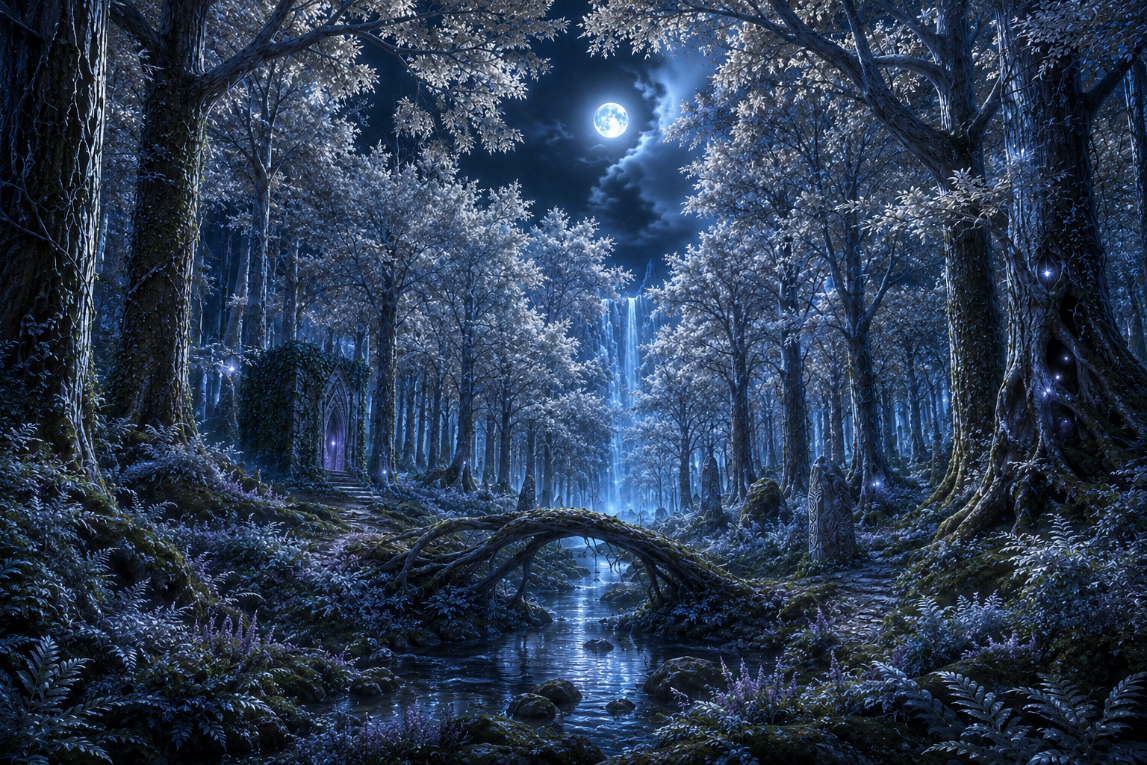

Silver Woods of Puevon
The Silver Woods of Puevon are among the strangest surviving remnants of the Fey realm in Warlderia. A forest of pale boughs, silver leaves, moonlit pools and ancient paths, they possess an otherworldly beauty that can make even experienced travellers forget how dangerous they truly are. The Woods are not a place of darkness or corruption. Indeed, much of the forest is breathtakingly beautiful. Its danger lies instead in the fact that the rules by which it lives are not mortal ones. Like the Golden Woods of Anwyn, the Silver Woods were brought into Warlderia during the great exchange of lands associated with the Galsitanic Intrusion. Yet the two forests have developed very differently. In Anwyn, Fey, Elves, Half-Elves and Humans gradually learned to live together, and the customs of the Fey became tempered by generations of contact with mortal ideas of justice, compassion and responsibility. No such accommodation ever truly occurred in Puevon. The Silver Woods remain much closer in spirit to the older Fey realm. Its inhabitants value promises, hospitality, obligation, ownership, courtesy and ancient custom enormously, but concepts such as fairness, proportional punishment or the protection of strangers may mean very little to them. A Fey creature might risk its life to honour a promise made three centuries ago and, on the following morning, transform a woodcutter into a tree for cutting down a favourite hawthorn. To the Fey, there need be no contradiction.
This does not make the Silver Woods an evil place. Many of its inhabitants are friendly, some are genuinely kind, and others simply wish to be left alone. Yet the Woods have also become a refuge for Fey driven from more ordered realms, particularly the Golden Woods of Anwyn. Hags, redcaps, quicklings and other darker creatures have discovered that beneath the silver leaves few questions are asked about what they may have done elsewhere. Among these is the notorious Mistress Ysabet Vale, whose crimes in Anwyn eventually forced her to flee into Puevon. Here, a creature of her nature attracts considerably less attention. Over this strange society presides one of the most powerful Fey remaining in Warlderia: Vaelithra Silverbriar, the White Thorn of the Silver Woods, Lady of the Pale Boughs, Mistress of the Silver Court and Keeper of the Old Paths. Beautiful, ancient and fiercely loyal to the Fey Queen, Vaelithra embodies the character of the forest itself. She is capable of extraordinary generosity and terrible cruelty, and regards neither as incompatible with honour. For the people of neighbouring Puevon, therefore, the Silver Woods are neither enemy territory nor friendly wilderness. They are something older and considerably more complicated. Generations have learned the distinction.
The Golden Woods protect the innocent. The Silver Woods protect the old laws.

The Forests Apart
The Golden Woods of Anwyn and the Silver Woods of Puevon were not always so different. For most of their long existence within the Fey World, the two forests shared broadly similar customs and attitudes. Both were unmistakably Fey places, beautiful and dangerous in equal measure, where ancient traditions mattered far more than mortal ideas of good and evil. Promises were binding, hospitality was sacred, debts demanded repayment and ownership of a grove, stream or ancient pathway might be respected for thousands of years. Neither forest was evil, but neither was particularly concerned with being good. The divergence between them began only some fifty or sixty years ago, with the growing influence of Dîmeril Laeghartha and the foundation of the Sisterhood of Anwyn.
Dîmeril brought something unusual to the Golden Woods: the belief that those with power bore some responsibility for those without it. Under her influence, the Sisterhood began protecting travellers, defending weaker inhabitants and actively confronting creatures that preyed upon others. Behaviour that had once been regarded simply as the way of the Fey increasingly became unacceptable beneath the golden leaves. The change was gradual, and it remains far from complete. Many of the older inhabitants of Anwyn can still remember the Woods before Dîmeril, and not all approve of what they have become. Some embraced the Sisterhood and its ideals enthusiastically. Others regarded the movement as an attempt to impose Elven and mortal notions of morality upon a people who had never needed them. For the more unpleasant inhabitants of the Golden Woods, the consequences were considerably more practical. Hags, murderous spirits, cruel tricksters and other predatory Fey increasingly found themselves watched, opposed or driven out. Some fled elsewhere in the Fey World, but many found an obvious refuge beneath the pale boughs of the Silver Woods. There was no Dîmeril in Puevon.
No equivalent of the Sisterhood arose there, and the ancient customs remained largely unchanged. A creature arriving from Anwyn was not necessarily asked why it had been expelled, and deeds committed beneath golden leaves were not automatically considered the concern of those who dwelt beneath silver ones. Thus the Silver Woods gradually acquired a darker reputation without themselves becoming darker. The Silver Woods did not fall. The Golden Woods changed. That distinction remains fundamental to understanding the two forests today. Anwyn has begun experimenting with ideas of protection, responsibility and justice. The Silver Woods continue to value the older virtues of the Fey: honouring one's word, respecting hospitality, repaying debts, defending what belongs to you and observing agreements whose origins may have been forgotten by everyone except the Fey themselves. To the Sisterhood, the Silver Woods can sometimes seem dangerously indifferent. To many of the older Fey of Puevon, Anwyn is engaged in a strange and very recent experiment. And after only fifty or sixty years, neither side can yet claim to know where that experiment will lead.

The Silver Court
At the heart of the Silver Woods lies the Silver Court, the greatest gathering of Fey power beneath the pale boughs. It is not a court in the mortal sense. There is no bureaucracy, no written law and certainly no orderly chain of officials administering the forest. Instead, it is an ancient web of loyalties, obligations, privileges and agreements binding many of the most powerful inhabitants of the Woods together. At its centre stands Vaelithra Silverbriar, the White Thorn of the Silver Woods (pictured), known formally as Lady of the Pale Boughs, Mistress of the Silver Court and Keeper of the Old Paths. Vaelithra is undoubtedly the most influential Fey within the Silver Woods, although describing her as their ruler would be misleading. Ancient dryads rule their own groves, spirits claim streams and pools, and powerful Fey maintain domains whose rights predate even the memories of some members of the Court. Vaelithra does not interfere lightly in such matters. Her authority rests instead upon age, reputation and obligation. When Vaelithra speaks, others listen. When she offers protection, few willingly challenge it. When disputes between powerful Fey threaten the wider Woods, it is often before the White Thorn that they are settled. Above all, Vaelithra remains a servant of the Fey Queen.
Her title of Keeper of the Old Paths is no ornament. Before the Galsitanic Intrusion, Vaelithra was entrusted with the protection of several ancient routes through the Fey realm, including stretches of the mysterious Queen's Roads. Some of those pathways crossed into Warlderia with the Silver Woods, and Vaelithra continues to guard them as fiercely as she did before. Whether any still lead home is something upon which the White Thorn rarely speaks. The Law Beneath the Pale Boughs The Silver Court possesses laws, but they are Fey laws. Hospitality freely offered must be respected. A sworn promise must be honoured. A bargain willingly entered must be fulfilled. Gifts create obligations. Ancient boundaries are recognised. Sanctuary, once properly granted, cannot lightly be violated. Certain paths, groves and waters belong to particular beings, and trespass upon them can carry consequences that mortals would consider wildly disproportionate.
What the Silver Court does not possess is any general obligation to protect the innocent. A hag who murders travellers has not necessarily broken the law of the Silver Woods. A redcap preying upon those foolish enough to enter its territory may simply be exercising what it considers its ancient rights. Unless such creatures violate an oath, trespass upon another's domain, break hospitality or offend some other recognised custom, the Court may have no interest whatsoever in intervening. This is perhaps the greatest source of misunderstanding between the Silver Woods and outsiders. The White Thorn can be honourable without being merciful. She can be generous without being kind. And she can uphold the law perfectly while allowing something terrible to happen. That does not trouble Vaelithra nearly as much as mortals believe it should.
Vaelithra Silverbriar, The White Thorn
Vaelithra Silverbriar, Lady of the Pale Boughs, Mistress of the Silver Court and Keeper of the Old Paths, is the most powerful and influential Fey remaining within the Silver Woods. Ancient even by the standards of her people, Vaelithra is strikingly beautiful, with almost colourless skin, long silver-white hair and the slightly unsettling perfection common to the oldest of the Fey. She favours pale gowns, silver ornaments and living flowers, and frequently carries a slender blade more as a symbol of her authority than as a weapon. Those expecting the mistress of the Silver Woods to be cruel or sinister are often surprised by her. Vaelithra can be charming, witty and extraordinarily gracious. She enjoys music, conversation, beautiful things and interesting people. She is capable of genuine friendship and affection, remembers acts of kindness for centuries and can reward those who please her with astonishing generosity. She is also capable of acts that mortals find horrifying. The contradiction exists largely in the minds of mortals. Vaelithra sees none.
Vaelithra's morality is founded upon an ancient Fey understanding of the world. She values honour rather than goodness, obligation rather than charity and consequence rather than justice. A starving stranger has no automatic claim upon her food. A guest invited beneath her roof may expect lavish hospitality and absolute protection. Someone who steals that same food might receive a punishment grotesquely greater than the value of what was taken. To Vaelithra, these positions are entirely consistent. Her title the White Thorn reflects this nature. A thorn does not hate the hand that grasps it. It does not consider itself cruel when it draws blood. It is simply a thorn.
Vaelithra's relationship with Dîmeril Laeghartha is considerably more complicated than simple rivalry. She respects Dîmeril. Indeed, Vaelithra may admire her courage, determination and willingness to stand behind her beliefs. Dîmeril has accomplished something extraordinary in the Golden Woods, and the White Thorn is intelligent enough to recognise it. Whether it was wise is another matter. Vaelithra regards the transformation of Anwyn during the last fifty or sixty years with a mixture of fascination and scepticism. To her, the Sisterhood's belief that the strong possess a responsibility to protect strangers represents a profound departure from traditional Fey thinking. She does not necessarily oppose it. She simply sees no reason why the Silver Woods should follow it.
The arrival of exiles from Anwyn has occasionally strained relations between them. Dîmeril may consider a particular creature dangerous enough that it should not be permitted to prey upon others anywhere. Vaelithra's position is much simpler: if the creature has left Anwyn, then Dîmeril's authority over it has ended. Mistress Ysabet Vale is perhaps the most notorious example. Vaelithra need not like the green hag. She certainly need not trust her. Yet Ysabet's crimes beneath the golden leaves do not automatically constitute crimes beneath the silver ones.
Keeper of the Old Paths
Of all Vaelithra's titles, Keeper of the Old Paths may be the most ancient. Long before the Galsitanic Intrusion, she guarded certain paths and crossings belonging to the Fey Queen. Among them were portions of the mysterious Queen's Roads, ancient routes capable of carrying travellers across distances—and sometimes between places—that ordinary roads could never connect. When the Silver Woods were caught in the Intrusion, some of these paths came with them. Vaelithra guards them still. She knows which paths are dead, which merely sleep and which should never be walked. She can open some ways that appear to others as nothing more than woodland tracks and close others so completely that even experienced Fey cannot find them. And since arriving in Warlderia, the White Thorn has become intensely interested in one particular individual. Dîmeril Laeghartha can walk roads she should not be able to walk. Vaelithra does not yet know exactly what that means. But the Keeper of the Old Paths intends to find out.

Exiles Beneath the Silver Leaves
For centuries the Silver Woods have offered something increasingly difficult to find elsewhere in the Fey realm: a place where few questions are asked. As the influence of Dîmeril Laeghartha and the Sisterhood of Anwyn grew within the Golden Woods, some of its inhabitants discovered that behaviour once tolerated beneath the golden leaves was tolerated no longer. Predatory Fey were confronted, dangerous creatures driven from settled areas, and those who repeatedly threatened others could find themselves expelled altogether. The Silver Woods became an obvious destination. Not everyone who came was evil. Some were simply unwilling to accept the changing customs of Anwyn. Others had quarrelled with the Sisterhood, broken local laws, offended powerful neighbours or simply preferred the older ways. Others were monsters. Hags, redcaps, malicious quicklings, cruel spirits and stranger things gradually found their way beneath the silver leaves. Here they discovered a society considerably less interested in judging what they had done elsewhere.
This has sometimes led outsiders to describe the Silver Woods as a sanctuary for evil Fey. The inhabitants themselves would reject the description. The Silver Court does not forgive those who arrive, because forgiveness implies that it possesses some right to judge them in the first place. A creature expelled from Anwyn has already suffered the judgement imposed upon it by Anwyn. Once it crosses into the Silver Woods, the question becomes not “What did you do?” but “How will you behave here?” The distinction is enormously important. An exile who respects the ancient customs, honours bargains and keeps within its own domain may remain undisturbed for centuries. One who breaks hospitality, violates another's sanctuary or ignores the authority of the Silver Court may rapidly discover that Vaelithra's tolerance has very definite limits.
Perhaps the most notorious of these refugees is Mistress Ysabet Vale, the green hag whose activities in the Golden Woods brought her into conflict with Dîmeril Laeghartha. Ysabet eventually fled Anwyn and disappeared into the Silver Woods, where a creature of her nature attracted considerably less attention. She remains dangerous, malicious and utterly unrepentant. Her presence illustrates perfectly the gulf that now exists between the two forests. The Sisterhood sees Ysabet as a predator who escaped justice. The Silver Court sees a hag who was driven from Anwyn and subsequently established herself within another domain. Provided Ysabet observes the laws beneath the Pale Boughs, those two statements can both be true. This does not mean Ysabet is safe from everyone. Old enemies remain old enemies, victims may seek vengeance, and nothing in the customs of the Silver Woods requires another Fey to like her. It simply means that being evil is not, by itself, a crime in the Silver Woods.
Inhabitants of the Silver Woods
The Silver Woods contain much the same extraordinary variety of life that might be encountered elsewhere in the Fey realm. Dryads, pixies, sprites, satyrs and other woodland Fey inhabit its groves and clearings, while unicorns, giant owls, strange woodland beasts and creatures unknown beyond the Fey lands wander beneath the pale canopy. Most are neither hostile nor particularly interested in mortals. A traveller might encounter a family of sprites who prove delightful company, a dryad who happily offers directions or a satyr who demands nothing more threatening than music, wine and conversation. Such encounters are one reason experienced visitors warn against assuming that everything within the Silver Woods is dangerous. The opposite assumption is equally foolish.
Beauty is a particularly unreliable guide in the Silver Woods. Some of its most benevolent inhabitants appear monstrous, while creatures of breathtaking beauty may regard mortals as toys, prey or temporary entertainment. The Fey themselves find the mortal tendency to associate beauty with goodness rather peculiar. Nor do the inhabitants divide themselves neatly between good Fey and evil Fey. A dryad might lovingly protect every animal within her grove while showing complete indifference to a wounded traveller lying twenty yards beyond its boundary. A satyr might guide lost children safely home and later steal a farmer's finest horse because it amused him. A powerful spirit might protect a village for a century because one of its founders once performed a kindness that nobody now remembers. The Silver Woods are filled with such contradictions.
There are, nevertheless, creatures beneath the silver leaves that are unquestionably evil. Green hags establish hidden lairs around pools and ruined dwellings. Redcaps haunt lonely places and abandoned paths. Quicklings delight in cruelty and malicious tricks, while other predatory Fey use glamour, enchantment and beautiful appearances to lure victims away from safer paths. Some have inhabited the Silver Woods since long before the recent arrival in Warlderia. Others are refugees and exiles from Anwyn or elsewhere in the Fey realm. Their presence is tolerated rather than celebrated. Even the most vicious creature understands that there are boundaries it is unwise to cross. The ancient domains of powerful Fey are respected, guests enjoying formally granted hospitality are protected, and few inhabitants willingly provoke the Silver Court. The Woods may be amoral. They are not lawless.
Mortals Beneath the Boughs
Mortals are much rarer. A handful of Elves and Half-Elves have long lived among the Fey, particularly around the more settled paths and clearings that crossed into Warlderia with the forest. Some families have relationships with particular Fey extending back many years. Humans are considerably less common. Those now entering from Puevon are newcomers to a society that barely knew their lands existed less than a year ago. Traders, hunters, woodsmen, fugitives and the simply curious have all begun testing the forest's boundaries. Some return with extraordinary stories. Some return extraordinarily wealthy. Some return twenty years older than when they entered. And some do not return at all.


Courts Beneath the Silver Boughs
Although Vaelithra Silverbriar, the White Thorn, is the most powerful and influential Fey within the Silver Woods, she is not their queen. The Woods possess no single ruler in the mortal sense, and Vaelithra herself would consider many of the ancient inhabitants to be subjects of the Fey Queen, rather than subjects of her own. Instead, the Silver Woods are divided amongst numerous smaller domains. Ancient Sidhe nobles, powerful dryads, spirits and other Fey claim authority over particular glades, valleys, pools, hills or stretches of woodland. Some of these territories have existed for centuries. Others change according to bargains, marriages, wagers, feuds or agreements whose terms would appear utterly incomprehensible to outsiders. Their boundaries can be equally peculiar.
A stream may separate the lands of two rival Fey nobles. A particular species of flower might mark another boundary. One domain may extend only as far as the sound of a particular waterfall can be heard, while another might exist solely beneath the light of the moon. The Fey generally know exactly where these boundaries lie. Mortals generally do not. Lesser Fey frequently attach themselves to one of these courts for companionship or protection, while others acknowledge no authority beyond their own grove or dwelling. Some of the older Sidhe still proudly describe themselves as servants of the Fey Queen, despite having had no contact with her Court since the Galsitanic Intrusion stranded the Silver Woods in Warlderia. Others have begun to wonder whether their unexpected arrival in a new world presents opportunities of its own.
When disputes threaten the wider Woods, it is usually the Silver Court and Vaelithra to whom the greater powers turn. Her authority is considerable, but it rests upon reputation, ancient obligations and her position as Keeper of the Old Paths, rather than upon any simple right to command every creature beneath the silver leaves.
Old Customs and Courtesies
The Silver Woods operate according to customs far older than the Human settlements now surrounding them. Hospitality, promises, gifts, names and debts possess particular significance amongst the Fey. These customs are not merely good manners. To some inhabitants of the Woods they have an almost supernatural weight. A traveller who accepts food may inadvertently accept hospitality and therefore become temporarily subject to the rules of their host. A promise casually made may be remembered decades later. A gift may establish an obligation even when none was intended. Giving one's full name to the wrong creature can grant it an intimacy or influence that the speaker never intended. Yet these same customs can offer protection. A traveller formally accepted as a guest may be safer beneath the roof of a terrifying Fey lord than in any mortal castle. A promise given by one of the Sidhe may be relied upon centuries later. Even some thoroughly evil Fey respect the ancient laws of hospitality, although trusting them to interpret those laws as a mortal would remains extremely unwise. The inhabitants of neighbouring Puevon are therefore rapidly developing their own practical folklore concerning the Woods. Parents teach their children several simple rules: Never give a Fey your full name merely because they ask. - Never promise something you cannot deliver. - Never eat at a stranger's table until you understand why you have been invited. - Never assume that a gift is free. - And above all: Never thank a hag for a gift.
Nobody now remembers precisely why the final rule exists. This is generally considered an excellent reason to continue observing it.
The Queen's Roads
Several ancient paths cross the Silver Woods which predate their arrival in Warlderia. Collectively they are known as the Queen's Roads. Some appear to be little more than narrow trails winding between silver maples. Others are magnificent avenues bordered by standing stones, ruined arches or ancient trees whose branches meet perfectly overhead. They do not always lead where geography suggests they should. Most connect distant parts of the Silver Woods with impossible speed. A journey that should require a full day might take less than an hour if the correct path is followed. A traveller attempting the return journey may discover that the same road no longer provides the same shortcut. A few are believed to still touch the Fey World. Such paths are unreliable. Some appear only beneath particular moons or during particular seasons. Others seem to open only for particular travellers. There are even stories of paths that decide for themselves where someone needs to go, regardless of where that person actually intended to travel. Those who are Fey-touched appear able to travel the Queen's Roads with somewhat greater success, as though the paths recognise something familiar within them. Even then there are no guarantees. For ordinary mortals, deliberately attempting to travel the Queen's Roads is considered exceedingly unwise. Adventurers inevitably do so anyway. Vaelithra's ancient title of Keeper of the Old Paths is closely connected to these roads. She knows routes forgotten by most other Fey, can open some paths that appear closed and can prevent travellers from finding others. Since the Galsitanic Intrusion, however, even Vaelithra cannot be entirely certain what has happened to every road. Of particular interest to her is Dîmeril Laeghartha, whose unusual ability to travel the Queen's Roads suggests a relationship with them that Vaelithra does not yet fully understand. The White Thorn intends to discover why.
Places That Still Belong to the Queen
Scattered throughout the Silver Woods are reminders that the forest was once merely one small part of a vastly greater Fey realm. There are abandoned pavilions formed from living trees, ruined fountains whose waters still possess minor magical properties, circles of standing stones and clearings where flowers bloom regardless of season. Occasionally travellers discover structures of astonishing beauty standing apparently untouched amongst the trees. They are almost always empty. Almost. The greatest of these places are treated with considerable respect by the inhabitants of the Woods. Even redcaps, hags and quicklings have been known to avoid particular glades, bridges or pavilions associated with the Fey Queen. Vaelithra herself fiercely protects several such places. Mortals sometimes assume that because the Queen departed and these places stand abandoned, they are now ruins available for exploration, occupation or plunder. The Fey take a very different view. When asked how an empty palace, forgotten garden or abandoned stretch of woodland can possibly still belong to a Queen who is no longer there, the answer is invariably the same: “She never surrendered them.”

Puevon and the Woods
The relationship between Puevon and the Silver Woods is ancient and deeply hostile, although the Humans who now inhabit the town are not the Humans with whom that hostility began. The original Puevon was a Human settlement whose inhabitants regarded the surrounding Fey with fear and hatred. Conflict between town and forest continued for generations, eventually leading the townsfolk to surround their settlement with formidable walls incorporating cold iron and powerful magical wards. No Fey could cross them. When the Galsitanic Intrusion carried the surrounding lands into Warlderia, those same defences apparently prevented the Fey Queen's magic from properly affecting the people within Puevon. The consequences were terrible. While the surrounding countryside passed through the Queen's magic, the inhabitants trapped behind Puevon's cold-iron wards aged a year and a day. Their decayed bodies were later discovered by the people of Vrowbin, whose own settlement had been transported during the Intrusion and who found themselves occupying Puevon instead. Whether this catastrophe was an unintended consequence of the wards resisting the Queen's magic or a deliberate act of the Fey Queen remains unknown. The Fey of the Silver Woods give contradictory answers. Some smile when asked.
Modern Puevon is therefore a strange successor to the settlement that once stood upon the same ground. Its population consists predominantly of Humans, together with a growing number of Half-Orcs and others, none of whom participated in the ancient struggle between the town and the Woods. Nevertheless, they have inherited its defences. The cold iron woven into Puevon's walls remains. The ancient wards remain active. And the Fey still cannot enter. For the present inhabitants this has rapidly ceased to be merely an inherited curiosity. Redcaps and hags inhabit the deeper Woods, and there are things beneath the silver maples against which a strong wall and a strip of cold iron provide considerable reassurance. The settlement maintains a small temple to Xerbo, reflecting its dependence upon trade, fishing and the sea. The mysterious scholar Stal Pheral maintains his magical mansion and exotic gardens there, while Edelmir Grausam is amongst its prominent traders. Maelara Grausam, a Ducal Knight of Everwatch, has been named Lady of Puevon and the Silver Woods, although her duties frequently take her elsewhere. The title is impressive. How much authority the Lady of Puevon actually possesses over the inhabitants of the Silver Woods is another question entirely. Most of the Fey have never heard of the Duchess of Everwatch. Those who have generally regard the idea that one Human ruler can grant ownership of their forest to another Human as exceptionally funny.
An Inherited Feud
Relations between modern Puevon and the Woods are considerably less hostile than those which existed between the Fey and the original inhabitants. This is partly because the newcomers from Vrowbin have no ancient grievance against the Fey. They inherited Puevon's walls, its cold iron and its rather alarming neighbours, but they did not inherit centuries of hatred. The Fey appear to recognise the distinction as well. Some remain suspicious of anyone living behind the hated iron walls. Others seem fascinated by the newcomers. A few have even attempted to explain to the people of Vrowbin exactly why their predecessors were so thoroughly disliked, although the accounts differ wildly depending upon which Fey is telling the story. For now, both sides are proceeding cautiously. The people of Puevon gather timber and food primarily from the surrounding mundane lands rather than venturing deeply into the forest. Hunters who enter the Silver Woods generally travel in groups and carry some form of cold iron. Fey occasionally approach the walls. They cannot cross. Some come merely from curiosity. Others trade outside the gates, exchanging rare herbs, magical plants and unusual objects for things difficult to obtain within the forest. There have even been tentative friendships between individual townsfolk and some of the less dangerous inhabitants of the Woods. And then there are those who simply stand amongst the silver trees beyond the walls and watch. They sometimes remain there for hours. They never call out. They never approach the gates. They never appear to threaten anyone. The guards dislike those most of all.
Places of Note
The Silver Woods contain countless glades, pools, ruins and ancient dwellings, many of which possess names known only to the Fey. Since the Galsitanic Intrusion, mortal explorers have begun adding names of their own, although using the wrong name for a place in the presence of its inhabitants can occasionally cause offence. Several locations are particularly important.
The Court of Pale Boughs
Deep within the Silver Woods lies the domain of Vaelithra Silverbriar, a place generally known as the Court of Pale Boughs. There is no castle. Instead, enormous silver-barked trees form a natural palace around a broad clearing. Their branches intertwine high overhead, creating great vaulted chambers open to the forest, while living roots form stairways, seats and raised platforms. At night thousands of tiny lights appear amongst the branches, although whether these are insects, spirits or something else entirely is uncertain. At the centre stands Vaelithra's seat beneath an immense ancient tree known simply as the Pale Bough. The Court is one of the safest places in the Silver Woods for an invited visitor. It is also one of the easiest places to make a catastrophic social mistake.
Hospitality is strictly observed here. Weapons need not necessarily be surrendered, but drawing one without cause is a grave offence. Food and drink offered by Vaelithra may be safely accepted once hospitality has formally begun, and anyone recognised as her guest enjoys the protection of the White Thorn. Even Vaelithra's enemies respect that protection. The Court is also where disputes between the greater Fey are sometimes heard. These gatherings can be extraordinary affairs, attended by Sidhe nobles, dryads, satyrs, sprites, ancient spirits and occasionally creatures considerably less pleasant. A mortal witnessing such proceedings may find the judgement difficult to understand. The Fey rarely do.
The Queen's Pavilion
Some distance from the Court stands one of the most beautiful surviving remnants of the Fey Queen's presence. The Queen's Pavilion is a delicate structure of white stone, living branches and silver glass standing beside a perfectly circular pool. Flowers bloom around it throughout the year, and neither fallen leaves nor dust ever seem to settle upon its floors. It is completely empty. No servant tends it. No guard watches its doors. Nevertheless, no Fey will enter without invitation. The Pavilion belonged to the Fey Queen before the Intrusion and, as far as the inhabitants of the Silver Woods are concerned, it belongs to her still. Even Vaelithra stops at its boundary unless some ancient duty requires otherwise. Mortals occasionally find this difficult to understand. An abandoned building filled with beautiful objects can look remarkably like an opportunity. The Fey have another word for it. Theft.
The Moonbridge
The Moonbridge appears at first to be nothing more than a graceful arch of pale stone crossing a narrow woodland stream. During daylight it behaves exactly as expected. At night things become more complicated. Under certain phases of the moon, crossing the bridge does not necessarily deposit the traveller upon the opposite bank. Instead, the Moonbridge becomes part of the Queen's Roads. Travellers have crossed it and emerged many miles away. Others have returned to precisely the same place several hours before they left. Fey stories insist that on rare nights the bridge still reaches the Fey World itself. Vaelithra knows when the Moonbridge will awaken. Usually. The inhabitants of Puevon have developed a considerably simpler rule: Do not cross the Moonbridge after sunset.
Stillwater House
Hidden amongst the deeper trees stands a surprisingly pleasant old house overlooking a dark, perfectly still pool. Smoke frequently rises from its chimney. Herbs hang beside the doorway. The gardens are beautifully maintained, and travellers arriving at dusk may sometimes find a smiling woman waiting outside with food already prepared. This is Stillwater House. Its mistress is Ysabet Vale.
The green hag appears to have established herself comfortably since fleeing the Golden Woods, and the Silver Court has shown little interest in removing her. Ysabet observes enough of the ancient customs to avoid provoking her more powerful neighbours and is careful about precisely whom she chooses as prey. Those who know her reputation give Stillwater House a very wide berth. Those who do not occasionally discover a warm fire, excellent food and an extraordinarily charming hostess waiting for them in the wilderness. Sometimes Ysabet merely wants information. Sometimes she wants something stranger. And sometimes she is simply hungry.

Stranded in Warlderia
For the inhabitants of the Silver Woods, the Galsitanic Intrusion is not ancient history. It happened only months ago. Many Fey still remember perfectly clearly the landscape that once lay beyond the forest. Paths which once led to neighbouring Fey domains now end at unfamiliar hills, Human roads or the shores of a sea that was never there before. Creatures who had known the wider Fey World for centuries suddenly find themselves confined to a fragment of it. Reactions have varied enormously.
Some desperately want to return home. Others believe the Fey Queen will eventually come for them and see their present circumstances as little more than an inconvenience. A few have begun exploring Warlderia with enormous enthusiasm, fascinated by its Humans, cities, religions and peculiar customs. Others have concluded that being stranded in a new world presents opportunities unavailable in the old one. The Silver Court itself has adopted no single position. Vaelithra continues to protect the Queen's possessions and maintain the Old Paths, behaving as though her sovereign might return tomorrow. Lesser courts have begun establishing relationships with neighbouring lands, while individual Fey wander increasingly far beyond the forest.
The greatest uncertainty concerns the Queen's Roads. If even one still provides a reliable passage back to the Fey World, the Silver Woods may not truly be stranded at all. If none do, then the inhabitants face a truth that many have not yet accepted: Warlderia may now be their home.
