Dark Cleft Canyon
Formal Name: The Confederation of the Dark Cleft
Government: Confederation of Four Great Tribes
Supreme Authority: Council of the Four Warlords
Capital: Grathang (Traditional)
Major Settlements: Grathang, Ernalgug, Morgalaz, Barathang
Resources: Iron, Copper, Giant Boars, Timber, Slaves, Mercenaries
Population: 165,000 (30% Urban), 60% Orc, 20% Half-Orc, 10% Human, 10% Other (mostly slaves)
Languages: Orcish, Common
Common Alignment: Evil
Major Religions: Gruumsh, Erythnul, Nerull, Bahgtru, Luthic
Enemies: Most neighbouring Human kingdoms
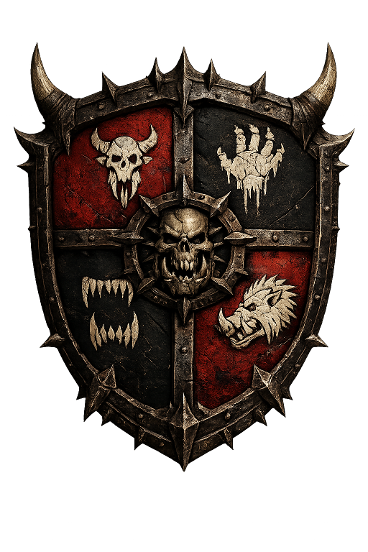
The Dark Cleft is one of the natural wonders of Warlderia and the ancient heartland of Orc civilisation. From the surface there is almost nothing to suggest that an immense canyon lies beneath the earth. Barely a mile from its edge, travellers can pass by without ever suspecting that the land suddenly falls away into a chasm hundreds of feet deep. For most of the year the towering cliffs keep the canyon in perpetual shadow. Only during the height of summer does sunlight reach the canyon floor for more than an hour each day. Generations of Orcs have transformed these sheer rock walls into one of the greatest fortresses in the world. Vast halls have been carved into the cliffs, bridges span impossible heights, while countless stairways, ladders and tunnels connect hundreds of terraces suspended above the canyon floor.
The Dark Cleft was once the capital of the mighty Kingdom of Gar'anash, from which the Orc Kings ruled much of the north-east of Warlderia. Although that kingdom collapsed centuries ago, its monumental palaces, temples and fortresses still dominate the canyon. Many now serve as the ancestral homes of the great tribes that once swore loyalty to the Orc Kings. Today no ruler possesses the strength to claim the ancient crown.
Instead, the Dark Cleft is governed by an uneasy Confederation of Four Great Tribes, each controlling one of the four cities that line the canyon. Beneath these dominant tribes are dozens of lesser clans whose loyalties shift with every generation. The Four Warlords meet in council only when matters threaten the survival of the Confederation, and agreements reached there are often temporary. Raids, assassinations, blood feuds and skirmishes between rival tribes are accepted as part of daily life, provided they do not erupt into full civil war. The tribes understand that open conflict would invite invasion by their enemies, and so an uneasy peace has endured for generations.
The only people who move freely throughout the Confederation are merchants, mercenary captains and priests. Free Humans rarely enter the Dark Cleft and fewer still leave again. Most Humans within the canyon are slaves, while those who earn their freedom often remain as craftsmen, engineers or traders under the protection of powerful Orc patrons. Although divided politically, the Orcs of the Dark Cleft still speak proudly of Gar'anash. Every tribe believes itself the rightful heir to the ancient kingdom, and each dreams of one day restoring Orc dominion across the north-east.
Grathang
Grathang (Large City): Alignment: NE, Population 18,000 (75% Orcs, 10% Half-Orcs, 15% others (slaves). Authority Figure:- King Oragha (male Orc)
Grathang occupies the central terraces of the northern wall and remains the ceremonial heart of the Confederation. Once the throne city of the Kings of Gar'anash, it possesses the finest architecture in the Dark Cleft. Vast halls supported by colossal pillars disappear into the mountainside, while ancient bridges connect towering fortresses carved directly into the living rock.
The ruling tribe, the Obsidian Skulls, were once regarded as the noblest of all Orc bloodlines, for it was from their ranks that the Kings of Gar'anash were chosen. That prestige survives, but little of the old authority remains. Its ruler, Warlord Oragha, dreams of restoring the ancient kingdom and leading another age of conquest across Warlderia. A fearsome warrior, Oragha possesses little talent for diplomacy and trusts few beyond his own household. His inability to unite even the lesser tribes of Grathang has steadily weakened his influence, allowing younger rivals to eclipse his once-proud city.
Ernalgug
Ernalgug (Small city): Alignment: CE, Population 11,000 (70% Orcs, 15% Half-orcs, 15% others (slaves). Authority Figure: - Chieftain Unglak (male Orc)
Situated nearest the eastern plains, Ernalgug controls the fertile grazing lands that feed the Confederation. Vast herds of livestock, giant boars and thousands of slaves are driven through its gates each year, making it the principal commercial centre of the Dark Cleft. Rather than magnificent fortresses, Ernalgug is dominated by sprawling stockyards, slave pens, tanneries and markets. The city is noisy, filthy and prosperous, attracting merchants from every tribe.
Its rulers, the Severed Hands, were once among the wealthiest tribes after founding the great harbour of Tulka. Now, however, Tulka's growing independence threatens to destroy their influence. Chieftain Unglak has become increasingly desperate, urging the Confederation to march against the rebellious port before it is lost forever.
Morgalaz
Morgalaz (Large City): Alignment: CE, Population 25,000 (80% Orcs, 10% Half-orcs. 10% others (slaves). Authority Figure: - Prince Balig (male Orc)
The southern city of Morgalaz has become the true political power of the Confederation. Home of the Blood Fangs, the city has grown steadily for generations through calculated alliances, careful diplomacy and ruthless opportunism. While the other great tribes exhausted themselves in endless feuds, the Blood Fangs welcomed lesser clans into their protection, steadily expanding both their influence and manpower.
Much of Morgalaz has been rebuilt during the last century. Its buildings lack the grandeur of ancient Grathang but are practical, spacious and heavily fortified. Workshops, armouries and barracks dominate entire districts, reflecting the city's increasingly militaristic character. Its ruler, Warlord Balig, is widely regarded as the most dangerous politician among the Orcs. Rumours persist that he has entered into a secret alliance with Herzag Bloodyhammer of Tulka, though neither has publicly acknowledged any agreement.
Barathang
Barathang (Small City): Alignment: N, Population 9500 (60% Orcs, 35% Half-0rcs, 5% others (slaves). Authority Figure: - Chieftain Granzak (male half-Orc)
Barathang surrounds the mighty fortress of Rathang, one of the oldest strongholds in Warlderia. According to Orc tradition it was built shortly after their arrival upon the continent, when Dwarven masons and Elven engineers still worked beside Orc craftsmen against the Human tribes that dominated the surrounding lands.
Today that ancient fortress still overshadows the growing city beneath its walls. Unlike the other great tribes, the Drinkers of Blood have embraced change. Under the leadership of the Half-Orc Chieftain Granzak, increasing numbers of Half-Orcs have joined the tribe, bringing new ideas and tactics. The vast plains west of Barathang now support immense herds of Giant Boars, allowing the city to field formidable mounted warbands whose speed has transformed Orc warfare. Many conservative tribes distrust Granzak's reforms, yet none can deny his growing success. Slowly but steadily, Barathang is emerging as a power capable of challenging the older cities.
Tulka
Although lying beyond the canyon on the western coast, Tulka is widely regarded as the fifth city of the Confederation. Originally founded by the Severed Hands as little more than a fortified harbour, it has grown into the greatest naval power of the Orcs.
The rise of Herzag Bloodyhammer and his attempts to establish Tulka as an independent maritime state now threaten to shatter the already fragile unity of the Confederation. Whether Tulka remains part of the Dark Cleft or becomes the first truly independent Orc city may determine the future of Orc civilisation throughout Warlderia. I think this version fits much better with the quality and tone of your more recent Warlderia articles. It also leaves plenty of room for future developments, especially if Herzag's rebellion becomes the catalyst for a new era in Orc history.