 The Early Years
Dîmeril Laeghartha was born in the ancient Veyrwood of Goerath, the only child of the Wood-Elven Laeriel Saelwyn and the human ranger Edric Laeghartha. She grew up amongst humans, Elves and Half-Elves who had lived alongside one another in the Veyrwood for generations. Her mixed ancestry was consequently nothing remarkable, and Dîmeril's childhood was largely a happy one, spent amongst the forest settlements and accompanying her father whenever he considered the journey safe enough. Edric encouraged his daughter's fascination with the wilderness, but he was not her only teacher. One of his oldest friends was Caerodan, a centaur who ranged through the deeper Veyrwood and took an early liking to the inquisitive young Half-Elf. From Caerodan, Dîmeril learned much of the woodland lore which would later become second nature to her: how to read tracks and broken foliage, recognise changes in the weather, move quietly beneath the trees and understand the habits of the creatures with whom the people of the Veyrwood shared their home.
It was also Caerodan who first properly taught Dîmeril to ride. A centaur's understanding of horses was rather different from that of most human riding masters, and he taught her to regard a mount as a companion rather than something simply to be controlled. Dîmeril proved a gifted pupil, developing the instinctive balance and confidence in the saddle which would eventually make her an exceptional horsewoman and, many years later, a formidable cavalry commander. Edric nevertheless remained the great example of her childhood. He was charming, restless and well liked, and it was his life as a ranger that Dîmeril dreamed of following.
There was one slightly stranger element to the Laeghartha family history. Old family stories claimed that somewhere amongst Dîmeril's human ancestors had been a nymph of the Silvermere. Dîmeril regarded the tale as entertaining family folklore and little more. Much later, when people began commenting upon her unusual affinity with animals, the attention she sometimes attracted from Fey and the rather indefinable quality which seemed to draw others towards her, some began to wonder whether the old story contained more truth than she supposed. Dîmeril herself remained unconvinced.
Edric's death while Dîmeril was still young changed the course of her life. She remained close to her mother, but increasingly sought to emulate the father she had lost. The lessons of Edric and Caerodan had already given her the beginnings of the ranger she would become, and as Dîmeril approached adulthood the Veyrwood began to feel less like the whole of her world and more like the place from which she intended to set out and discover it. When she finally left, she did so with no great destiny in mind. Dîmeril was simply a young ranger eager to see the world beyond the forest, earn her own living and test the skills Edric and Caerodan had taught her.
The Wandering Years
What followed were several wandering years in which Dîmeril travelled remarkably far across Goerath, sometimes alone but more often in the company of the famous, talented and deeply flawed adventurers of her generation. Among the most memorable was Shyran, the Blue Wizardess, already gaining a reputation for formidable magic and an equally formidable personality. There was Nibwick Glassgleam, the infamous Gnomish rogue known simply as the Collector. Nibwick had the peculiar habit of taking one eye from each genuinely unusual or dangerous creature he personally helped defeat. Trolls, basilisks, owlbears, hags and stranger creatures all contributed to his collection. Each eye was carefully preserved in a small glass jar and meticulously labelled with the creature, place and date. To Nibwick they were not gruesome trophies. They were memories. Everyone else found this distinction considerably less reassuring. Then there was Caladren Vaelor, an itinerant High-Elven fighter of considerable skill and almost unbearable arrogance, who wandered Goerath seeking worthy opponents while confidently assuming that almost everyone he encountered was beneath him.
Dîmeril travelled with these and many others, sometimes for months and sometimes for no more than a single expedition. She stood amongst those who uncovered the Shadow of the Standing Stones, ventured into the Bone Pinnacle of the Ravaged Coast, and somehow survived the events subsequently remembered as the Hubris of the Last Prince of Glory Falls. There were other adventures whose names have been forgotten, and several which Dîmeril herself maintains became considerably more impressive with each retelling. They explored forgotten ruins, hunted monsters, guarded caravans, pursued bounties and occasionally became involved in troubles that had absolutely nothing to do with them until somebody decided they ought to. Companions came and went. Friendships were formed, quarrels erupted, treasure was won and frequently spent almost as quickly. These were important years for Dîmeril. The Veyrwood had taught her how to survive in the wilderness. Adventuring taught her how to survive people.
She learned when to trust, when to question, when to negotiate and when there was simply no substitute for drawing a sword. She discovered that brave people could be fools, rogues could possess surprising principles, and supposedly honourable men could prove thoroughly unreliable when circumstances became difficult. She also became very good at what she did. By the end of these wandering years, Dîmeril was no longer the inexperienced young ranger who had left the Veyrwood. She was a seasoned adventurer, scout and warrior, accustomed to making decisions when plans collapsed and comfortable fighting alongside people whose abilities and temperaments differed wildly from her own. It was this Dîmeril who eventually heard of a great expedition gathering for war upon the Korvaj Peninsula and decided to join it. She could not then have known that the decision would bring her wandering adventuring years to an end and begin the first period of her life in which other people would look to her for command.

Dîmeril and the Copper Crests
 The expedition to the Korvaj Peninsula introduced Dîmeril to warfare on a scale very different from the small battles and skirmishes of her adventuring years. Among the forces gathering there was a newly formed mercenary cavalry regiment known as the Copper Crests, named for the distinctive copper-crested helmets worn by its troopers. Dîmeril joined initially as a relatively junior officer. She discovered that military life suited some of her talents remarkably well. Years spent ranging and adventuring had made her an experienced scout, an excellent horsewoman and someone accustomed to making decisions when plans went wrong. She understood terrain instinctively, knew how to move quickly through difficult country and had little tendency to panic simply because events had ceased to resemble whatever had been discussed around the commander's map the previous evening.
The Copper Crests were primarily light cavalry. They scouted ahead of larger forces, screened marching columns, harassed enemy formations, carried messages and pursued broken troops. Their usefulness depended upon speed, initiative and the ability of junior officers to act without waiting for detailed orders. Dîmeril flourished. She was not initially considered particularly ambitious. She sought neither promotion nor personal glory and showed little interest in the politics which inevitably developed amongst the regiment's senior officers. Her soldiers nevertheless began trusting her. That mattered rather more.
The Battle of Low Harbour
Dîmeril's reputation within the Copper Crests was established at the Battle of Low Harbour. The battle began badly. The regiment's senior officers were killed or incapacitated during the fighting, leaving several squadrons confused and increasingly close to collapse. Dîmeril, still relatively junior, found herself the highest-ranking officer able to exercise effective command over a substantial part of the regiment. She took control. There was nothing particularly theatrical about what followed. Dîmeril reorganised the surviving squadrons, restored communication between units and used the Crests for precisely the work light cavalry did best. They screened the retreat of friendly infantry, struck at exposed enemy troops, gathered scattered riders and prevented a difficult withdrawal from becoming a rout. At several points Dîmeril personally led counter-attacks intended less to defeat the enemy than to buy desperately needed time. By the end of the battle the Copper Crests were battered, exhausted and considerably reduced in number. They were still a regiment. Many believed that without Dîmeril they would not have been. Her assumption of command was subsequently confirmed, and Dîmeril became Captain of the Copper Crests. She had not sought the position. That became something of a pattern in her life.
Captain of the Crests
Under Dîmeril's command, the Copper Crests developed a strong reputation as dependable light cavalry. She was never a great believer in glorious cavalry charges for their own sake. Horses and trained riders were too valuable to throw away merely because a charge looked impressive from a distant hilltop. Dîmeril preferred scouting, manoeuvre, ambush, pursuit and attacking an enemy at precisely the moment they were least prepared to receive cavalry. She also expected officers to understand that their soldiers were not expendable. This did not make her cautious in battle. Dîmeril was perfectly willing to take serious risks when there was something worth achieving. She simply disliked wasting lives. The distinction earned considerable loyalty from those serving beneath her. Among the officers who became particularly close to Dîmeril was the Half-Elf Sabine Thornmere. Sabine was an accomplished ranger, scout and cavalrywoman in her own right, and the two women developed a friendship forged through campaigning, shared danger and the particular intimacy which develops between people who have repeatedly trusted one another with their lives. Sabine's feelings for Dîmeril eventually became considerably more complicated than friendship. Dîmeril either failed to recognise this for some time or chose not to acknowledge it. Sabine has never entirely decided which explanation annoys her more. Whatever remained unspoken between them, their friendship endured.
Gimdaruth and Therion Valcrest
The overall campaign was commanded by Gimdaruth, an accomplished Half-Elven ranger who had gathered the army which would eventually break the Orcish strongholds dominating much of the Korvaj Peninsula. To the younger Dîmeril, Gimdaruth initially seemed almost everything she admired. He was experienced, charismatic, successful and already possessed the sort of reputation she had once imagined her father might have acquired had he lived longer. Dîmeril developed a distinctly youthful infatuation with him, something she believed she concealed considerably better than she actually did. Unfortunately for Dîmeril, Gimdaruth's affections were already firmly engaged elsewhere.
His long-standing companion and discreet lover was Therion Valcrest, a handsome and socially polished High Elf whose relationship with Gimdaruth was something of an open secret amongst the army's senior officers. Few cared particularly that the two men were lovers. The difficulty was that Gimdaruth's affection sometimes influenced his judgement. Therion had been appointed commander of the newly raised Copper Crests, despite possessing considerably more charm and social accomplishment than actual experience commanding cavalry in battle. Friendship and affection had prepared him rather better for Gimdaruth's confidence than military service had prepared him for the role. At the Battle of Low Harbour, that weakness became disastrous. Faced with the confusion and violence of his first major engagement, Therion lost control of the inexperienced regiment. Orders became contradictory, squadrons separated and the Copper Crests began to fragment. What should have been a valuable mobile reserve threatened to become a rout. Dîmeril took command because somebody had to. There was no formal transfer of authority and no attempt to humiliate Therion. She simply rallied the riders she could reach, sent messengers after the scattered squadrons and began using the regiment as the light cavalry it had originally been intended to become. By the end of the fighting, Dîmeril had probably saved both the Copper Crests and Therion himself. Therion knew it.
To his credit, he never seriously disputed what had happened. Humiliated though he was, he understood perfectly well that Dîmeril had succeeded where he had failed and that leaving him in command after Low Harbour would have been indefensible. Gimdaruth found the situation considerably harder to accept. There was simply no credible way to retain Therion as commander. Too many soldiers and officers had witnessed both his failure and Dîmeril's success. Dîmeril was therefore confirmed as Captain of the Copper Crests. For a time, Gimdaruth appears to have accepted the decision. As the campaign continued, however, the Copper Crests became increasingly successful under Dîmeril's leadership. Their reputation spread beyond the army, and so did that of their Half-Elven captain. Initially this reflected well upon Gimdaruth. Then it began to irritate him. Dîmeril had replaced his lover. She had turned Therion's failing regiment into one of the most effective formations in the army. More troubling still, the Copper Crests had developed an unmistakable personal loyalty towards their Captain. Dîmeril had no apparent interest in challenging Gimdaruth's authority. Gimdaruth increasingly behaved as though she did. By this point Dîmeril's youthful infatuation with him had largely evaporated. The more closely she came to know the man behind the reputation, the less impressive he became. Some respect remained, however. That finally disappeared when the Korvaj campaign was won and the conquered territories were divided.
The Division of the Spoils
Victory brought rewards. Estates, titles, commands and positions were distributed amongst those who had distinguished themselves during the campaign. Successful captains became landholders. Officers who had served well received honours and new responsibilities. Dîmeril had every reason to expect that she would be amongst them. She had taken command of a regiment on the verge of collapse, rebuilt it into one of Gimdaruth's most effective formations and served successfully throughout the remainder of the campaign. Instead, Dîmeril received nothing.
The omission was deliberate. The contrast was made particularly obvious by the treatment of Therion Valcrest. Despite his disastrous performance at Low Harbour and his removal from command of the Copper Crests, Therion was granted extensive estates in the conquered territories and elevated to the dignity of Graf of Valdorn. Therion himself appears to have been embarrassed by the generosity of the reward. He had never denied Dîmeril's achievements and knew perfectly well which of them had contributed more directly to the eventual success of the campaign. Nevertheless, the grant was Gimdaruth's to make. Therion accepted it. Other officers whose contributions had been considerably less significant than Dîmeril's likewise received land, honours and commands. Dîmeril received nothing. She neither protested nor petitioned. The insult was far too obvious for that.
There had once been a time when Dîmeril admired Gimdaruth deeply. She had looked upon him as an example of the sort of ranger and commander she might someday hope to become, and that admiration had briefly become something considerably more adolescent and embarrassing. The infatuation had long since vanished. Some respect had survived it. Now that went too. Dîmeril understood exactly what Gimdaruth had done. His resentment towards her mattered more to him than fairly rewarding months of loyal and successful service. The fact that his lover received a Grafdom while Dîmeril received nothing made the message impossible to misunderstand. She bore Therion no particular ill will. He had behaved honourably towards her after Low Harbour, had never attempted to reclaim the Copper Crests and had never denied that Dîmeril had saved both him and the regiment. The fault was Gimdaruth's.
Dîmeril had no intention of begging a man she had once admired for recognition he should have freely given. She resigned her commission. For the Copper Crests, the decision came as a shock. Some officers urged her to reconsider. Others were prepared to resign themselves and follow her. There were riders who would gladly have made Dîmeril rather than Gimdaruth the object of their loyalty. Dîmeril refused to allow it. Whatever she now thought of Gimdaruth, the Copper Crests were not hers to steal away because she had been insulted. They had been raised to fight the Korvaj campaign and had served honourably. She would not turn their loyalty into mutiny. Dîmeril surrendered the command she had won at Low Harbour, said farewell to her riders and walked away from Gimdaruth for the last time. Among those she left behind was Sabine Thornmere.
For Dîmeril, it was the painful farewell of two close friends who had campaigned together for years. For Sabine, it was rather more complicated. She remained with the Copper Crests for a time. Eventually she too resigned. Then she went looking for Dîmeril.
Aelheryn and the Perpetuity of Ilyr Vael
After leaving the Copper Crests and departing the Korvaj Peninsula, Dîmeril returned at last to her childhood home in the ancient Veyrwood. She had been away for years and returned a very different woman from the young ranger who had first set out in emulation of her father. Home had changed as well. Her mother, Laeriel Saelwyn, had remarried, taking a Wood-Elven husband, and had begun another family. There was no great quarrel between them and Dîmeril bore her mother no lasting resentment, but her return proved uncomfortable for everyone concerned. The household had grown around her absence, acquiring its own relationships and rhythms in which Dîmeril no longer quite knew her place. She had returned expecting to find home and instead discovered that home had continued perfectly well without her. Her visit was brief.
What Dîmeril did not know was that Sabine Thornmere was already trying to find her. Sabine had remained with the Copper Crests for a time after Dîmeril's resignation, but eventually resigned her own commission. Her feelings for Dîmeril had long since grown beyond friendship, although she had never quite found either the courage or the right moment to say so. By the time Sabine reached the Veyrwood, Dîmeril had already disappeared into its depths.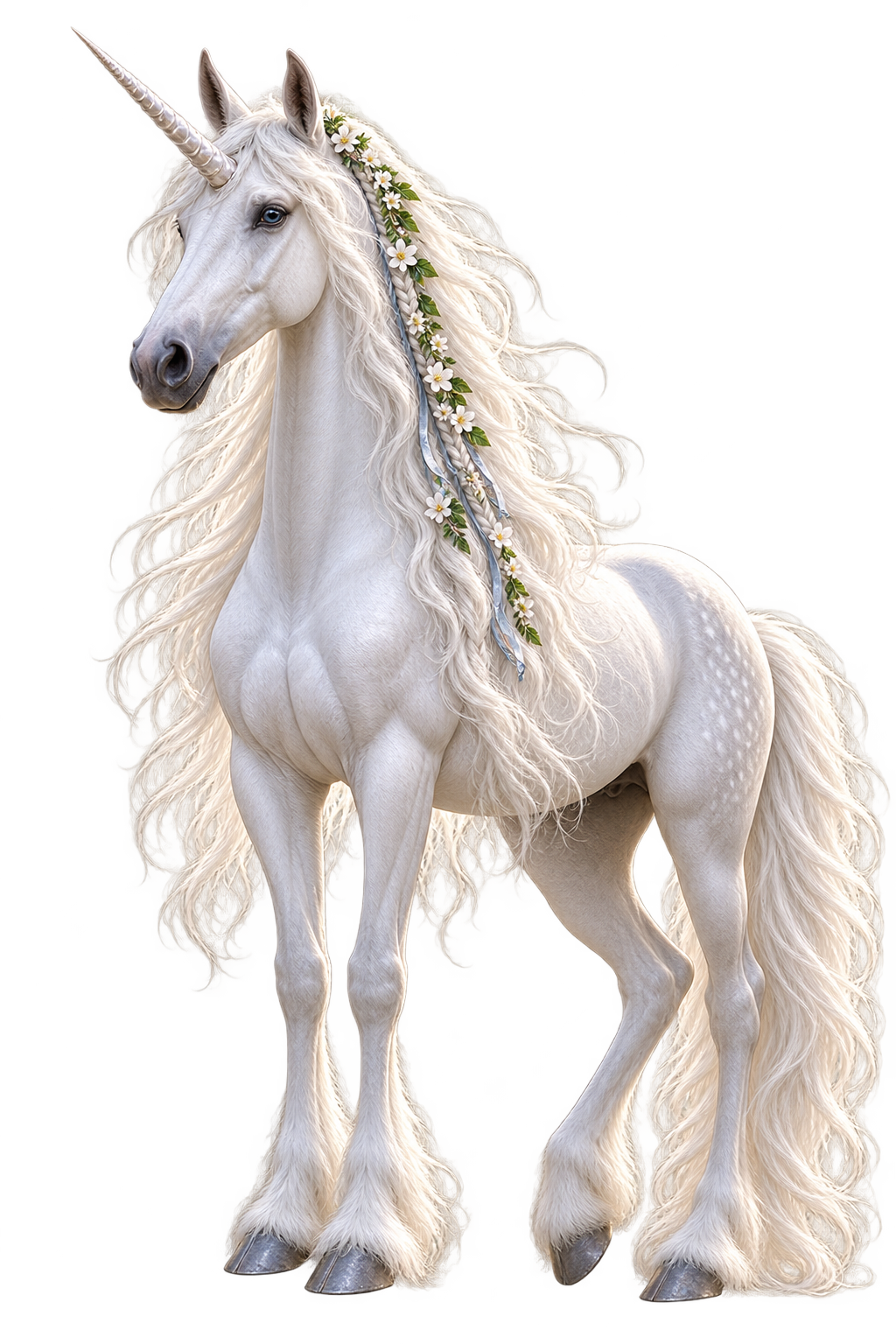
Aelheryn
Dîmeril took once more to the forest, travelling increasingly far into the ancient interior of the Veyrwood. It was during this unhappy and solitary period of her life that she encountered Aelheryn. Aelheryn was a female unicorn. Why she chose Dîmeril was never entirely clear. Perhaps she sensed the unhappiness beneath the Half-Elf's increasingly hardened exterior. Perhaps she recognised something in Dîmeril's character which Dîmeril herself could not yet see. Perhaps the old stories of Fey blood in the Laeghartha family played some part. Or perhaps Aelheryn's reasons belonged entirely to Aelheryn. Dîmeril eventually stopped trying to understand them. What mattered was that Aelheryn chose her. Dîmeril accepted. The bond changed more than Dîmeril's choice of travelling companion. In accepting Aelheryn she entered the ancient tradition of the Unicorn Riders, adopting the chastity traditionally associated with women who formed such bonds. It was not a bargain made to obtain Aelheryn's friendship; the choice had already been made. Nor did Dîmeril regard chastity as evidence of greater virtue than any other way of life. It was simply part of the path upon which she now found herself.
Dîmeril had never previously imagined such a life for herself, but the commitment came surprisingly naturally. Whatever relationships might once have awaited her elsewhere, Aelheryn had chosen Dîmeril. Dîmeril chose Aelheryn in return. Their relationship quickly became one of the most important of Dîmeril's life. Aelheryn was never merely a mount. She was intelligent, wilful and perfectly capable of disagreeing with her rider. Dîmeril learned very quickly that travelling with a unicorn involved considerably more negotiation than owning a horse. The two nevertheless developed an extraordinary understanding. For the first time since leaving the Copper Crests, Dîmeril no longer felt entirely alone.
Beyond the Veyrwood
Together Dîmeril and Aelheryn travelled farther into the Veyrwood than Dîmeril had ever ventured before. Eventually they discovered one of the strange hidden paths which passed between worlds. Dîmeril could never afterwards say precisely how she found it. There was simply a point at which one path amongst the trees felt different from all the others, and an inexplicable certainty that following it would lead somewhere beyond the Veyrwood. Aelheryn showed no reluctance. So they followed it.
The forest changed around them. Without any obvious boundary, they passed beyond Goerath and into the Golden Woods of the Fey World, travelling through a realm where distance and direction obeyed rules Dîmeril did not entirely understand. Eventually another path carried them through the Veil again. They emerged into a world completely unknown to Dîmeril. It was Erdian, the world that the people of Warlderia would much later know simply as the Other Place.
Erdian was very different from the world Dîmeril had left behind. Humans lived there in considerable numbers, but across many lands they occupied a distinctly subordinate position beneath peoples who collectively regarded themselves as the Higher Races. Dîmeril's Half-Elven ancestry therefore placed her in an unusual position. She was not human, yet neither was she readily accepted amongst the ancient Elven societies she encountered. More importantly, she was a foreigner in the most literal sense. She came not merely from another kingdom or distant continent. She came from another world. Her achievements on Goerath meant nothing here. Nobody in Erdian had heard of the Korvaj Peninsula, the Battle of Low Harbour or the Copper Crests. Dîmeril might claim to have commanded cavalry in a distant war, but there was nobody who could confirm any of it. What she could demonstrate was considerably more persuasive. Dîmeril was an accomplished ranger, an exceptional horsewoman and an experienced soldier with a thorough understanding of scouting, reconnaissance and cavalry warfare. And she travelled beside Aelheryn. Whatever doubts might surround the foreign Half-Elf's stories, the fact that a unicorn had chosen her was considerably harder to dismiss. In time, her abilities attracted attention.
The Perpetuity of Ilyr Vael
Dîmeril eventually found herself amongst the lands of the Perpetuity of Ilyr Vael, an ancient High-Elven state which considered itself not so much a kingdom as an uninterrupted historical condition. Individual rulers mattered comparatively little. Offices, institutions, bloodlines and policies were expected to endure for millennia, their temporary occupants merely custodians of something vastly older than themselves. Dîmeril found the entire arrangement impressive, bewildering and occasionally ridiculous. At the time, the Perpetuity was engaged in what it regarded as a relatively minor border dispute with the human Picayune States. The conflict had become unexpectedly troublesome.
 Ilyr Vael had deployed the celebrated Argent Lances of Vael, an ancient regiment of High-Elven heavy cavalry commanded by Lord-Captain Caelir Vaeltharan, Hereditary Lance-Lord of the Seventh Radiance. The Argent Lances were magnificent. Their riders were drawn largely from the lesser nobility of the Perpetuity. They were superbly mounted, beautifully equipped, magnificently disciplined and drilled to standards which would have impressed almost any cavalry commander Dîmeril had ever known. They were also performing badly. Their principal opponents, the Picayune irregular horse, stubbornly refused to fight the war the Argent Lances wanted. The human riders employed ambushes, feigned retreats, broken terrain and constant harassment. When the Argent Lances concentrated, the Picayunes dispersed. When the Elves pursued, the humans drew them into difficult country before turning upon isolated detachments. The proud Vaelian regiment found itself repeatedly frustrated and occasionally humiliated by opponents it had initially regarded with contempt. Somewhere within the Vaelian command, somebody had the good sense to notice that the foreign Half-Elf travelling with a unicorn appeared to understand precisely what was going wrong.
Dîmeril was eventually retained as a mercenary officer and military adviser to Lord-Captain Vaeltharan. Only then did her old experience with the Copper Crests truly become relevant. The Vaelians neither knew nor cared about the reputation of a cavalry regiment from another world. What mattered were the lessons Dîmeril had learned while commanding it. Dîmeril quickly concluded that the Argent Lances were not poor soldiers. Their problem was that they were attempting to fight the war for which their traditions had prepared them rather than the war actually taking place around them. She encouraged smaller and more independent detachments, greater reliance upon scouts, better use of blocking forces and lighter equipment where circumstances demanded it. Above all, she persuaded the Vaelians to stop blindly pursuing an enemy whose apparent flight was frequently nothing more than another weapon. Dîmeril did not attempt to turn the Argent Lances into Picayune irregulars. Their discipline, horsemanship, equipment and formidable charge remained genuine advantages. Her task was to create circumstances in which those advantages could actually be brought to bear. Caelir Vaeltharan proved sufficiently intelligent to recognise the value of her experience. Despite resistance from some of his more traditional officers, he supported Dîmeril's reforms and gradually learned to adapt his own command to the realities of the campaign.
An Unwanted Courtship
Unfortunately, Caelir's growing professional admiration for Dîmeril eventually became something considerably more personal. He became enamoured of his Half-Elven adviser. Eventually he proposed that Dîmeril become his paramour. Dîmeril refused. Emphatically. Quite apart from whether she might otherwise have found Caelir attractive, Dîmeril's bond with Aelheryn had placed that particular question beyond consideration. Caelir nevertheless initially persisted with gifts and further attentions, apparently believing that Dîmeril's refusal represented the beginning of an elaborate courtship rather than its conclusion. Dîmeril eventually explained the situation with sufficient clarity that even a High-Elven aristocrat accustomed to several centuries of romantic convention could no longer misunderstand her. She did not wish to become his lover. She was not playing coy. There was no ritual obstacle he was expected to overcome. And another gift would not improve matters. To his credit, Caelir eventually understood his mistake. He apologised, ceased his pursuit and thereafter maintained a professional relationship with her. There was a certain irony in all this of which Dîmeril remained completely unaware. While a High-Elven lord in another world attempted rather grandly to win her affection, Sabine Thornmere was back on Goerath quietly trying to find her.
The End of the Picayune War
By the closing stages of the conflict, the Argent Lances were a very different regiment from the splendid but inexperienced force which had first ridden against the Picayunes. They had not abandoned their traditions. Nor had Dîmeril transformed them into light cavalry. Instead, hard experience had finally been added to their ancient discipline. The Picayune riders discovered that familiar tricks were increasingly anticipated, false retreats were no longer automatically pursued and Vaelian squadrons had developed an unpleasant habit of appearing where previously they never would have been. Eventually the Picayune States were brought to terms and the border war came to an end. Dîmeril's employment ended with considerably less ceremony. The Perpetuity of Ilyr Vael calculated what remained of her contract, added the appropriate campaign gratuity, formally thanked her for her services and considered its obligations discharged. Dîmeril was entirely content with the arrangement. After Gimdaruth, there was something rather refreshing about simply being paid what she had been promised. She collected her money, packed her belongings and departed Ilyr Vael without ceremony, accompanied by Aelheryn. There was, however, one resident of Ilyr Vael who found the strange foreign Half-Elf rather too interesting simply to allow her to disappear.
Solara Elenhi
Solara Elenhi was a High-Elven wizard of considerable talent, comfortably established within the ancient society of the Perpetuity and increasingly bored by it. Dîmeril fascinated her. Part of that fascination was undoubtedly Dîmeril's claim to come from another world. Part was Aelheryn. Part was simply that Dîmeril seemed to accumulate adventures, dangers and unlikely situations with a frequency Solara found enormously entertaining. Where most Vaelians regarded the foreign Half-Elf as an interesting temporary visitor, Solara wondered: Where is she going next? Eventually curiosity won. Solara followed her. There was no great declaration of loyalty. Solara was not swearing herself to Dîmeril's service and certainly did not regard herself as anybody's retainer. She simply decided that accompanying Dîmeril and Aelheryn for a while promised to be considerably more interesting than remaining in Ilyr Vael. Dîmeril assumed the High Elf would eventually tire of rough roads, uncomfortable camps and dangerous company and return home. Solara rather assumed the same. Neither proved correct. What began as curiosity became companionship, and companionship eventually became habit. Solara would remain one of Dîmeril's closest friends long after the brief border war which first brought them together had faded into memory. So Dîmeril left Erdian much as she had arrived: following one of the strange paths which wound through the Golden Woods between worlds.
Only now there were three travellers upon the path: Dîmeril, Aelheryn and Solara. And somewhere on Goerath, entirely unknown to Dîmeril, Sabine was still looking for her.
The Border Lord of Ardenfell
The paths through the Golden Woods did not return Dîmeril directly to the Veyrwood. Instead, Dîmeril, Aelheryn and Solara emerged into the Caledor Forest, far from the place where Dîmeril had originally disappeared from Goerath. For Dîmeril, returning to her own world after so long away was disorientating enough. What happened next was considerably more unexpected. Sabine found her. Sabine's search had taken her across much of Goerath. She had followed rumours, old acquaintances and stories of a Half-Elven ranger travelling with a unicorn, frequently arriving weeks or months after Dîmeril had already moved on. Eventually, in the Caledor Forest, the pursuit ended. Dîmeril was astonished to see her. Sabine was considerably less surprised. She had, after all, been looking. Their reunion settled something which neither woman had ever formally discussed. Whatever roads Dîmeril might follow in future, Sabine had no intention of being left behind merely because Dîmeril possessed an extraordinary talent for disappearing into other worlds. Dîmeril, for her part, discovered that she was rather pleased by this. Soon afterwards they befriended Luin, a Wood Elf of the Caledor Forest who would become one of Dîmeril's longest-standing companions and closest friends. The four spent a happy winter together in the forest. For perhaps the first time since leaving the Copper Crests, Dîmeril had something resembling a settled circle of companions around her: Aelheryn, Sabine, Solara and Luin. It did not last. With Dîmeril, it rarely did.
Ardenfell
Their travels eventually brought them to Ardenfell, a troubled frontier territory where settled lands pressed against wilderness inhabited by monsters, raiders and considerably older dangers. The region was difficult to defend. Small settlements were scattered across a broad area, roads were poor and heavily wooded country allowed raiders to approach almost unseen. Local forces could defend walls and villages reasonably well once warned, but they struggled to discover threats early enough to prevent isolated farms and travellers from being attacked. It was precisely the sort of problem Dîmeril understood. She had spent her youth ranging through the Veyrwood, her adventuring years travelling wild country and her military career learning the value of reconnaissance, mobility and knowing where the enemy was before they arrived. Dîmeril initially became involved simply because people needed help. As usual, temporary involvement proved rather less temporary than intended. She organised patrols, established watch points, improved communications between isolated settlements and encouraged local riders to think of themselves not as miniature heavy cavalry but as mounted scouts. Her methods worked. Eventually Dîmeril was offered formal responsibility for the defence of the region and accepted the title of a Border Lord. There was a certain irony in this. Gimdaruth had once deliberately denied Dîmeril the land and title her service deserved. Years later, somewhere else entirely, people who had never heard of Gimdaruth gave her both because they wanted her to stay. Dîmeril appreciated the irony. Sabine appreciated it considerably more.
The Hobilars of Ardenfell
The mounted force Dîmeril developed at Ardenfell became known as the Hobilars. They were not glamorous cavalry. That was deliberate. The Hobilars rode sturdy horses, carried practical equipment and were expected to spend considerably more time watching, scouting and carrying messages than charging dramatically across battlefields. Dîmeril drew heavily upon everything she had learned from the Copper Crests. The Hobilars patrolled the frontier, escorted travellers, investigated reports of monsters or raiders and maintained contact between the scattered communities under Dîmeril's protection. When fighting was necessary, they concentrated quickly. When it was not, they avoided it. Dîmeril's philosophy remained much as it had been during the Korvaj campaign: A cavalryman's first duty was to arrive where he was needed. His second was to understand what was happening when he got there. Actually fighting the enemy came somewhere after that. The system was effective. For a time, Ardenfell prospered. Dîmeril acquired a reputation very different from the one she had possessed as Captain of the Copper Crests. She was no longer simply an officer commanding soldiers. People brought her disputes.
Farmers complained about boundaries. Merchants wanted safer roads. Villagers demanded patrols. Local dignitaries expected meetings. Somebody was forever unhappy about taxes, grazing rights, timber, bridges or whose responsibility it was to repair something. Dîmeril discovered that governing people was considerably more complicated than defending them. She nevertheless proved surprisingly good at it. Not because she enjoyed administration, she did not , but because she listened. The Border Lord became a familiar figure throughout Ardenfell, often travelling with Aelheryn rather than remaining behind a desk. The arrangement might have lasted for years. Then came Pyraxxion.
 The Red Dragon
Pyraxxion was an old and powerful red dragon whose territory lay beyond the settled frontier. Dîmeril knew of the dragon. Everyone did. For years, however, Pyraxxion had shown comparatively little interest in Ardenfell. Dragons measure time differently from mortals, and whatever concerns occupied him appeared to lie elsewhere. That changed. Attacks began upon the outer settlements. Livestock disappeared. Buildings burned. Travellers vanished. Eventually there could be no doubt that Pyraxxion had begun deliberately testing the defences of Ardenfell. Dîmeril responded cautiously. A red dragon was not an Orc raiding party which could be intercepted by a troop of Hobilars. Concentrating men against Pyraxxion merely presented him with a more attractive target. Instead she strengthened warning systems, prepared places of refuge and sought information. Then Dîmeril learned of an old complex of ruins believed to contain something connected with the dragon's activities. She assembled a small party and went to investigate. Aelheryn did not accompany her into the ruins. The passages were too confined for the unicorn, and there appeared little reason to expose her unnecessarily to whatever waited below. Dîmeril left Aelheryn outside. It was a decision she would remember for the rest of her life.
The Death of Aelheryn
While Dîmeril and her companions were underground, Pyraxxion came to Ardenfell. Whether the dragon knew Dîmeril was absent, whether he had followed her movements, or whether the timing was simply appalling fortune was never established. Aelheryn encountered him. Precisely what happened is unknown. There were no surviving witnesses close enough to describe the confrontation. What was clear afterwards was that Aelheryn had not fled. Perhaps she attempted to draw Pyraxxion away from nearby people. Perhaps the dragon attacked her simply because she was a unicorn. Perhaps Aelheryn understood that if Pyraxxion was interested in Dîmeril, then she herself stood between the dragon and the woman she had chosen so many years before. Whatever her reasons, Aelheryn fought. Against an old red dragon, courage was not enough. When Dîmeril emerged from the ruins, Aelheryn was dead. There are losses which change a person because they are unexpected. Others change them because they destroy something which had become so much a part of life that its absence seems impossible. For Dîmeril, Aelheryn was both. The unicorn had found her when Dîmeril was lonely, angry and uncertain where she belonged. She had chosen Dîmeril without asking for rank, reputation, land or achievement. Through strange worlds, wars and years of wandering, Aelheryn had remained beside her. Dîmeril had once chosen Aelheryn in return. Now she was gone. Those closest to Dîmeril expected grief. They got it. What frightened them more was what came afterwards. Dîmeril became very calm.
The Hunt for Pyraxxion
Dîmeril did not immediately ride after the dragon. The old cavalry officer in her understood perfectly well what blind pursuit achieved. She waited. She gathered information. She studied everything known about Pyraxxion's movements, habits and lair. Scouts watched the skies. Rangers traced his hunting grounds. Old stories were collected and compared. Dîmeril sought magical assistance and prepared weapons specifically intended to harm a creature of his kind. Sabine recognised the behaviour. Dîmeril was planning a campaign. Only this time there would be no regiment. Eventually Dîmeril learned enough. She went after Pyraxxion. The confrontation which followed became one of the most famous episodes of Dîmeril's life, although she herself has always disliked the way later storytellers turned it into a heroic tale of vengeance. There was nothing glorious about it to her. Pyraxxion was stronger than Dîmeril. He was older than Dîmeril. In open battle, with every advantage available to him, he could probably have killed her. So Dîmeril did not give him such a battle. She tracked him, chose the ground, prepared carefully and attacked when the circumstances favoured her. It was not a knight challenging a dragon beneath an open sky. It was a ranger hunting something more dangerous than herself. And Dîmeril was very, very good at hunting. The battle was brutal. Dîmeril was badly wounded. But Pyraxxion died. There was no triumph afterwards. No great declaration. No satisfaction sufficient to compensate for what had been lost. Aelheryn remained dead. Dîmeril returned to Ardenfell carrying the knowledge that she had avenged her friend and discovered, as many people do, that vengeance and healing are not the same thing.
Leaving Ardenfell
Dîmeril remained Border Lord for a time after Pyraxxion's death. She fulfilled her responsibilities, maintained the Hobilars and continued protecting the settlements entrusted to her. But something had changed. Ardenfell had become inseparable from Aelheryn's death. More importantly, Dîmeril had begun to understand something about herself. She could command soldiers. She could administer land. She could hold a title and perform its duties competently. None of those things meant that she wanted to spend the rest of her life doing so. The title Border Lord had once seemed like an unexpected opportunity to build something permanent. After Aelheryn, permanence felt rather less certain. Eventually Dîmeril relinquished Ardenfell and returned to the road. She did not leave because the experiment had failed. In many respects, it had succeeded. The Hobilars remained. The settlements were stronger than when she had arrived. People who had once waited helplessly for raiders now possessed patrols, warning systems and defenders of their own. Ardenfell no longer needed Dîmeril in quite the way it once had. And Dîmeril had never been particularly good at remaining somewhere simply because people had given her a title. So she left. Sabine went with her. So did Solara. And Luin. But for the first time in many years, when Dîmeril looked beside her upon the road, there was an empty place where Aelheryn should have been.
 Glovanna of Foxglove Glade
It was during Dîmeril's midnight watch that she heard a woman crying. The sound was faint, coming from somewhere amongst the trees beyond the ruined keep: frightened sobs interspersed with confused cries. Dîmeril woke Luin. He could hear nothing. Leaving him to watch over the sleeping camp, Dîmeril followed the sound alone. Some distance from the keep she came upon a small glade filled with foxgloves. At its centre stood an enormous and venerable oak. Clinging desperately to its trunk was what appeared at first glance to be a naked young woman. Her skin possessed the faintest shade of living green. Long pink-purple hair fell untidily around her shoulders,
The woman was Glovanna of Foxglove Glade. She was a dryad. And she had been born that night. Under the light of the spring full moon, something within the ancient oak had awakened. For perhaps centuries the spirit which would become Glovanna had existed within the living tree without separate thought or identity. Now she had stepped from its bark and discovered herself suddenly possessed of a body, senses and a mind of her own. Glovanna knew what she was. She knew the tree was part of her, yet somehow separate from her. She knew the glade, the flowers and the creatures moving through the surrounding woodland. What she did not yet understand was being Glovanna. More surprising still was Dîmeril. The newly awakened dryad had instinctively concealed herself and her glade from outsiders. Yet Dîmeril had heard her cries when Luin could not. She had followed them. And somehow she had simply walked through Glovanna's concealments and found her. Neither of them understood why. For Dîmeril, explanations could wait. There was a frightened young woman clinging naked to a tree. She removed her cloak and wrapped it around Glovanna. Then she sat beside the ancient oak and talked to her.
They remained there alone until morning. There was no battle to fight and no mystery to solve. Dîmeril simply stayed. She explained what she could of the world beyond the glade while Glovanna asked questions with the strange mixture of instinctive knowledge and complete innocence possessed by something which had, in one sense, existed for centuries and, in another, had been a person for only a few hours. Gradually Glovanna's fear subsided. As the first light appeared amongst the trees, she embraced Dîmeril. Then, quite simply, she kissed her. Dîmeril was rather surprised. Glovanna smiled. She stepped backwards against the enormous trunk and disappeared into the living wood. When Dîmeril eventually returned to the ruined keep, several fresh foxglove blossoms were tucked into the fastening of her cloak. Luin naturally wanted to know where she had been all night. Dîmeril told him that she had made another new friend. At the time, she believed that was all that had happened.
Mistress Ysabet Vale
Dîmeril returned to the ruined keep expecting nothing more remarkable than breakfast. Instead, she discovered that they had apparently acquired a hostess. A woman had arrived during the morning and introduced herself as Mistress Ysabet Vale, claiming the old keep as her home. This was surprising. The companions had found no sign of permanent occupation when they first explored the ruins. Ysabet nevertheless behaved as though there were nothing remotely unusual about discovering a group of armed strangers camping in her courtyard. She welcomed them. More surprisingly, she seemed genuinely pleased to have company. Ysabet was charming, intelligent and remarkably easy to like. She laughed readily, remembered names after hearing them only once and possessed an uncanny ability to discover precisely what would make each of her unexpected guests comfortable. Food appeared. A fire was lit. The horses were accommodated. When rain began falling outside, remaining at the keep for another night suddenly seemed an extremely sensible idea. Ysabet proved an excellent conversationalist.
For Luin, she produced an old Elven drinking cup which she claimed to have discovered amongst the ruins. For Lusara, she mentioned an injured deer she had been feeding nearby. For Maeriel, she casually described tracks she had noticed beside the eastern wall. Sabine simply found her entertaining. Nothing about the woman seemed threatening. That was the problem.
The longer they remained at the keep, the less urgent everything seemed. There were peculiarities. Dîmeril noticed tracks which did not entirely make sense, but decided they could wait until morning. Luin remarked upon the unnatural silence of the birds, then wondered whether he was simply becoming suspicious of everything in the Fey World. Even Lusara, ordinarily difficult to distract from something which troubled her, found herself unusually content simply to sit beside the fire and talk. None of them felt enchanted. They merely felt safe. Concerns slipped gently from the mind before they could properly form. Questions which should have been asked could always be asked later. Weapons were set aside. Cloaks were removed. Food was eaten. Conversation became easier. By evening the companions were sitting together in the old courtyard with Ysabet as though they had known her for years. Dîmeril's sword belt lay several feet away. She noticed this. It did not seem important.
 Glovanna Comes to Merilrond
Five hundred yards away, in Foxglove Glade, Glovanna knew that something was wrong. She could not have explained how. Perhaps she sensed the unnatural stillness spreading through the surrounding woodland. Perhaps the strange magic around the ruined keep disturbed something which the newly awakened dryad understood instinctively. Or perhaps it was simply that Dîmeril had returned to the ruins and had not come back. Glovanna called to her. There was no answer. Eventually the young dryad did something extraordinary. She left her oak. Glovanna had been awake for only a short time. Her bond to her Heart Tree was still overwhelming, and she had scarcely ventured beyond the immediate surroundings of Foxglove Glade. The ruined keep was approximately five hundred yards away. Every step towards it took her farther from the living thing upon which her existence depended. At first the separation was merely uncomfortable. Then it hurt. Glovanna continued. Her strength began to fail. Still she continued. By the time she reached the ruined keep, the dryad was pale, trembling and struggling simply to remain manifested. Then she found Dîmeril.
Dîmeril was sitting peacefully beside Ysabet. She smiled when she saw Glovanna. That frightened the dryad more than anything else. The woman who had found Glovanna naked and terrified beneath her oak would normally have taken one look at her and immediately demanded to know why she had travelled so far from her tree. Instead Dîmeril merely seemed pleased to see her. “Glovanna. Come and sit with us.” Glovanna tried to warn her. Dîmeril gently dismissed her fears. Everything was fine. Glovanna stared at her. Then, with the straightforward logic of a creature who had been a person for only a very short time, she did the one thing she knew had previously produced a strong reaction from this strange Half-Elven woman. Glovanna grabbed Dîmeril and kissed her.
Dîmeril's eyes widened. For a heartbeat nothing changed. Ysabet was still smiling. The fire was still warm. The food still smelled delicious. Then Dîmeril smelled decay beneath the cooking herbs. She heard something scratching beneath the floor. She saw the unnatural stillness of the courtyard. And she realised that her sword was lying several feet beyond her reach. Dîmeril looked back at Glovanna. The dryad could barely stand. The enchantment shattered. “How far are you from your tree?” Glovanna managed an answer. “Too far.” Dîmeril moved.
Ysabet knew immediately that she had lost her. The pleasant hostess vanished with remarkable speed, fleeing through the ruined keep and down a stairway leading beneath its oldest surviving structure. The others were beginning to shake off the enchantment as Dîmeril recovered her weapons. There was no time for explanations. Glovanna needed to return to her oak. But something was beneath the keep. Something Ysabet desperately did not want them to find. And Dîmeril Laeghartha had just discovered that the woman who had fed them, entertained them and persuaded an entire company of experienced adventurers to put aside their weapons was not a woman at all. Mistress Ysabet Vale was a green hag. The companions followed her underground. What they discovered beneath the ruined keep would explain what had happened to many of Ysabet's previous guests. It would also introduce Dîmeril to someone who was going to prove considerably harder to get rid of.
Énglantine
 With Ysabet's enchantment broken, the companions pursued the green hag beneath the ruined keep. The pleasant appearance of the place did not survive closer inspection. Beneath the oldest part of the ruins lay cellars and passages which Ysabet had used for years. Here were the remains of travellers who had accepted the hospitality of the charming woman who supposedly lived alone in the forest. Then, from behind a heavy door, Dîmeril heard someone swearing. She recognised the language. Opening the chamber revealed a small cage constructed from cold iron and reinforced with magical wards. Inside was a pixie. She was filthy, painfully thin and obviously exhausted. Her copper-red hair was matted, her translucent wings badly damaged and the cold iron had left her terribly weak. She was also absolutely furious. The pixie did not ask who Dîmeril was. She did not beg to be rescued. Instead, she dragged herself upright, pointed towards the passage down which Ysabet had fled and croaked: “Kill that bitch.” It was Dîmeril's introduction to Énglantine.
Énglantine had been imprisoned beneath the keep for months. She had not stumbled innocently into Ysabet's trap. Travellers had been disappearing in the surrounding woods and Énglantine, deciding that somebody ought to discover why, had investigated the apparently abandoned keep herself. Using her natural invisibility, she discovered the truth. Mistress Ysabet Vale was a green hag who had occupied the ruins for years, using enchantment and deception to lure travellers into her power. Énglantine attempted to expose her. Ysabet caught her. The hag could easily have killed the pixie, but believed that a living Fey creature might eventually prove useful in her magical workings. Instead she constructed a cage specifically designed to hold her. Cold iron caused Énglantine continual pain, while magical wards prevented her using her innate abilities to escape. Ysabet deliberately kept food beyond her reach and provided only enough to keep her prisoner alive. Énglantine repeatedly attempted to escape anyway. Her wings bore the evidence. Months of imprisonment had reduced her almost to starvation. They had not made her cooperative.
Dîmeril left the cage where it was. There would be time to deal with it afterwards. First there was a hag to find. The companions followed Ysabet deeper beneath the keep, through cellars and passages which the green hag knew considerably better than they did. Without the enchantments which had disguised both herself and her lair, Mistress Vale was considerably less charming. She was also considerably less interested in fighting. Ysabet had survived for years by deception, patience and knowing when circumstances had turned against her. Glovanna had broken her hold over Dîmeril, her true nature had been exposed and she now faced an experienced group of armed adventurers within her own compromised lair. The hag fled. Dîmeril pursued her through the passages beneath the keep, but Ysabet had prepared for precisely such an eventuality. Somewhere amongst the oldest foundations was a concealed way out, known only to the hag. By the time Dîmeril discovered it, Mistress Ysabet Vale was gone.
They searched the surrounding woods. There was no sign of her. For a time Dîmeril expected the hag to return. Days became weeks, however, and eventually it appeared that Ysabet had abandoned the old keep entirely. In truth, she had fled much farther. Ysabet eventually found refuge in the Silver Woods of Puevon, a strange and diminished woodland where her nature attracted considerably less attention than it had amongst the inhabitants of the Golden Woods. There she disappeared. Dîmeril would not see Mistress Ysabet Vale again for many years. But Ysabet did not forget her.
Only then did Dîmeril return to the prisoner in the cold-iron cage. Opening Énglantine's cage was not straightforward. The cold iron and magical wards had been deliberately constructed to contain a Fey creature, and Énglantine herself was far too weak to be of much assistance. Eventually the cage was opened. Énglantine emerged after months behind its bars. She attempted to fly. Her damaged wings could not support her. Dîmeril caught her. Énglantine objected to this indignity with considerably more strength than she had displayed attempting to stand. Dîmeril ignored her. For the moment, the pixie was going nowhere. She needed food, warmth, rest and time for her wings to heal. Dîmeril and the others gave her all four.
Énglantine initially remained with the companions because she believed herself indebted to them. Dîmeril told her that no debt existed. Énglantine disagreed. As the days passed and her strength returned, however, obligation became increasingly irrelevant. Énglantine found Dîmeril fascinating. The Half-Elf had somehow heard the cries of a newly awakened dryad when nobody else could. She had walked through Glovanna's instinctive concealment without apparently realising she had done anything unusual. She could perceive things hidden from ordinary mortals and find paths through the Veil which even some Fey could not see. There was also a considerably simpler reason. Travelling with Dîmeril appeared likely to be interesting. Eventually Énglantine was strong enough to leave. She intended to do so. She never quite got around to it. Over time the tiny pixie became Dîmeril's scout, adviser and companion. Her flight, invisibility and natural curiosity made her exceptionally useful when travelling through dangerous country. She also became fiercely loyal to Dîmeril. She did not, however, become Dîmeril's follower. The distinction would remain important to Énglantine for many years. Much later, when somebody described her as one of the followers of the famous Ranger Lord, Énglantine looked genuinely puzzled. “I don't follow Dîmeril.” She pointed towards her. “We travel together.” Dîmeril had long since learned not to argue the distinction.
 The Woodland Folk
With Mistress Ysabet Vale driven from the ruined keep and Énglantine slowly recovering from her imprisonment, Dîmeril expected life in the Golden Woods to become quieter. For a little while, it did. The companions cleaned several chambers, repaired what they could and made the old keep reasonably comfortable. Nobody regarded the work as permanent. The ruins were simply a convenient refuge while they decided what to do next. Then visitors began to arrive. At first they came cautiously. A pair of sprites watched the keep from the trees for several days before revealing themselves. A family of woodland folk appeared carrying baskets of mushrooms and berries. Satyrs wandered close enough to investigate the newcomers and subsequently denied having done anything of the sort. Others simply appeared. Some had heard that the green hag was gone. Others had heard about the strange Half-Elf who had somehow found a newly awakened dryad hidden within her glade. Énglantine's rescue had also become known. Stories travelled quickly amongst the Fey. Accuracy travelled somewhat more slowly. Dîmeril discovered that she had apparently defeated Ysabet in single combat, broken an ancient curse upon the forest and rescued forty-seven imprisoned pixies. Énglantine particularly enjoyed the last version. Dîmeril did not.
The visitors began bringing things. Usually they were small. Fresh bread. Berries. Honey. Bundles of herbs. A beautifully carved wooden bowl. Someone left a brace of rabbits outside the gate without identifying themselves. Dîmeril initially regarded these as simple gestures of thanks and accepted them in the spirit in which she believed they had been offered. Énglantine was less certain. She understood something Dîmeril did not yet fully appreciate. Amongst the peoples of the Fey World, gifts could create obligations.
So could hospitality. So could protection. Nobody had formally asked Dîmeril to rule anything. Nobody had sworn allegiance. No boundary stones had been erected and no proclamation had been made. But people had begun bringing gifts to the keep. And when something frightened them, increasingly they came looking for Dîmeril.
The first problems were small. Livestock disappeared from an isolated holding. Something unpleasant established itself beside a woodland path. Travellers reported being followed through one part of the forest. A group of Fey complained about a creature which had occupied a spring they traditionally used. Dîmeril helped when she could. She did not regard this as government. She was a Ranger. Dangerous creatures were threatening people. Someone should probably deal with them. Frequently, that someone turned out to be Dîmeril. Sometimes Sabine accompanied her. Sometimes Luin. Énglantine increasingly travelled ahead as a scout, disappearing from sight before returning invisibly to hover beside Dîmeril and whisper whatever she had discovered into her ear. Dîmeril found this extremely useful. People watching her apparently receive military intelligence from empty air found it somewhat unnerving. Slowly, the country surrounding the keep became safer.
The change was gradual enough that Dîmeril barely noticed it. People who had avoided particular paths began using them again. Families returned to abandoned homes. Woodland creatures ventured into places from which they had previously been driven. Travellers discovered that the old keep was now somewhere they could approach for help rather than somewhere sensible people avoided. The gifts continued. So did the requests. Dîmeril continued insisting that she was simply helping her neighbours. The woodland folk increasingly regarded her as their protector. Énglantine understood both positions. She also understood that, in the Fey World, authority did not necessarily begin with a crown, a charter or somebody standing upon a balcony making a proclamation. Sometimes it began because people brought you gifts. Then they asked for your help. Then you helped them. Then they came back. Dîmeril had encountered this process before in Ardenfell, although there it had been accompanied by Human titles, soldiers, taxation and administration. Here nobody seemed particularly interested in any of those things. That did not mean nothing was happening.
The Old Keep
Meanwhile, the ruined keep itself was changing. At first the companions repaired only what they needed. A roof was made watertight. A chimney was cleared. Doors were rehung. One habitable room became several. The courtyard was cleared of accumulated rubbish and the remains of Ysabet's occupation were removed. Énglantine took particular pleasure in this. She remembered the keep as a place of imprisonment. She remembered its cellars, the cold-iron cage and the remains of those who had not survived Ysabet's hospitality. Watching the old hag's lair become somewhere people could approach without fear mattered to her more than she generally admitted. Others began helping. Some brought timber. Others brought tools or food for those doing the work. Craftsmen appeared who Dîmeril did not remember inviting. One visitor repaired part of a wall in return for several nights' shelter. Another stayed considerably longer than originally intended. The distinction between guest, companion and resident gradually became rather difficult to determine. Dîmeril continued referring to the place as the old keep. Increasingly, nobody else did.
Roses already grew amongst the ruins. They had survived years of neglect, climbing across broken walls and spreading through the abandoned courtyard. As the keep was repaired, nobody removed them. Instead they were encouraged. Cut back where necessary, supported where they climbed and allowed to spread across the restored stonework, the roses gradually became one of the most distinctive features of the place. In time the old keep acquired a name. In the Elven tongue it became Merilrond. To Humans and others who preferred a translation, it was simply: The Hall of Roses. Dîmeril did not name it after herself. She did not declare herself its ruler. She did not announce the creation of a new realm. Indeed, had anybody suggested that this was what she was doing, she would probably have denied it. But the abandoned keep was no longer abandoned. People lived there. Others came there for shelter. The surrounding woodland was becoming safer because Dîmeril and her companions protected it. And an increasing number of the inhabitants of the Golden Woods had begun to regard Merilrond as the place to go when they needed help.
Énglantine saw what was happening before Dîmeril did. Gifts created obligations. Protection created loyalty. Hospitality created bonds. And repeated acts, in the Fey World, could become customs remarkably quickly. Something resembling a small domain was forming around Merilrond. Dîmeril repeatedly denied being its ruler. Énglantine believed her completely. She also knew that this would not necessarily matter to the Fey Courts. For the moment, however, nobody came demanding fealty or offering Dîmeril another title. There were roofs to repair. Paths to clear. People to protect. And somewhere amongst all of that, without any particular moment at which Dîmeril could point and say this is when it happened, the temporary refuge she intended to leave became home. The woman who had entered the Fey World determined never again to acquire a territory had acquired one anyway. This time, nobody had given it to her. It had grown around her.
The Making of the Golden Woods
Old Nan Crookbone was not the only danger remaining within the Golden Woods. As word spread that there was now somewhere people could go when something threatened them, Dîmeril began hearing about places which had simply been avoided for years. Some of these stories proved to be nothing more than stories. Others did not. Dîmeril was careful not to confuse dangerous with evil. The Golden Woods were wild, and she had no intention of making them tame. Wolves hunted. Fey guarded their territories. Strange creatures inhabited ancient places and did not necessarily appreciate visitors. Dîmeril understood all of this. A creature was not an enemy merely because Humans or Elves found it frightening. What concerned her were those things which had learned to prey deliberately upon the weaker inhabitants of the woods. There were creatures occupying paths which had once been safe. Predators had driven families from isolated homes and Fey from their glades. Some woodland folk had simply adapted by learning where not to go. Dîmeril had a different response. She went there.
 One of the most troublesome creatures was a redcap which had established itself in the deeper woods. The creature delighted in violence and fear, attacking isolated travellers and terrorising weaker Fey. Several paths had effectively been abandoned because nobody wished to risk encountering it. Dîmeril hunted it. The redcap proved considerably more difficult to catch than Old Nan Crookbone. It understood the hidden paths of the Fey World and had survived precisely because it knew when to disappear. Whenever Dîmeril seemed close to finding it, the creature vanished deeper into the woods. This was where Énglantine proved invaluable. Invisible and capable of travelling through country which would have betrayed the approach of a larger creature, the pixie eventually discovered where the redcap was hiding. Dîmeril went after it. This time it did not escape. The redcap died in the Golden Woods.
Other encounters ended differently. Dîmeril occasionally investigated some terrible creature only to discover that the situation was considerably more complicated than she had been told. An angry woodland spirit might have an excellent reason for being angry. A creature accused of attacking travellers might actually be defending its nesting ground. Fey disputes could have been continuing for so long that nobody involved remembered precisely how they had begun. Dîmeril increasingly found herself settling such problems rather than fighting them. She was not always successful. Sabine maintained that there were occasions when diplomacy consisted principally of discovering which person actually deserved to be hit. Dîmeril never formally endorsed this doctrine. She nevertheless occasionally applied it.
The changes came slowly. There was no campaign in the military sense. Dîmeril did not lead troops systematically across the Golden Woods clearing one district after another. Instead, problems were dealt with as they became known. A dangerous stretch of road became safe. A family returned to an abandoned holding. A spring could once again be approached without fear. Woodcutters returned to parts of the forest they had avoided. Travellers began using paths which had fallen almost completely out of use. Sometimes Dîmeril was responsible. Sometimes Sabine, Luin, Énglantine or one of the growing number of people associated with Merilrond dealt with the matter. Increasingly, the woodland folk themselves began cooperating. That was perhaps the most important change of all. Before Merilrond, an isolated household threatened by something dangerous might simply have fled. Now somebody knew somebody who knew somebody who could reach the Hall of Roses. And help might come.
Merilrond consequently acquired something resembling a fighting company without Dîmeril ever creating one. They were not soldiers. There were no uniforms, formal enlistments or regular patrols. They were Rangers, Fey, hunters, woodland folk and adventurers who could be called upon when something genuinely dangerous threatened the surrounding country. Some accompanied Dîmeril once. Others returned repeatedly. A few became permanent companions. Dîmeril had commanded professional soldiers before and made no attempt to pretend that this loose collection of friends and volunteers was another regiment. In some respects, she preferred it. Nobody was there because they had been ordered to follow her.
Dîmeril's reputation spread. As usual, the stories improved considerably in the telling. The Half-Elf who had driven Mistress Ysabet Vale from her keep became the warrior who had defeated an ancient hag. The Ranger who killed Old Nan Crookbone became the hunter who had destroyed an entire coven. The redcap became progressively larger, more dangerous and more numerous each time Énglantine heard the story repeated. Dîmeril attempted to correct these accounts. Énglantine advised her that correcting stories told by Fey was an activity with no realistic prospect of success. Sabine agreed. Dîmeril continued trying anyway.
The Golden Woods Become Safe
There was no final battle. No enemy army surrendered. No flag was raised above a captured fortress. There was not even a particular day upon which Dîmeril could have looked around and declared the work finished. Instead, one year was simply better than the year before. Fewer people disappeared. More paths remained open. Homes which had stood empty were occupied again. Children could wander farther from their settlements without their parents immediately fearing what might find them. The woodland folk still respected the dangerous places. The Golden Woods remained wild. They simply ceased to be a place where the cruelest creature in a particular stretch of forest automatically became its master. Dîmeril had not conquered the Golden Woods. She had no desire to. She had done something rather more important. She had helped make them somewhere people could live without being afraid. And the people of the Golden Woods remembered who had done it.
The Challenge of the Violet Hart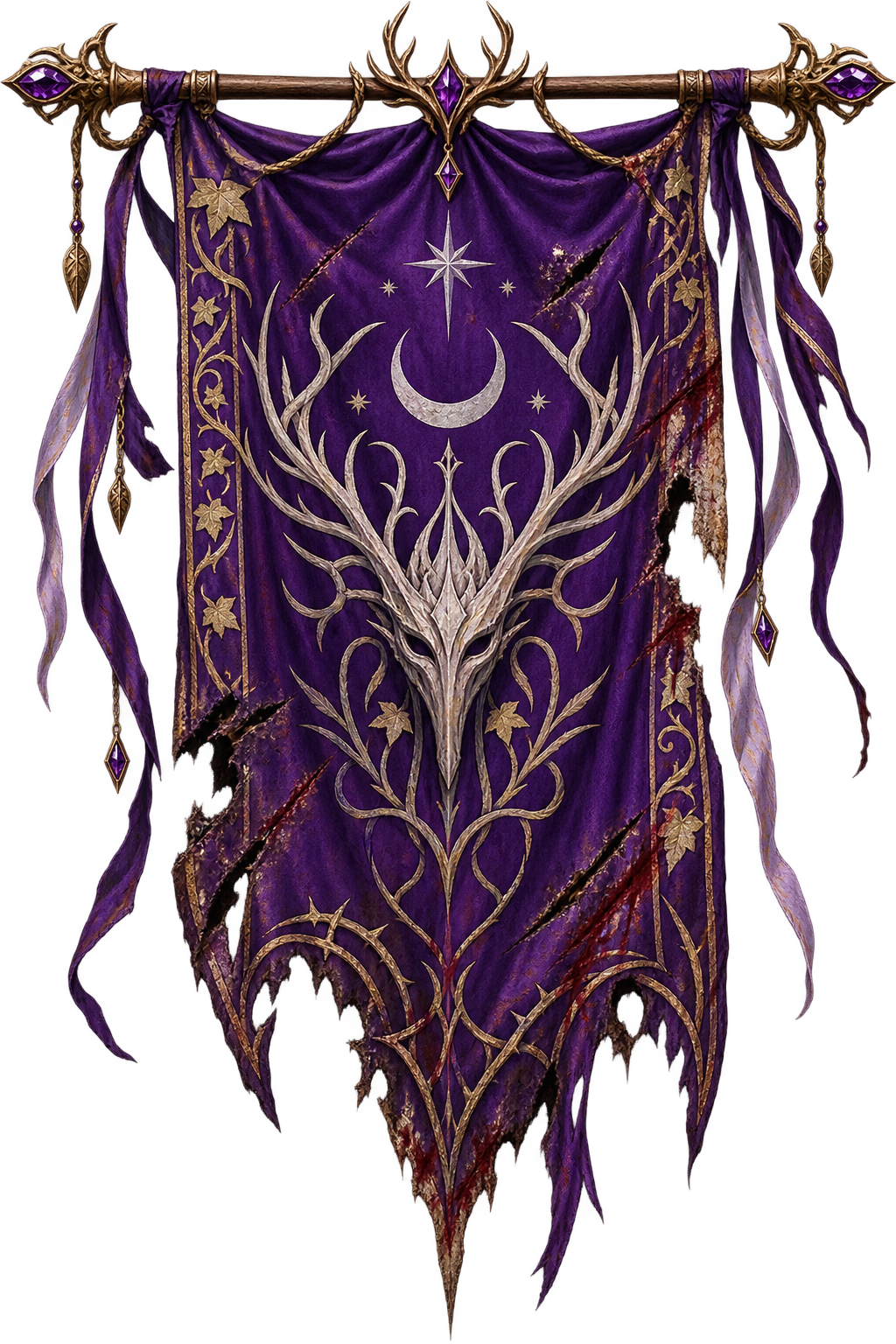
The growing peace of the Golden Woods did not please everyone. Some distance from Merilrond lay the domain of Lord Vaeroth Amaranthine, Lord of the Violet Hart, a Sidhe noble of old blood who was thoroughly accustomed to the lesser inhabitants of the Fey World recognising the authority of their betters. Vaeroth had initially regarded the Half-Elven adventurer living in an abandoned keep as beneath his notice. That became increasingly difficult. Woodland folk who might once have sought the favour or protection of established Fey nobility were travelling instead to Merilrond. They brought gifts to Dîmeril, asked her to settle disputes and sought her help when something threatened them. More irritatingly, Dîmeril appeared to be succeeding. Paths were safer. Predators had been driven away. The Hall of Roses was growing. People were moving towards Dîmeril without being commanded to do so. From Vaeroth's perspective, this was not neighbourly cooperation. It was the emergence of a rival power. The fact that Dîmeril repeatedly insisted she had no interest in becoming one did little to reassure him.
Lord Vaeroth eventually came to Merilrond to remind its inhabitants of what he regarded as the proper order of things. He expected deference. Dîmeril was polite. This was not the same thing. Vaeroth questioned by what right she exercised authority within the Golden Woods. Dîmeril replied that she exercised no authority over anyone who did not wish to listen to her. Vaeroth pointed out that the woodland folk brought her gifts. Dîmeril agreed. They also brought her apples. She was uncertain what conclusion he wished her to draw from this. Vaeroth was not amused. The discussion deteriorated. Dîmeril had encountered enough nobles during her life to recognise when somebody was less interested in obtaining an answer than in receiving submission. She had no intention of providing it. Vaeroth left Merilrond angry. Énglantine watched him go. She suggested that he would return. Dîmeril hoped he would have the sense not to. Sadly he did not have that or any degree of unpampered common sense and thus returned.
Vaeroth returned with armed retainers. Amongst them rode Caelwen Briarstep, one of the household knights of the Violet Hart. Caelwen had no personal quarrel with Dîmeril. That was irrelevant. He had sworn himself to Vaeroth's service, and when his lord called his household to arms, Caelwen answered. They rode beneath a magnificent violet banner bearing the Silver Hart beneath the Crescent Moon. Vaeroth expected the display of force to settle matters. Perhaps he believed the woodland folk would scatter. Perhaps he expected Dîmeril to recognise that an established Sidhe lord possessed rights which an adventurer occupying an old keep did not. Perhaps he simply assumed that Dîmeril would surrender rather than risk Merilrond. Whatever Vaeroth expected, he had badly misjudged the people living there. Dîmeril had commanded soldiers in war. Sabine had ridden beside her. Luin was an experienced warrior. Énglantine knew every approach to the Hall of Roses. And many of the woodland folk Vaeroth regarded as frightened peasants had spent their lives surviving in the Fey World. Merilrond did not submit.
The Flight of the Violet Hart
The resulting battle was short and decisive. Vaeroth's retainers fought well. They simply had not expected Merilrond to fight better. Once the attack failed to break Dîmeril's defenders, Vaeroth found himself in precisely the sort of battle he had never intended to fight. His force began to give ground. Then it broke. Vaeroth fled. His retainers followed. Some did so rather more quickly than others. The magnificent banner of the Violet Hart was abandoned during the retreat and fell into Dîmeril's possession. The woodland folk subsequently gave the engagement a name. Dîmeril did not choose it. Vaeroth certainly would not have approved of it. They called it: The Flight of the Violet Hart. Not everyone escaped. During the retreat, Caelwen Briarstep remained behind to cover the withdrawal of his lord and fellow retainers. He was grievously wounded. Vaeroth saw him fall. Recovering Caelwen would have meant delaying the retreat. Vaeroth did not delay it. He left his knight behind. When Dîmeril's companions found Caelwen amongst the fallen, he was still alive. Barely. Caelwen expected them to finish him. Instead, somebody called for help.
Caelwen awoke several days later in a bed inside the Hall of Roses. His weapons were gone. His wounds had been cleaned and dressed. There was food and water beside him. And the people caring for him were the same people he had recently attempted to kill. Caelwen found this profoundly difficult to understand. He had ridden to Merilrond believing its inhabitants to be usurpers and brigands gathered around an ambitious Half-Elf. His own lord had abandoned him amongst the dead. His supposed enemies had saved his life. Nevertheless, Caelwen remained loyal to Vaeroth. When he was strong enough to speak properly, he informed Dîmeril that once he had recovered he intended to return to his lord. Dîmeril did not object. She demanded no ransom. She required no oath. She did not ask Caelwen to betray Vaeroth or reveal anything about his household. Her answer was simple. “Then recover. Your road is your own afterwards.” For reasons Caelwen could not immediately explain, that troubled him almost as much as being rescued in the first place.
Eventually Caelwen was well enough to travel. True to his word, he returned to Vaeroth. He was prepared to forgive what had happened. Battles were confused. Retreats sometimes required terrible decisions. Perhaps Vaeroth had believed him dead. Perhaps attempting to recover one wounded knight would have endangered everyone else. Caelwen had spent his life understanding the obligations between lord and retainer. He could accept that sometimes those obligations demanded unpleasant choices. Vaeroth's reaction destroyed those excuses. The Lord of the Violet Hart was not pleased to discover that Caelwen had survived. He was suspicious. Why had Dîmeril saved him? What had Caelwen told her? Why had she allowed him to leave? Had she enchanted him? Had he betrayed the Violet Hart? Vaeroth even questioned whether Caelwen had deliberately allowed himself to be captured rather than die honourably with his fellows. Caelwen had been willing to forgive being abandoned. He could not forgive discovering that his lord regarded his survival as an inconvenience. He removed the badge of the Violet Hart. Placed it before Vaeroth. And left.
Caelwen did not immediately return to Merilrond. For several months he travelled alone. For the first time in much of his life he belonged to no household and owed allegiance to no lord. Eventually his wandering brought him back into the Golden Woods. One evening, a familiar figure approached the Hall of Roses carrying his armour, his sword and everything else he owned. Dîmeril met him. Caelwen looked towards Merilrond. “You said my road was my own.” Dîmeril nodded. “It is.” Caelwen looked again towards the Hall. “Then I think it brought me back.” Thus one of the warriors who had attacked Merilrond became one of its defenders.
The Fey Queen Watches
Dîmeril's growing influence did not escape the attention of the Fey Queen. She simply chose to do nothing about it. This was not indifference. The Queen had ruled amongst the Fey for far too long to believe that every problem required intervention. Sometimes it was better simply to watch. The humiliation of Lord Vaeroth Amaranthine had certainly caused her no distress. The Lord of the Violet Hart was proud, ambitious and rather too conscious of his own importance. Seeing him brought down a peg by a Half-Elf he had regarded as beneath him was, from the Queen's perspective, not entirely unfortunate. More interesting was the effect Dîmeril had upon the other Fey nobility. Nobody quite understood what she wanted. Dîmeril sought no position at Court, demanded no royal title and showed remarkably little interest in the rivalries of the Fey lords. Yet woodland folk gathered around her, Merilrond prospered and those who challenged her had an unfortunate habit of losing. The established nobles began watching the Golden Woods. While they watched Dîmeril, they spent rather less time scheming against one another, and against the Queen. The Queen found this useful. So no royal messenger arrived at Merilrond. No decree defined Dîmeril's authority. Even when Dîmeril placed Caelwen Briarstep in a neighbouring lordship, the Queen remained silent. That silence soon acquired a significance of its own. Had the Queen condemned Dîmeril, everyone would have understood where matters stood. Had she formally recognised her, the same would have been true. Instead, any Fey lord contemplating a challenge to Merilrond was left wondering: Would the Queen object?
Nobody knew. Dîmeril herself remained largely unaware of these calculations. She kept the Golden Woods peaceful, protected their inhabitants and showed no ambition whatsoever to challenge the Queen. For the moment, that suited the Queen perfectly. There was no alliance between them and no agreement had ever been made. There was simply an understanding which neither woman had needed to express. Dîmeril did not trouble the Queen. And the Queen saw remarkably little reason to trouble Dîmeril.
Dîmeril Today
The return of the Golden Woods to Warlderia has brought Dîmeril something she had enjoyed remarkably little of during her years in the Fey World. Worry. For all its dangers, the Fey World had become familiar. Dîmeril understood its inhabitants, its customs and even, to some extent, its politics. Most threats to the Golden Woods had been local ones which could be dealt with by Dîmeril, her companions and the woodland folk themselves. Warlderia is different. Beyond the trees are kingdoms, armies, ambitious rulers and conflicts capable of consuming entire provinces. Dîmeril has seen such things before. She fought as a cavalry officer, commanded the Copper Crests and later defended the frontier at Ardenfell. She knows how quickly somewhere peaceful can become a battlefield.
Merilrond is not defenceless. Dîmeril has experienced companions around her, capable Rangers patrol the woods and many of the inhabitants are considerably more dangerous than an outsider might suppose. The paths themselves favour those who know them, while the creatures and Fey of the Golden Woods provide another layer of protection. But Dîmeril increasingly believes that this is not enough. The Golden Woods have never maintained anything resembling a conventional army. Their defence has traditionally depended upon individuals responding when danger appeared. That worked in the Fey World. Dîmeril is no longer convinced it will work in Warlderia. For the first time since the early days of Ardenfell, she has therefore begun seriously considering the military organisation of the lands under her protection.
 She does not intend to turn Merilrond into a fortress or the people of the Golden Woods into soldiers. Indeed, much of what she values about the place would be destroyed if she did. But patrols can be organised. Rallying points can be established. Weapons can be stored. Messengers can be prepared. Those capable of fighting can know beforehand where they are expected to go and whom they are expected to follow. Most importantly, the Golden Woods must be capable of responding to a serious attack before an enemy reaches Merilrond. These are problems Dîmeril understands extremely well. Perhaps rather too well.
Dîmeril also understands that the Golden Woods cannot defend themselves entirely through swords, bows and woodland paths. Since their arrival in Warlderia, she has begun building relationships beyond their borders. Some of these alliances would once have seemed extremely unlikely. Dîmeril has established friendly relations with Lady Virago Termagent of Steelrayn (pictured) and the Sorority of Picayune. Age has made her considerably less interested in inherited quarrels.
Dîmeril has also developed ties with the neighbouring Duchy of Everwatch. Maelara Grausa, a Ducal Knight of Everwatch, and her uncle Edelmir Grausam on matters concerning the Fey and the strange Silver Woods of Puevon. Few people in Warlderia possess Dîmeril's experience of the Fey World. She understands that apparently simple agreements may carry obligations never stated aloud, that gifts may mean considerably more than their apparent value and that a perfectly innocent path through a forest may not necessarily lead to the same place on the return journey. Where the Silver Woods are concerned, such knowledge has proved useful.
Most significant of all has been Dîmeril's recognition by Duchess Katalin Valdid, the de facto ruler of the western shore of the Divine Empire. For much of her life, Dîmeril's authority had existed without anyone being entirely certain what to call it. In the Fey World this scarcely mattered. The inhabitants of the Golden Woods accepted her protection, neighbouring powers learned to deal with her and Dîmeril herself remained remarkably uninterested in acquiring another impressive title. Warlderia is rather more concerned with such things. The return of an entire woodland territory containing an established ruler, armed followers and a population owing her varying degrees of loyalty could easily have created a political problem. She recognised Dîmeril and her authority within the Golden Woods. For Dîmeril, the importance of that recognition lies less in ceremony than in what it represents. Merilrond is no longer merely a displaced fragment of the Fey World whose position in Warlderia remains uncertain. It has a recognised place within the political landscape of the western Divine Empire. That gives Dîmeril something she has rarely possessed during her long life: powerful neighbours who have an interest in the Golden Woods remaining peaceful. So while Rangers patrol the Golden Woods and preparations are quietly made for their defence, Dîmeril is doing something equally important beyond their borders. She is making friends. And some of them are friends the younger Dîmeril Laeghartha would never have imagined possessing.
There is an irony which has not escaped her companions. Dîmeril spent years attempting to escape positions of command. She resigned from the Copper Crests rather than tolerate Gimdaruth's treatment of her. She became a Border Lord of Ardenfell almost reluctantly. She entered the Fey World insisting that she wanted neither lands nor followers and spent years denying that the community growing around Merilrond made her anything resembling a ruler. Now, at last, nobody is forcing command upon her. And Dîmeril is beginning to accept that she must exercise it. The Golden Woods contain people she loves. Her friends live here. Her wards grew up here. Her children live here.
Dîmeril knows perfectly well what happens when peaceful people discover too late that somebody else has decided to make war upon them. She has no intention of allowing that to happen to the Golden Woods. For now, Merilrond remains the open and welcoming place it has always been. Travellers still find shelter at the Star Hall. Children still play beneath the Cutting Tree. Rangers disappear along woodland paths, Glovanna comes and goes between her trees, and Énglantine continues to involve herself in almost everything whether invited or not. But preparations have begun. Quietly, carefully and without turning the Golden Woods into something they were never intended to be, Dîmeril Laeghartha is preparing them for war. Not because she wants one. Because she has lived long enough to know that this has never prevented one from coming.