The Companies of Redwardine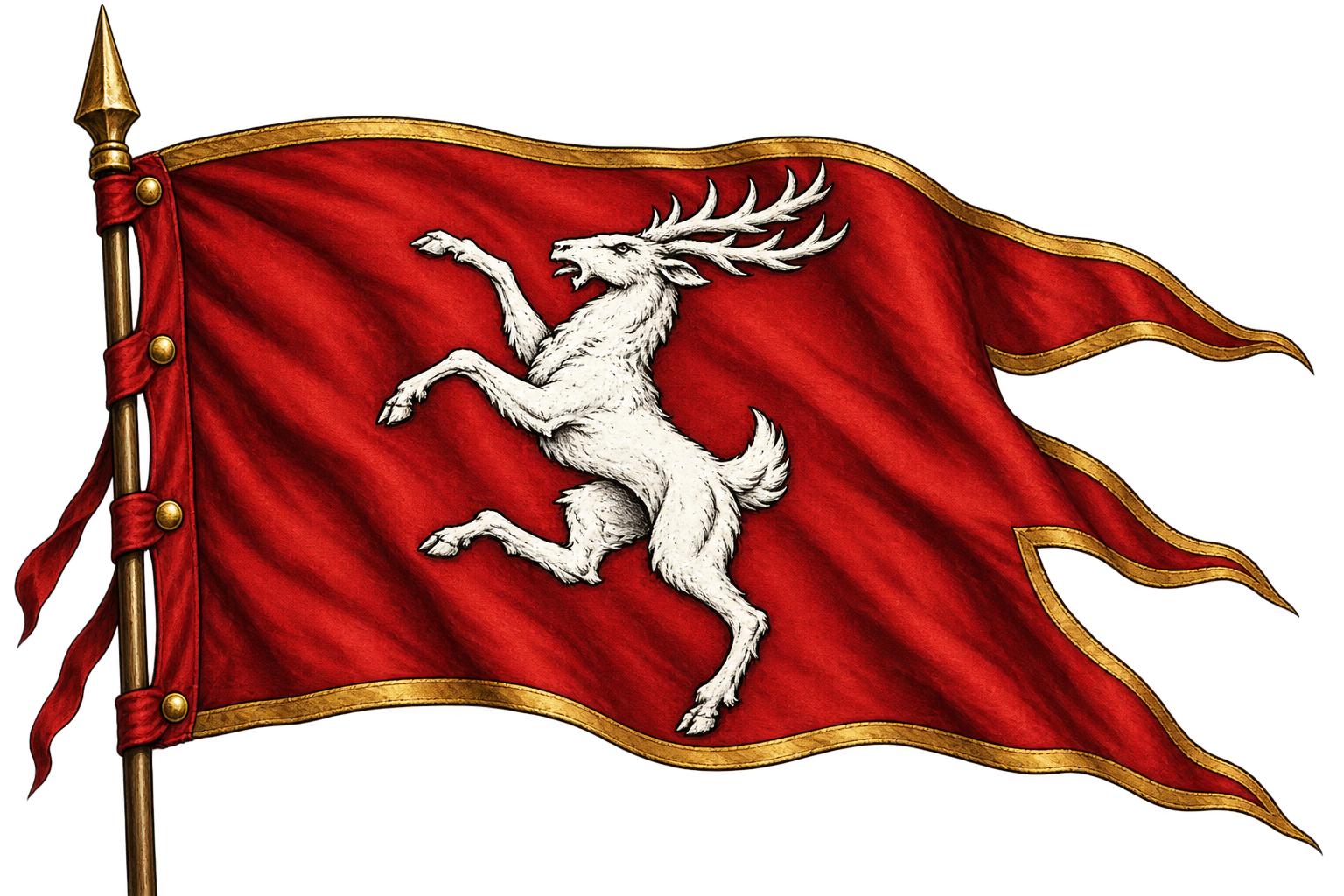
The military forces presently serving Baron Rufus Renfrew are an unusual mixture, reflecting both the Baron's long career as a mercenary commander and the troubled circumstances surrounding the creation of Redwardine. Rather than a conventional feudal army, Rufus commands veteran Blood Isler mercenaries who have followed him for many years, troops inherited from the old military establishment of Everwatch, and newly raised soldiers drawn from amongst the peoples of the liberated territories.
At the heart of the force are Rufus's three old Blood Isler companies: the Red Helms, Crimson Auxiliaries and Red Slingers. These 846 professional soldiers considerably predate Rufus's elevation to the nobility and remain the troops he knows and trusts best. Alongside them serve the Ducal Scouts, an established Everwatch formation particularly suited to frontier warfare, and the newly created Baronial Scouts, raised by Lady Agnes Renfrew from hobgoblin and mixed-blood soldiers left behind by the collapse of humanoid rule.
Together these formations number 1,473 soldiers, all ultimately under the overall command of Baron Rufus Renfrew, although they are presently dispersed across the new Barony. Their differing origins, loyalties and methods of warfare make them a remarkably varied force, but one particularly well suited to the difficult task of restoring order to a land only recently emerged from decades of war.
 Lord Renfrew's Red Helms
Commander: Captain Hakon Veyr, under Baron Rufus Renfrew | Strength: 405 | Type: Elite Heavy Infantry | Training: Elite | Morale: Elite
The Red Helms are the largest and most formidable of the veteran Blood Isler companies that followed Baron Rufus Renfrew long before he possessed either title or lands of his own. They have campaigned beside him for many years and formed the solid centre of the mercenary army with which Rufus eventually entered Harmonias during the Liberation. Although now commonly referred to as Lord Renfrew's Red Helms, the regiment predates the creation of the Barony of Redwardine and its loyalty remains as much personal as political. The regiment takes its name from the distinctive red-painted helmets worn by its soldiers. What may once have been little more than a convenient means of identifying one another amid the confusion of battle has become a source of considerable regimental pride. Helmets are repainted before major campaigns and recruits are not permitted to wear the red helm until they have completed their training and been formally accepted into the company.
The Red Helms are heavy infantry, equipped primarily with polearms and axes and trained to fight in disciplined close formation. Unlike the more fluid Crimson Auxiliaries, they are intended to seize ground and hold it. Their ranks can receive an enemy charge, advance steadily beneath missile fire and maintain formation during the confusion of prolonged hand-to-hand combat. Once committed, they rely upon discipline, mutual confidence and controlled aggression rather than individual heroics. Their battlefield reputation has been built upon steadiness. The Red Helms are exceptionally difficult to panic or drive from a position they have been ordered to defend, and Rufus has repeatedly used them as the anchor around which the rest of his forces manoeuvre. Other troops may scout ahead, harass the enemy or attack exposed flanks, but when a battle requires someone to stand directly in the enemy's path, it is usually the Red Helms who are sent.
Although Baron Rufus Renfrew remains closely associated with the regiment and is its ultimate commander, the day-to-day command of its 405 soldiers rests with Captain Hakon Veyr, an experienced Blood Isler officer and one of Rufus's long-serving captains. Hakon is a demanding commander who believes that the strength of heavy infantry lies in absolute confidence between the soldiers of a formation. His men drill relentlessly at advancing, changing facing, receiving charges and withdrawing without losing cohesion.
The relationship between Hakon Veyr and Ulf Bjarne of the Crimson Auxiliaries is characterised by the familiar rivalry of soldiers who have campaigned alongside one another for years. Hakon considers Ulf's loose-order infantry unnecessarily untidy, while Ulf regards the Red Helms' obsession with formation as proof that heavy infantry require several hundred men to accomplish what a good Blood Isler ought to manage by himself. The arguments are longstanding; the respect beneath them is equally so.
The Red Helms are presently with Baron Rufus at Howedin, where their strength and discipline make them particularly valuable during the difficult work of securing and rebuilding the newly liberated lands. Their absence from Astonwick also means that Lady Agnes Renfrew must rely upon rather different soldiers to maintain her father's authority there.
The Red Slingers
 Commander: Redd Sunniva | Strength: 233 | Type: Skirmishers | Training: Elite | Morale: Veteran
The Red Slingers are the third of the veteran Blood Isler mercenary companies serving Baron Rufus Renfrew. Like the Red Helms and Crimson Auxiliaries, they followed Rufus for years before his elevation to the nobility and have fought through numerous campaigns under his command. Although now counted amongst the military forces of Redwardine, they remain professional mercenaries whose loyalty to Rufus was established long before there was a Barony to defend.
The Slingers specialise in missile skirmishing, relying upon speed, accuracy and mobility rather than close-order combat. Their principal weapon is the sling, a weapon easily underestimated by soldiers unfamiliar with its use. In the hands of the Red Slingers it is capable of delivering a relentless hail of stones or lead shot at considerable range, allowing them to harass enemy formations while remaining difficult to bring to battle. The company's soldiers wear leather armour, deliberately sacrificing heavier protection in favour of mobility. They are trained to move rapidly across difficult ground, spread into loose formations and exploit whatever cover the battlefield provides. Individual slingers are expected to judge range, choose targets and reposition themselves without waiting for detailed instructions from their officers.
On the battlefield the Red Slingers commonly deploy ahead of Rufus's main force. They screen the army's movements, disrupt enemy troops and attempt to provoke opponents into breaking formation or advancing prematurely. Against heavily armoured enemies their task is rarely to destroy them outright, but rather to irritate, exhaust and disorder them before the Red Helms or Crimson Auxiliaries engage. They are particularly dangerous against enemy skirmishers, lightly protected troops and exposed officers, while massed volleys can make even heavily armoured soldiers reluctant to remain beneath sustained fire. When threatened by stronger infantry, the Slingers are expected to withdraw rather than accept a disadvantageous melee, drawing pursuing enemies towards other elements of Rufus's army whenever possible.
The company is commanded by Redd Sunniva, an experienced Blood Isler officer who has spent much of their career mastering precisely this sort of mobile warfare. Under Sunniva the Slingers have acquired Elite training, with considerable emphasis placed upon judging distance, coordinated volleys, rapid deployment and maintaining order while dispersed across a wide frontage. Although their Veteran morale does not quite match the exceptional battlefield stubbornness of the Red Helms or Crimson Auxiliaries, the Slingers are seasoned professional soldiers. They understand that their purpose is not to stand immovably against every opponent but to know when to fight, when to move and when to make the enemy follow.
Together with the Red Helms and Crimson Auxiliaries, the Red Slingers form part of the old professional army upon which Rufus built his reputation. The three companies fight in very different ways, but years of campaigning together have taught them how to complement one another: the Slingers provoke and disrupt, the Auxiliaries exploit, and the Red Helms finish the business.
 The Ducal Scouts
Commander: Captain Krayvan Sankari | Strength: 407 | Type: Frontier Infantry and Scouts | Training: Elite | Morale: Veteran
The Ducal Scouts are unlike the Blood Isler companies serving Baron Rufus Renfrew. They are not mercenaries and owe no longstanding personal allegiance to the Renfrew family. They are an established Ducal military formation, originally raised during the rule of the late Duke Rocco of Everwatch to patrol the dangerous frontier between Everwatch and Harmonias. From their beginning, the Scouts recruited men whom more conventional forces were often unwilling to accept. Mixed-bloods, half-humanoids, former raiders, frontier settlers and men with distinctly questionable histories all found places within their ranks. A recruit's ancestry or past mattered considerably less than whether he could follow orders, survive in the wilderness and prove useful to his comrades.
This produced an unusual but remarkably effective military culture. The Scouts value fieldcraft, stealth, observation and individual initiative more highly than parade-ground precision. Their officers expect soldiers operating several miles from the main body to make sensible decisions for themselves rather than wait for instructions that may never arrive. Their discipline is consequently less obvious than that of the Red Helms, but no less real.
The Scouts are equipped primarily with longbows, swords and shields, together with relatively light armour suitable for prolonged movement across difficult country. When operating as scouts, their shields are slung and their bows kept ready. If forced into close combat they can put aside their bows, ready sword and shield and fight as capable infantry.
They excel at reconnaissance, patrols, ambushes, screening and running battles. Rather than merely watching an enemy and reporting what they have seen, the Scouts have traditionally been encouraged to interfere whenever circumstances favour them: attacking isolated patrols, disrupting supplies, ambushing stragglers and then disappearing before a stronger force can respond. An old saying amongst the Scouts describes their purpose simply as taking the war back to those who would make war upon us.
Their willingness to employ such methods has not always made them popular. The Scouts have a reputation for looting defeated humanoid enemies and for regarding many of the niceties of conventional warfare as luxuries of soldiers who fight safely behind walls. Their methods are particularly despised by some of the Knights Heroic of Heironeous, who regard ambush, deception and attacks upon vulnerable enemies as fundamentally unchivalrous. The Scouts generally regard this criticism with amusement.
Discipline within the formation is nevertheless severe where it matters. Private blood feuds are forbidden, and whatever a recruit may have done before joining is expected to remain outside the company. Desertion is treated particularly harshly; traditionally, Scouts sent to recover a deserter are expected to bring back his equipment rather than the man himself. In earlier years even condemned criminals were occasionally offered service in the Scouts as an alternative to execution.
The old Ducal Scouts were once commanded by the notorious “Widowblade” Naldesh, an unconventional and deeply unsettling officer whose battlefield abilities were respected even by those who suspected him of considerably darker allegiances. Following Duke Rocco's death and the fall of Castle Everwatch, the formation became scattered and fragmented. Duchess Katalin subsequently restored the Scouts as a single military force and placed them under Captain Krayvan Sankari.
Krayvan is himself half-hobgoblin, the son of Geznem and half-brother of Mulabarsh, later leader of the Kal-Varzt hobgoblin clan. Krayvan briefly held leadership of the Kal-Varzt himself before being betrayed and narrowly escaping with his life. His unusual background would have made advancement impossible in many armies, but amongst the Ducal Scouts it proved considerably less remarkable. The slaughter ordered by Margrave Quellin of Harmonias against those possessing humanoid blood subsequently drove many mixed-blood inhabitants northwards. Some of the refugees who were fit, willing and, in the Scouts' rather flexible judgement, decent enough, eventually found their way into the regiment. Consequently, the modern Ducal Scouts contain a particularly high proportion of soldiers of mixed human and humanoid ancestry.
Today the 407 Ducal Scouts are an exceptionally capable frontier force. Their Elite training and Veteran morale reflect years of hard service rather than immaculate uniforms or ceremonial discipline. Baron Rufus recognises their considerable military value, although they are very different from the Blood Isler soldiers with whom he is accustomed to campaigning. Perhaps consequently, when Lady Agnes Renfrew required additional troops at Astonwick, the Ducal Scouts proved remarkably convenient troops to send her. For Agnes, however, their arrival has proved rather more useful than her father may originally have intended. The Scouts provide her with hundreds of experienced soldiers ideally suited to the difficult country surrounding Astonwick — and, under Krayvan, they have also provided the model from which she has begun creating an entirely new force of her own.
The Baronial Scouts
Commander: Captain Garran Veysk | Strength: 220 | Type: Frontier Infantry and Scouts | Training: Veteran | Morale: Average
 The Baronial Scouts are the newest military formation in Redwardine and, unlike Baron Rufus Renfrew's veteran Blood Isler companies or the long-established Ducal Scouts, they possess almost no history of their own. The regiment has been created from some 220 mixed-blood and hobgoblin soldiers left behind by the collapse of humanoid power in Harmonias and the subsequent Liberation. The name Baronial Scouts is itself significant. When the soldiers first came under Rufus's authority they were generally referred to simply as the Hobgoblin Recruits, a convenient description for a collection of troops nobody was entirely certain what to do with. Many were already experienced soldiers, but their previous allegiances, tribal backgrounds and differing degrees of hobgoblin ancestry made their long-term place within the newly liberated province politically difficult.
Rufus had little desire to incorporate them into his old Blood Isler army. Disbanding more than two hundred trained soldiers into an unsettled countryside, however, would have been equally unwise. His solution was characteristically practical: they were sent to Astonwick, where his daughter Lady Agnes Renfrew had both a considerable need for soldiers and a considerable number of problems for them to solve. Agnes chose not to disperse the newcomers amongst existing formations. Instead, she began turning them into a permanent Baronial regiment, deliberately modelled upon the Ducal Scouts already stationed at Astonwick. The new formation consequently adopted many of the older regiment's methods, particularly its emphasis upon reconnaissance, patrol work, fieldcraft, independent action and fighting effectively across broken countryside.
Like their Ducal counterparts, the Baronial Scouts are being equipped with longbows, swords and shields, together with light equipment suitable for extended patrols. They are intended to operate equally comfortably as scouts, missile troops and light infantry. Their duties around Astonwick include patrolling roads, escorting travellers and supplies, watching the frontier, investigating raids and maintaining contact with isolated settlements.
The regiment's Veteran training reflects the fact that these are not inexperienced soldiers despite their former designation as recruits. Many have fought for years, some in organised humanoid armies and others in tribal warbands or frontier conflicts. Agnes has therefore found that relatively little effort is required to teach them the fundamentals of soldiering. The greater challenge is persuading men from different backgrounds, tribes and former allegiances to regard themselves as members of a single regiment. For that reason their morale is presently rated only Average. The Baronial Scouts have yet to acquire the shared history that binds Rufus's older companies together. Agnes can be reasonably confident that they know how to fight; whether they will continue to stand together when a battle turns against them remains something that only experience can prove.
Command of such a force requires someone capable of commanding respect amongst both its mixed-blood and more strongly hobgoblin soldiers without making the regiment politically unacceptable to Redwardine's human population. Agnes found that officer in Captain Garran Veysk. Garran is the mixed-blood son of a hobgoblin chieftain and a human slave who became one of the chieftain's concubines. His paternal ancestry gives him something particularly valuable amongst the regiment's hobgoblins: recognised chiefly blood. Yet Garran learned early that ancestry might gain him an audience but could never guarantee obedience. As a mixed-blood son amongst his father's people, every privilege he received could be dismissed as favouritism and every failure used against him. He consequently spent much of his life proving himself as a soldier. By the time he came to Agnes's attention, Garran possessed both the lineage necessary to make traditional hobgoblins listen and the personal reputation necessary to make experienced soldiers follow him. His blood gives him standing. His record gives him command.
Garran's appointment is also politically significant. A full-blooded hobgoblin commanding a recognised Baronial regiment would presently be difficult for many inhabitants of recently liberated Harmonias to accept. Garran occupies the uncomfortable ground between the two communities and, for Agnes's purposes, that makes him particularly valuable. The regiment is also beginning to produce its own junior leaders. Among the most prominent is Sergeant Vesha Korr (pictured), an experienced mixed-blood ranger and archer who has become one of Garran's most reliable patrol leaders. Unlike Garran, Vesha possesses no chiefly ancestry and has earned her position entirely through ability and experience. Vesha has also provided the young regiment with one of its first traditions. She bears upon her face a tattoo of the Redwardine stag, adopted voluntarily as a declaration of allegiance to the new Barony. Other Scouts have begun copying the practice, although usually upon the hand, arm or shoulder rather than the face. Neither Garran nor Agnes has officially encouraged the custom, but neither has attempted to stop it.
The Baronial Scouts remain an experiment. Many people in Redwardine distrust them, some openly resent their presence, and there are those who believe Agnes foolish for placing weapons and authority into the hands of men who might recently have fought against the forces of Liberation. Agnes appears willing to take that risk. Her expectations are straightforward. While wearing the Baron's badge there will be no raiding, no private blood feuds, no attacks upon civilians and no settling of old tribal scores. In return, the Baronial Scouts are paid as soldiers, protected by the same military law as other troops and treated as a recognised regiment rather than a tolerated warband.
Whether the experiment succeeds remains to be seen. But around Astonwick the soldiers once dismissed as the Hobgoblin Recruits have already begun using a different name for themselves. They are the Baronial Scouts.