Barony of Redwardine
Formal Name: Barony of Redwardine
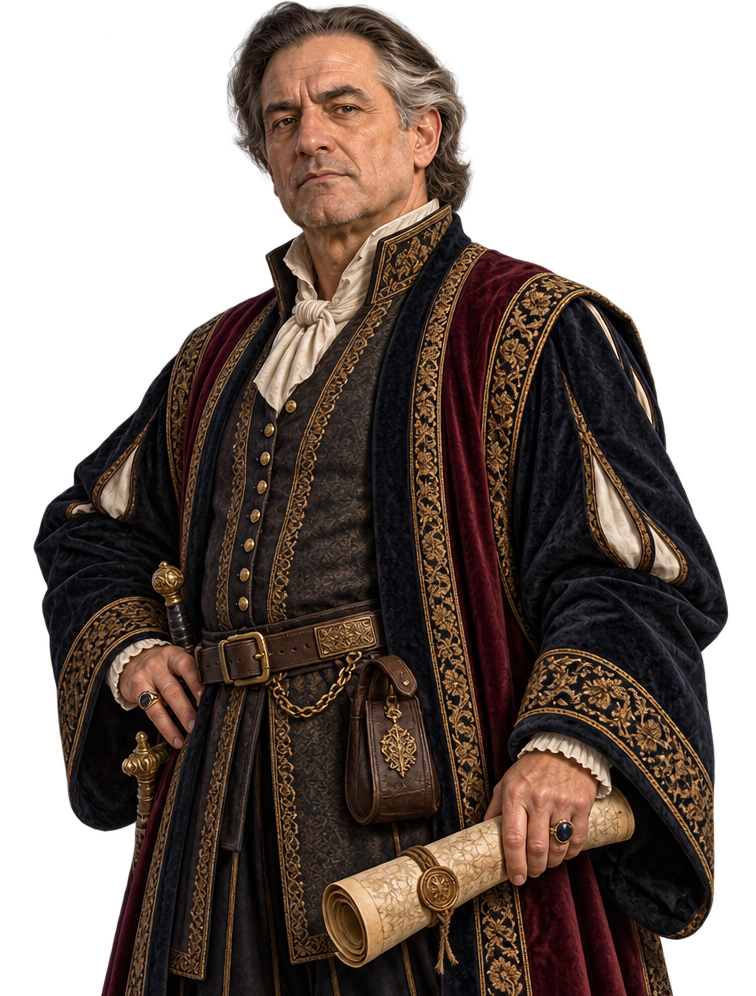
Ruler: Baron Rufus Renfrew
Government: Feudal Barony within the March of Harmonias
Allegiance: Duchess Katalin of Everwatch
Principal Settlements: Howedin and Astonwick
Major Religions: Pelor and the Old Faith (Gruumsh secretly)
Languages: Common and Orcish
Notable Regions: Red Canyon, Redwardine Hills and Tuskland
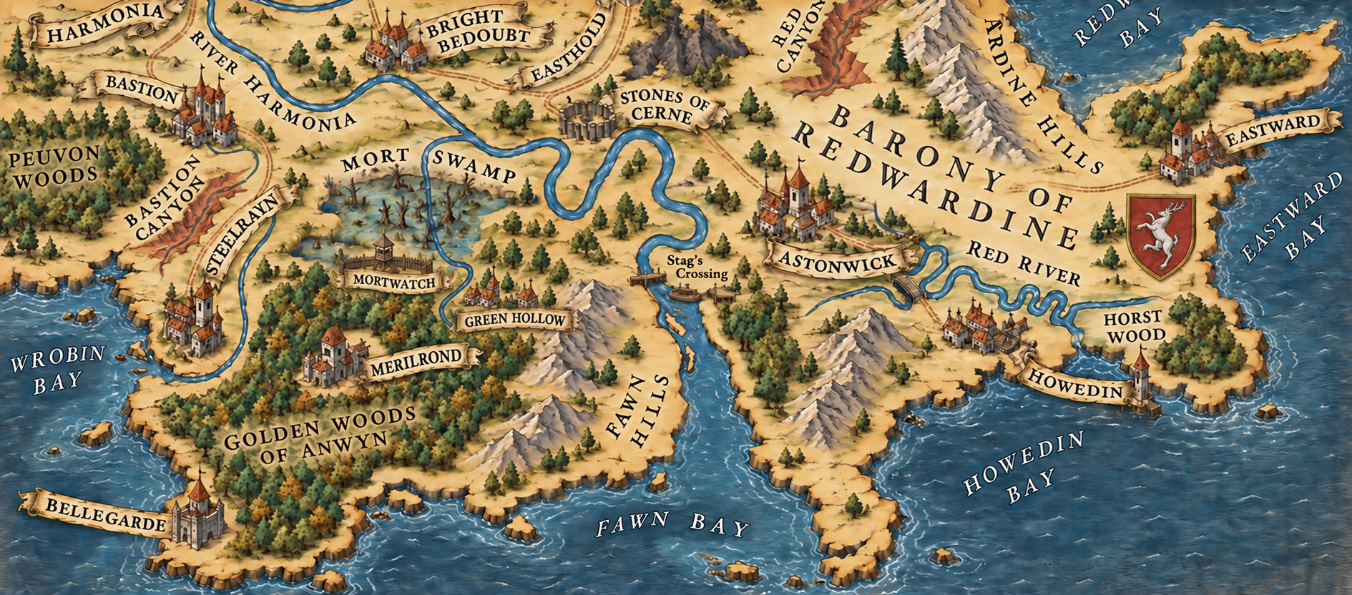
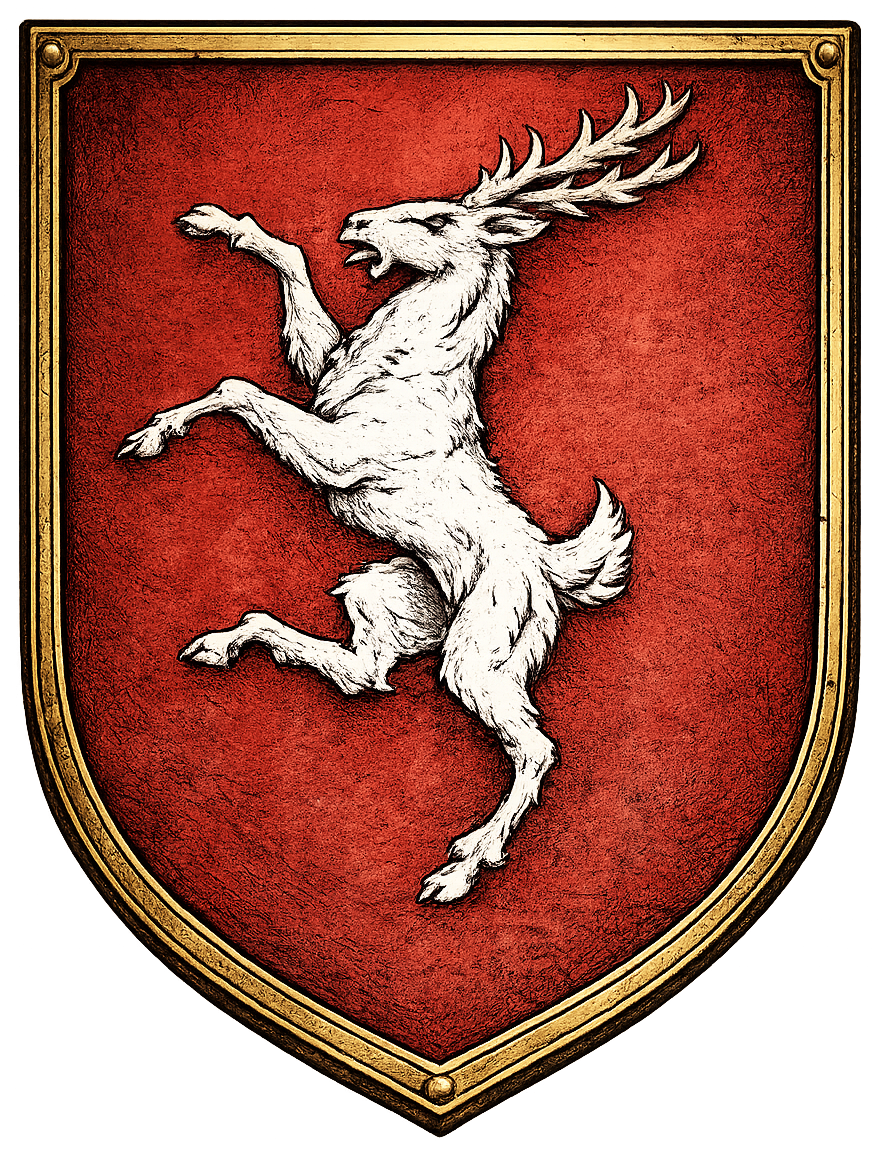
The Barony of Redwardine occupies the south eastern lands of the March of Harmonias and represents one of the most recently reclaimed parts of the old province. For decades the region lay under humanoid occupation, and even after the liberation much of Redwardine remained sparsely settled, dangerous and only loosely governed. Following the final defeat of the humanoid armies, Duchess Katalin of Everwatch granted these lands to her godfather, Rufus Renfrew, entrusting him with their reconstruction and defence. Rufus subsequently married Marjorie Hanratty, whose family claimed descent from the last Lords of Astonwick, and the Renfrews adopted the White Stag of the Hanrattys as their arms.
Unlike the increasingly prosperous lands surrounding Harmonia, Redwardine remains very much a frontier. Its towns and villages are separated by large stretches of open countryside, old ruins and wilderness, while the Red Canyon and Redwardine Hills have never been brought completely under Baronal authority. Humanoid communities survived the liberation in these more remote lands, creating problems that could not always be solved by the sword. The most important attempt to resolve this legacy was the agreement reached with Shovlarog, Prefectus of the Dralkaal Kaarlec. Brokered with the assistance of adventuring heroes, the treaty granted his people a reservation extending between the eastern edge of the Red Canyon and the Redwardine Hills. The arrangement has proved surprisingly durable, despite occasional disputes and violations by both sides. Lady Agnes Renfrew, Rufus's daughter and governor of Astonwick, has rather irreverently taken to calling the territory “Tuskland.” The name has stuck.
History of Redwardine
The lands now known as Redwardine formed the easternmost part of old Harmonias and were amongst the last areas of the province to be recovered following the long humanoid occupation. Before the fall of Harmonias they contained scattered farming communities, small settlements and the old town of Astonwick, but decades of warfare left much of the countryside depopulated. During the occupation, the region became a patchwork of humanoid territories. Orcs, goblins, hobgoblins and other peoples established themselves amongst the abandoned settlements and ruins, while surviving humans were killed, driven away or enslaved. Beyond the larger strongholds, effective authority was often little more than the power of whichever tribe or warlord happened to dominate the surrounding countryside. The eventual liberation of Harmonias brought Imperial rule back to the region, but Redwardine could not simply return to what it had been before. Much of the old population was gone, property claims were confused or meaningless, settlements had disappeared and some of the humanoid communities had lived in the region for an entire generation.
The Renfrew Grant
Following the liberation, Duchess Katalin of Everwatch granted the eastern lands to her godfather, Rufus Renfrew, creating the Barony of Redwardine. In accepting the grant, Rufus relinquished all his previous holdings, including the fortress of Telchion, but gained authority over the ruined city of Astonwick, the ports of Howedin and Eastward Bay, and the extensive surrounding territories. Rufus was charged not merely with ruling the territory but with rebuilding it. Roads had to be reopened, abandoned farmland reclaimed, settlements resettled and some form of law restored to countryside that had known little beyond warfare for decades. His position was strengthened by his marriage to Marjorie Hanratty, eldest child of the late Crispin Hanratty, a Leosandrian merchant who claimed direct descent from the last Lord of Astonwick. The Hanrattys were an old local family and therefore possessed a connection to the region that the newly arrived Renfrews lacked. Through the marriage, the new Baronal family combined the authority granted by Duchess Katalin with an older local tradition of lordship. The Renfrews subsequently adopted the White Stag, the ancient emblem of the Hanratty family, as their own device. It remains the symbol most closely associated with Redwardine today.
The reconstruction of the new Barony was divided amongst the family. Baron Rufus Renfrew established himself at Howedin, where he concentrated upon restoring the harbour and its once-famous shipyards, while responsibility for Astonwick passed to his daughter, Lady Agnes Renfrew. Agnes was well suited to the task. A former adventurer accustomed to the dangers of the March, she proved a practical and energetic governor rather than a distant aristocrat. Under her authority Astonwick developed into one of the principal settlements of the new Barony and an important centre for the reconstruction of the surrounding countryside. Albor Chesaray, Marjorie's wealthy stepfather, was appointed to govern Eastward Bay in return for a generous dowry. An experienced merchant with extensive commercial interests throughout the Successor States and beyond, Albor possessed both the wealth and connections necessary to undertake the reconstruction of the devastated port.
The Renfrews did not come to Redwardine alone. Their followers and mercenaries were granted lands and homes throughout the newly established Barony, and many brought their extended families with them. These newcomers provided soldiers, craftsmen, farmers and administrators at precisely the time Redwardine desperately needed them and became an important part of the population rebuilding the region. The Renfrews have never attempted to pretend that Redwardine is a completely pacified land. Their authority is strongest around Howedin, Astonwick, Eastward Bay and the principal roads, becoming progressively weaker towards the Red Canyon, the Redwardine Hills and the more isolated reaches of the Barony. In these northern and eastern lands, rebuilding has required negotiation as often as force.
The Red Canyon Settlement
One of the most difficult questions facing the new Barony concerned the surviving humanoids. Not every tribe had been destroyed during the liberation, and not every humanoid remaining in Redwardine was willing to continue the war. Some had been born in Harmonias and knew no other homeland. Attempting to exterminate every surviving community would have required another campaign and risked perpetuating the cycle of violence that had already devastated the region. The most important settlement concerned the hobgoblins of the Dralkaal Kaarlec, led by Shovlarog, their Prefectus. With the assistance of adventuring heroes, first a truce and then a treaty were negotiated between the hobgoblins and the Barony. The Dralkaal Kaarlec were granted a reservation encompassing the lands between the eastern edge of the Red Canyon and the Redwardine Hills. Its southern boundary was defined by the southern source of the Canyon River and the southern end of the Redwardine Hills. In return, the Dralkaal Kaarlec accepted the new political settlement and agreed to keep the peace. The arrangement satisfied nobody completely. Some human settlers objected bitterly to granting land to people they regarded as former occupiers. The hobgoblins, for their part, were being confined to a limited territory within lands their people had occupied for decades. Disputes over livestock, boundaries, travellers and the behaviour of individuals on both sides were inevitable.
Nevertheless, the treaty held. For the past several months there have been only minor infractions, and a fragile peace has developed along what was once one of the most violent frontiers in Harmonias. For a land whose recent history had consisted largely of invasion, enslavement, massacre and revenge, that was no small achievement. Lady Agnes Renfrew, whose lands at Astonwick lie closest to the reservation, has taken to referring to it unofficially as “Tuskland.” The name has rather unfortunately stuck. Official documents describe the territory in considerably more dignified language. Lady Agnes does not. She habitually refers to the hobgoblin reservation as “Tuskland,” a nickname which has spread amongst soldiers, merchants and inhabitants of Astonwick. Whether the Dralkaal Kaarlec themselves appreciate the name is considerably less certain. Despite occasional violations, the agreement with Shovlarog became one of the more unexpected successes of the post-war settlement. Travellers learned where the boundaries lay, patrols on both sides became accustomed to one another and, gradually, the presence of the Dralkaal Kaarlec ceased to represent an immediate threat of renewed war. For the first time in generations, the people of Redwardine began to believe that the frontier might actually remain peaceful.
The Land & People of Redwardine
Redwardine is a broad and still sparsely settled land. Much of the countryside consists of open farmland, rough pasture and gently rolling country, broken by wooded hills, old ruins and stretches of wilderness that have never been completely reclaimed since the humanoid occupation. Around Howedin and Astonwick, the recovery is most obvious. Farms have been re-established, roads repaired and abandoned villages resettled. New houses sometimes stand beside the foundations of buildings destroyed a generation earlier, while old field boundaries and overgrown tracks remain visible throughout the countryside. For many inhabitants, rebuilding Redwardine has meant quite literally building upon the remains of the world that existed before the war. Further from the principal settlements, the character of the land changes. Roads become tracks, farms grow increasingly isolated and the authority of the Barony becomes less immediate. The Redwardine Hills remain thinly populated, while the broken country around the Red Canyon has always provided shelter for creatures and communities wishing to remain beyond the reach of conventional authority. Redwardine is therefore peaceful in many places without ever feeling entirely tame.
The people of modern Redwardine are not simply the descendants of those who inhabited the region before its fall. Too many of the old population were killed, enslaved or driven into exile for that to be possible. The liberation instead brought together returning families, settlers from elsewhere in Everwatch and the Divine Empire, former slaves, soldiers who chose to remain after the fighting and people attracted by the availability of land. Consequently, many of Redwardine's inhabitants have only shallow roots in the places where they now live. This has created a society somewhat less bound by old hierarchies than those found in more settled parts of the Empire. Birth and ancestry still matter, particularly amongst the nobility, but a successful farmer, merchant, craftsman or former soldier can establish a family here in a way that would be considerably more difficult in an ancient Imperial province. There is land to be worked, settlements to be rebuilt and positions of responsibility to be filled. For those prepared to accept the risks, Redwardine offers opportunity.
The Legacy of Slavery
The long humanoid occupation has left a particularly complicated legacy. Many of the humans now living in the Barony were themselves slaves or are the children of people who spent years in captivity. Memories of the occupation are therefore not distant history. There are adults throughout Redwardine who remember humanoid masters, forced labour and the loss of family members. At the same time, decades of occupation produced relationships that cannot easily be divided into conqueror and conquered. Humans and humanoids lived alongside one another, however unequal that existence often was, and a substantial half-orc population remains within Redwardine.
Half-orcs consequently form a far more visible part of society here than in most Imperial lands. Some are descendants of violence and slavery; others are the children or grandchildren of relationships formed during the occupation. Many have no connection whatsoever to the old humanoid armies beyond their ancestry. Yet prejudice remains common, particularly amongst those who suffered under the occupation. The authorities generally regard Redwardine's half-orcs as subjects of the Barony like anyone else, but law and everyday attitudes are not always the same thing.
Relations with the surviving humanoid communities are equally complicated. To some inhabitants, an orc or hobgoblin will always represent the enemy that destroyed old Harmonias. Others, particularly those born since the liberation, have grown accustomed to the existence of peaceful humanoid neighbours, traders and travellers. The treaty with Shovlarog and the Dralkaal Kaarlec has forced both sides to accommodate realities that would once have seemed impossible. Hobgoblins who only a few years earlier might have been attacked on sight can now travel under agreed conditions, while Baronal patrols recognise the boundaries of their territory. This should not be mistaken for harmony. There are old grievances on both sides, and occasional thefts, killings or boundary disputes can rapidly become politically dangerous. Nevertheless, most people have discovered that an uneasy peace is preferable to another generation of war.
Life in Redwardine tends to produce practical people. A prosperous farm may still require stout doors and weapons close at hand. Travellers commonly journey together between settlements, and even comparatively ordinary villagers often possess experience of danger that would be unusual elsewhere in the Empire. The long wars have also given adventurers an unusually respectable place in local society. Redwardine owes much of its present existence to small groups of individuals who explored ruins, negotiated treaties, fought monsters and intervened when conventional armies or authorities could not. Lady Agnes Renfrew herself is a former adventurer.
Consequently, a band of armed strangers arriving in an inn is less likely to cause alarm here than it might elsewhere. The first question is often not “Who are you?” It is: “Are you looking for work?”

Settlements & Places of Redwardine
Redwardine remains a lightly populated Barony, and even its principal settlements are modest by the standards of the Divine Empire. Between them lie scattered farms, hamlets, ruined villages and large stretches of countryside in which the scars of the occupation remain clearly visible.
Howedin (Amersoyn)
Small Town: Alignment: TN/LN, Population: 1,980 (96% human, 4% other) Languages: Gnoll and Common, Religions: Zilchus and Bralm, Authority figure: Baron Rufus Renfrew (human male, fighter) and Guilder-Priest Lockshy of Zilchus (Human, male cleric).
Howedin was once a thriving trading port, renowned for its excellent harbour and exceptional shipyards, until it was overrun by invading Gnolls. The conquerors enslaved the human population and renamed the town Amersoyn, subjecting its inhabitants to years of brutal servitude. Curiously, the Gnolls proved remarkably disinterested in the everyday administration of their conquest. Lazy and indulgent, they largely left the running of Amersoyn to their human slaves, intervening principally to demand tribute, enforce obedience or indulge in occasional acts of exemplary violence. Their continuing low-level conflicts with neighbouring humanoids provided ample outlet for their aggression and bloodlust, leaving the enslaved population with a surprising degree of autonomy in their daily affairs. The result was a strange and deeply unpleasant arrangement. The inhabitants remained slaves and lived constantly beneath the threat of violence, yet they continued to operate the docks, workshops, markets and much of the machinery of the town themselves. Despite decades of servitude, Howedin therefore retained more of its civic organisation and practical skills than many other settlements liberated from humanoid rule.
Howedin was eventually liberated by the Divine Navy and the Army of Everwatch, after which the town came under the direct rule of Baron Rufus Renfrew. Rufus immediately brought in large quantities of food, clothing and building materials to support the newly freed population. He was assisted by Guilder-Priest Lockshy, a priest of Zilchus determined to restore commerce and market efficiency to the port, while clerics of Bralm concentrated upon the practical work of rebuilding the community. Under their direction, former slaves returned to the trades they had practised during the occupation. Houses were repaired, workshops reopened and work began upon restoring Howedin's once-famous shipyards. Reconstruction has progressed steadily, and the shipyard is expected to become fully operational within the year.
Freedom has not, however, transformed Howedin into an egalitarian community overnight. The highly structured and hierarchical administration established by Rufus, Lockshy and the clerics of Bralm has provided the former slaves with a familiar, if rigid, framework within which to rebuild their lives. This has undoubtedly helped the town recover quickly, but it has also produced a society in which obedience, labour and social order are valued more highly than individual freedom or political participation. A plantation system similar to that established around Astonwick has also developed outside the town. Conditions are noticeably harsher than those found on the Astonwick estates, with fewer of the idealistic concessions encouraged by Lady Agnes Renfrew. Security is provided by the Red Helms, an elite regiment stationed permanently at Howedin. Their presence gives Baron Rufus a dependable military force with which to defend the harbour, maintain order and respond to threats elsewhere in the Barony. The regiment is a conspicuous presence in the town and also serves as a reminder that Redwardine, despite its liberation, remains a frontier territory. Howedin is therefore recovering rapidly, but in a distinctly different fashion from Astonwick. It is becoming prosperous, orderly and productive once again, its harbour and shipyards promising a return to their former importance. But it is being rebuilt according to Rufus Renfrew's vision of order rather than Agnes's vision of opportunity.
Eastward Bay
Small Town: Alignment: TN, Population: 950 (97% human, 3% other), Languages: Common, Religions: Zilchus and Bralm, Authority Figure: Albor Chesaray (human male, merchant)
Eastward Bay was once a thriving human settlement and major trading port before the fall of Harmonias. Under humanoid occupation, however, its character changed dramatically. As the years passed, increasing numbers of corrupt and unscrupulous humans were drawn to the port, and a flourishing slave trade developed alongside more conventional commerce. Pirates from the Blood Isles, smugglers from the Old Empire and dubious merchants from the Successor States became familiar visitors. Eastward Bay remained remarkably cosmopolitan, attracting people of many races and backgrounds, but its growing prosperity was increasingly founded upon slavery, smuggling and the willingness of its rulers to conduct business with almost anyone. As the reconquest of Harmonias gathered pace, the port acquired another trade.
Orcs, hobgoblins and gnolls who could see the approaching collapse of humanoid rule began offering themselves as mercenaries. Unscrupulous employers were quick to exploit their increasingly desperate position, and ships carried bands of humanoid warriors away from Harmonias to fight in distant conflicts. Amid this growing chaos, the evil Lord Tarvin seized control of Eastward Bay, ruling alongside his half-Elven lover, the witch Elqwin. Under their rule, an already disreputable port descended still further into corruption and lawlessness. Eastward Bay became the last major stronghold of the humanoid occupation. The Army of Everwatch eventually stormed the town, bringing the long struggle for Harmonias to its bloody conclusion. The fighting was brutal. The humanoid defenders were slaughtered, but many of the unfortunate slaves trapped within the settlement also perished during the assault. Lord Tarvin was allegedly killed by Baron Rufus Renfrew during the fighting. Elqwin escaped. Her ultimate fate remains unknown. With the capture of Eastward Bay, the last major settlement still controlled by the old humanoid regime had fallen. Only scattered remnants remained in the countryside, where they were gradually hunted down, driven into the wilderness or forced to seek some form of accommodation with the new authorities.
Following the liberation, Baron Rufus appointed his father-in-law, Albor Chesaray (pictured), as steward of Eastward Bay. Albor had little interest in restoring the complicated society that had existed before the conquest. Instead, he expelled the surviving slaves and humanoids and declared the devastated settlement a “blank canvas” upon which an entirely new Eastward Bay could be constructed. Some four hundred craftsmen, labourers and artisans were brought in from across the Lands to begin rebuilding the town. Plots were sold to merchants, while considerable effort and money were directed towards restoring the docks and making the harbour commercially useful once again. Skilled craftsmen from Zargozan played a particularly important role in clearing the ruins and rebuilding the port. Many have subsequently chosen to remain, encouraged by the availability of land and the possibility of prospering as Eastward Bay recovers. Progress, however, has been slower than Albor expected. Despite the reconstruction, Eastward Bay still feels strangely empty. New buildings and repaired streets stand amongst vacant plots, while fewer settlers have arrived than its ambitious steward had hoped. The docks are increasingly active, but the bustling commercial town imagined by Albor has yet to materialise.
The shattered town wall has now been completely repaired, and a company of mercenaries is stationed outside the port to protect the settlement from hostile humanoids and other dangers remaining from the war. Albor's definition of a danger is broad. Humanoids attempting to approach the settlement are killed, while former slaves arriving at Eastward Bay are turned away and directed westwards towards Astonwick. There, in marked contrast to Albor's policies, Lady Agnes Renfrew's administration generally attempts to find a place for anyone willing to settle and work. The distinction has given the two towns very different reputations. Albor remains convinced that Eastward Bay's future depends upon order, investment and profitable trade, rather than becoming a refuge for the displaced peoples of the old Harmonias. His methods are harsh, but the harbour is functioning again, the walls have been restored and commerce is slowly returning. Whether his carefully planned new town will ever become the great trading port he envisages remains to be seen.
Astonwick
Once the second city of the province, Astonwick was sacked by the orcs and transformed into the brutal settlement of Agrabash. Its enslaved human population endured years of violence, deprivation and religious persecution at the hands of the fanatical followers of Gruumsh. Although liberated only six months ago, Astonwick remains a troubled and often violent place, its people still deeply scarred by their years of servitude. The town is now governed by Lady Agnes Renfrew, daughter of Baron Rufus, assisted by her old adventuring companion Father Filton Pyre of Pelor. Agnes has imposed firm law and order, while Father Filton and his followers provide food, healing, education and practical assistance to the former slaves. The old temple of Gruumsh has been cleansed and converted into a barracks, a temple of Pelor has been established, and rebuilding continues throughout the ruined town.
Despite its difficulties, Astonwick is recovering rapidly. The fertile surrounding lands are once again being cultivated, employment is plentiful and newcomers are welcomed regardless of race or background. Mercenaries and Ducal Scouts provide security, while Pelorian clergy and volunteers work alongside the inhabitants to rebuild the settlement. Settlers, merchants, prospectors and opportunists are arriving in increasing numbers, drawn by the possibilities offered by the newly liberated lands. Astonwick's people are healthier and safer than they have been for generations, but violence, old loyalties and the legacy of slavery remain close beneath the surface.
More detailed information is available here.
The Red Canyon
The Red Canyon lies beyond the more settled parts of the Barony and has long provided a natural stronghold for humanoid communities. Its steep-sided ravines, caves and broken ground make the region difficult to patrol and still more difficult to conquer. During the occupation it became associated particularly with hobgoblin forces, and following the liberation it remained one of the areas in which the new Baronal authorities exercised little direct control. The canyon now forms an important part of the territory associated with Shovlarog and the Dralkaal Kaarlec. Under the treaty negotiated after the war, the hobgoblins were permitted to maintain their community here rather than being driven from Redwardine altogether. Human travellers generally avoid entering the canyon without good reason. This is partly caution and partly recognition that, whatever Imperial maps may say, the inhabitants regard it as their land.
The Redwardine Hills
The Redwardine Hills form another of the Barony's wilder regions. Thinly populated and difficult to police, the hills contain isolated farms, old tracks, ruins and numerous caves. During the humanoid occupation they provided refuge for warbands, escaped slaves, bandits and others wishing to remain beyond the reach of whichever power happened to control the lowlands. Even today the Baron's authority is more theoretical in some of the remoter valleys. The hills also mark part of the uneasy frontier surrounding the territory granted to the Dralkaal Kaarlec. Boundaries that appear straightforward on a map are considerably less obvious amongst wooded ridges, streams and grazing land, and disputes occasionally arise over exactly where one jurisdiction ends and another begins.

Redwardine and the Divine Empire
The Barony of Redwardine occupies a slightly unusual position within the political structure of the Divine Empire. Although technically part of the March of Harmonias, Baron Rufus pays his fealty directly to Duchess Katalin of Everwatch, from whom he received his lands and authority. The new Barony has been recognised by Everwatch, Aelfshaw, Maelfasan, Veston Vale, Summerswane and even the Blood Isles, giving Rufus considerable practical legitimacy amongst the neighbouring powers.
The court of the Divine Emperor, however, has never formally recognised the creation of Redwardine. In earlier generations such an omission might have presented a serious political problem. Today it matters considerably less. As the Imperial court has become increasingly distant from affairs beyond the heartlands, provincial rulers have grown accustomed to resolving such matters amongst themselves. Redwardine exists, its neighbours recognise it, its Baron governs it and Duchess Katalin supports it. For most of its inhabitants, that is recognition enough.