Recent History
For more than thirty years the border between Everwatch and Fallen Harmonias remained relatively stable. That changed dramatically in early 360 I.Y., when the humanoid armies of Harmonias swept north, sacked Castle Everwatch and appeared poised to overrun the entire Duchy. Under the leadership of Duchess Katalin, however, Everwatch recovered with remarkable speed. The invading host was shattered and driven back into Harmonias, while the Council of Chieftains that had ruled the humanoid territories began to fracture. A succession of attacks by Everwatch and its allies pushed the enemy steadily southwards and reclaimed much of the disputed borderland. Humanoid cooperation soon collapsed altogether. Rival tribes and leaders turned upon one another, destroying much of the unity that had made the invasion possible. Their one significant success came at the First Battle of Shag'ra, where the 4th Divine Legion was defeated and forced to withdraw. During the fighting, Lady Arabella Mauberry, the last surviving heir of House Bravlin, was captured.
The High King of Galgortha
Arabella was taken to Galgortha, the old provincial capital of Harmonias, which was then controlled by the Uthabar Orog Tribe and their eastern human mercenary allies. These mercenaries were followers of Hextor, god of war, conflict and tyranny. With the old Council of Chieftains collapsing, an extraordinary proposal emerged. In an attempt to bring the war to an end, the rulers of Galgortha offered to elect one of the heroes as High King, provided he married Lady Arabella and ruled alongside her. Both Sadhaka Hakesh and Sir Wulfram Amali, who had not yet married Duchess Katalin, volunteered to wed Arabella. In the end, however, it was the wandering monk Quellin who accepted the mantle. Quellin and Arabella were married and crowned, gaining control of Galgortha, northern Harmonias and a considerable part of the remaining humanoid host. They made an unusual pair. Arabella was beautiful, aristocratic and accomplished in the magical arts, while Quellin was a wandering monk who had emerged from an exceptionally brutal background. Among their first acts was the appointment of several advisers, including Sir Tristram, leader of the Hextorian acolytes. The new rulers then ordered the humanoid army southwards to subdue the orcs, goblins and gnolls who refused to recognise the authority of the new High King. What followed in Galgortha changed the course of the war.
The Galgortha Massacre
With the main humanoid army safely marching south, Quellin acted against those who remained within the city. The following day, Sir Tristram and his Hextorian followers turned upon Galgortha's remaining humanoid population. Anyone possessing humanoid blood was targeted. With most of the warriors away with the army, many of those killed were females, children and the elderly. Thousands were hunted down and slaughtered, while some half-blood inhabitants managed to flee north and east towards Everwatch. The dead were dragged from the city and buried in three enormous mass graves, ostensibly to prevent the bodies from rotting within Galgortha. Humans who had previously been enslaved by the humanoids were freed, armed and encouraged to assist in the purge of those the new regime called the “green bloods.” Quellin then declared openly for “Humanity.” Several crusader units that had come to Harmonias specifically to fight the humanoids and liberate human slaves rallied to him. They were joined by the Maelfasan Brigade and, for a time, by the 4th Divine Legion. For the first time since the war had begun, however, the alliance against the humanoids seriously divided. The Church of Heironeous refused to support Quellin. The massacre itself was abhorrent to many of its clergy, while the prominent presence of Hextorian followers within the new regime made cooperation virtually impossible. Heironeous and Hextor were ancient enemies, and their churches regarded one another with particular hatred. There was little time to settle the dispute. The humanoid army sent south by Quellin had learned what had happened in Galgortha and was now returning, seeking bloody revenge.
The Fall of the High King
Sir Wulfram Amali led the 4th Divine Legion against the returning army. With assistance from the remaining allies, he defeated the humanoids and finally routed their forces, securing Galgortha from immediate attack. Victory did nothing to repair the political alliance. The Heroes of Everwatch quarrelled bitterly with High King Quellin over the massacre, with many placing particular blame upon Arabella and her advisers. Faced with the consequences of what had happened, Quellin abdicated and walked away into the wilderness. Arabella did not follow him.
Instead she proclaimed herself Margravine of Harmonias and initially vowed fealty to Duchess Katalin. The arrangement quickly deteriorated. Arabella retained the Hextorian mercenaries, continued the persecution and killing of those with humanoid ancestry, and expelled the Church of Pelor from her territory. The alliance that had liberated northern Harmonias finally collapsed. Open war broke out between Margravine Arabella and Duchess Katalin, who would not tolerate the establishment of a Hextor-dominated state upon the southern border of Everwatch.
War Between the Victors
Against expectations, the Second Battle of Galgortha ended in a tactical victory for Arabella. Duchess Katalin's forces were driven back towards Everwatch and another stalemate followed. Increasingly desperate for allies, Arabella turned to perhaps the most dangerous potential supporters available to her. She sought assistance from powers within the Underdark. The negotiations never reached their intended conclusion. A meeting between Arabella and representatives of the Underdark was interrupted by the Heroes of Everwatch, and Arabella was killed. Everwatch moved quickly. At the Battle of Nyrlin's Folly, Katalin's forces defeated the now leaderless armies of Galgortha. The Hextorian mercenaries negotiated safe passage in return for surrendering the city and finally departed Harmonias. The old city of Galgortha was officially renamed Harmonia, and Baron Jasper af Staller was appointed by Everwatch to govern it. A chain of small forts was established to the south-east while the surviving humanoid powers once again sued for peace.
The Uneasy Peace
For a short period, a fragile truce settled over the region. Humanoid communities to the south surrendered at least some of their human slaves to Duchess Katalin, who settled many of the freed people in the reclaimed northern lands. Stonehaven received particularly large numbers of former slaves, supported by the Church of Pelor and financed in part by the Temple of Zilchus. The peace did not last. This time, however, the threat came not from the old humanoid armies but from within the victorious human factions themselves.
The Chapray Intervention
Istavan Vadild, supported by House Chapray, landed at the port of Steelrayn and defeated the last remnants of the once-powerful humanoid Council of Chieftains. Istavan and his twin brother Tibor were the younger brothers of Duchess Katalin. Both had been believed killed during the sack of Castle Everwatch, but had in fact been rescued by the Heroes of Everwatch and brought forward through time. At only sixteen years of age, Istavan nevertheless believed himself to be the rightful Duke of Everwatch and turned to House Chapray for support. The Chaprays were followers of Pelor and fundamentally well-intentioned, but they badly underestimated the dangers of intervening in Harmonias. They believed that a swift and decisive victory would demonstrate Istavan's fitness and right to rule. Their easy conquest of Steelrayn appeared, initially, to vindicate them. It proved a disastrous illusion.
House Chapray subsequently attempted to destroy Kaplyn, the Necromancer of Mortesia. The expedition ended catastrophically. Istavan and his aunt, Eleanor Chapray, leader of the House, were both killed, their accompanying forces virtually annihilated and the Chaprays suffered grievous losses in both lives and treasure. Kaplyn then marched upon Harmonia. Everwatch, exhausted by years of warfare, was in no position to fight another major enemy. A hurried agreement therefore produced one of the strangest settlements of the entire Harmonias conflict: Duchess Katalin and Kaplyn agreed not to interfere in one another's affairs and to coexist. The treaty was deeply unpopular with the Church of Heironeous, but Katalin believed she had little alternative. Everwatch simply lacked the resources necessary to destroy the necromancer. For the first time in decades, the wars of Harmonias seemed to have reached an uneasy pause.
Then Galsitan Gresvurian played a song.
Settlements:
Harmonia (Galgortha)
Small City: Alignment: LN, Population: 8,400 (99% human). Authority figures: Baron Jasper af Staller (human male, fighter), Tibor Vadild (human male, fighter-aristocrat).
Harmonia is the old provincial capital and was once an impressive city of grace and beauty that has long since fallen in to disrepair since its sacking and capture by humanoids over thirty years ago. When dominated by the Orcs and then Uthabar Orogs, it was called Galgortha but recently was captured by the Duchy of Everwatch and reverted back to its old Harmonia name. For a brief period it was controlled by Margravine Arabella backed by Hextor mercenaries but her death and their defeat to the Duchy of Everwatch has led to its current governor, Baron Jasper af Staller, being appointed to rebuild the city.
Baron Jasper introduced strict no nonsense policies to administering the city with the formation of an active and honest city watch and magistrates. This stamped out much of the endemic corruption that plagued Harmonia but also caused a degree of unrest as the populace adjusted to the new rule of law. In turn the Baron never hesitated to keep order using the sizeable Everwatch garrison to quell unrest; over the last two years sizeable numbers of rioters and criminals were imprisoned and sentenced to hard labour for their criminal actions. Though a sizeable criminal underworld still exists the Watch maintains order and the economy of Harmonia is in turn booming. It is becoming more and more like a normal city and the bulk of the populace fear a return to the random violence and rampant corruption of the past. Along with the imposition of the rule of law major efforts to rebuild the city and to assist the populace took place. The Church of Pelor established a temple and numerous shrines from which aid and assistance was freely given while Clerics of Bralm continued to aid and guide construction and rebuilding.
To the north and east of Harmonia are the reliquum fields that are a valuable magical resource where grants to exploit the fields were issued. This has led to a boom in Harmonia and the population has doubled in size in a little over a year. Much of the rebuilding has been started but there are still sizeable run down areas that need further aid. Baron Jasper brought Tibor Vadild, the 19 year old brother of the Duchess, to join him and to learn how to rule. In time, the Baron wants to retire back to his estates at Milton and hopes that Tibor might rule Harmonia, with the aid of the Baron’s son Hyatt.
Maidenvale (Shag’ra)
Large Town: Alignment: TN, Population: 2,509 (90% human, 6% half-orc, 4% other). Authority figures: Sir Huwel af Morriss (human male, fighter), Honest-John Humblesworn (human, male, merchant).
Maidenvale was a prosperous market town to the north east of Harmonia till it was overrun by humanoids. It was then left largely abandoned for the next thirty years till it, as Shag’ra, became the new home of the Kal-Varzt Hobgoblins after they were evicted from Telchion (Fal’Nfort). Over 2,000 warriors and additional dependents lived there and the ruined town was fortified till the Kal-Varzt were defeated and destroyed in battle. It was occupied by Everwatch forces under Ducal knight Sir Huwel af Morriss who assisted 1,000 ex-slaves in rebuilding and settling in Maidenvale. As the town is between two large reliquum fields it has also grown as a trade centre and is somewhat of a boomtown. Unlike some of the southern Harmonias towns they also allow half-orcs residency, which has not caused much tension as hobgoblins were the previous slave masters. One of the ex-slaves, then known as 'Tainted Crawler' by his hobgoblin masters, has become a successful merchant and is a leading town figure under his new name of Honest-John Humblesworn. In the last two years Maidenvale has been repaired within her walls but outside are tents and other temporary buildings where the transient residents live. A town watch keeps the peace inside the walls and outside, to a degree, while unit of Ducal Scouts patrols the countryside for remnant humanoids and bandits.
Just outside of Maidenvale was a ruined temple of the evil god of slaughter and conflict, Hextor but it was totally demolished by the orders of Sir Huwel who had the lower levels filled in and the building stones broken down in to gravel for the local roads. Very little is left to mark the location but some say they fell an air of menace at the site but most dismiss this.
Gloryhome (Woodchase)
Village: Alignment: TN, Population: 500 (93% human, 4% Dwarven, 3% Other). Authority figure: Osthen Amali (human male, adventurer).
Gloryhome is a small port town on the north eastern coast of Harmonias on the shore of the Western Inderta Sea. It is a new settlement that was set up as a base for the 4th Divine Legion when it was sent to assist in the liberation of Harmonias province. When the legion withdrew it was taken over by Margravine Arabella’s forces but then destroyed in a surprise attack by Lord Rufus Renfrew’s forces from Telchion. Eventually members of the Amali family moved to Gloryhome from Lyand in the County of Southwatch. They were close relatives of Wulfram, the husband of Duchess Katalin. Osthen Amali and his three sons are the leaders and they brought in workers to start a thorough rebuild. Within the last two years a major wharf and warehouses have been constructed and a temple-market to Zilchus, the god of commerce. The settlement is now a well developing bustling port.
Steelrayn
Small Town: Alignment: LN, Population: 1,450 (55% human, 40% Dwarven, 5% Other). Authority figures: Lady Virago Termagent (human female, wizard) and Mother Trow Restell of Estana (human, female cleric).
Steelrayn is a fishing port and agricultural community located on the western shore of Harmonias. It is home to a group of female human ex-slaves, known as the Sorority of Picayune, and a settlement of Vargrimst, humiliated Dwarven ex-slaves. These groups arrived from "The Other Place" after a failed invasion of Aelfshaw by Elves and Dwarves. Once enslaved by evil Dwarven factions, Klan Martazhold and Klan Thorekmek, both worshippers of Abbathor, they banded together to create a new life for themselves. Many of the women were pregnant, and numerousl half-Dwarves were born in Steelrayn. The leader of the community is Lady Virago Termagent, once a noblewoman from Masalb, who was enslaved as the concubine of Jarl Martazhold, the Dwarven leader. She is supported by Trow Restell, a cleric of Estanna, the demigoddess of hearth and home. Known as Mother Trow, she is also the town’s midwife, famous for her kind heart and forgiving nature. Trow has her own half-Dwarf son and plays an essential role in the community. The town's sheriff is Avila Beltran, a tough yet fair half-Dwarf woman, known for her no-nonsense approach to leadership.
In the past year, the town has been rebuilt, largely due to the hardworking Vargrimst, while the women have focused on learning new trades and raising their children. The road to Harmonia has been restored, making Steelrayn an important southern port. However, the nearby Bastion Canyon and Mort Swamp still pose occasional threats, with unwelcome creatures from these areas visiting the town. To protect the village, a company of female warriors led by Captain Lizabeth Bathory has been formed. The Dwarven captors of these women never understood that women could be warriors and fighters, and in their chauvinism, they routinely killed male human prisoners but spared the women, some of whom proved to be highly capable. Traditionally, once per season, Sir Galwas visits Steelrayn, bringing the latest news from beyond the town. While he is technically the ruler, Sir Galwas always shows Lady Virago the utmost respect, honouring her in a chivalrous manner.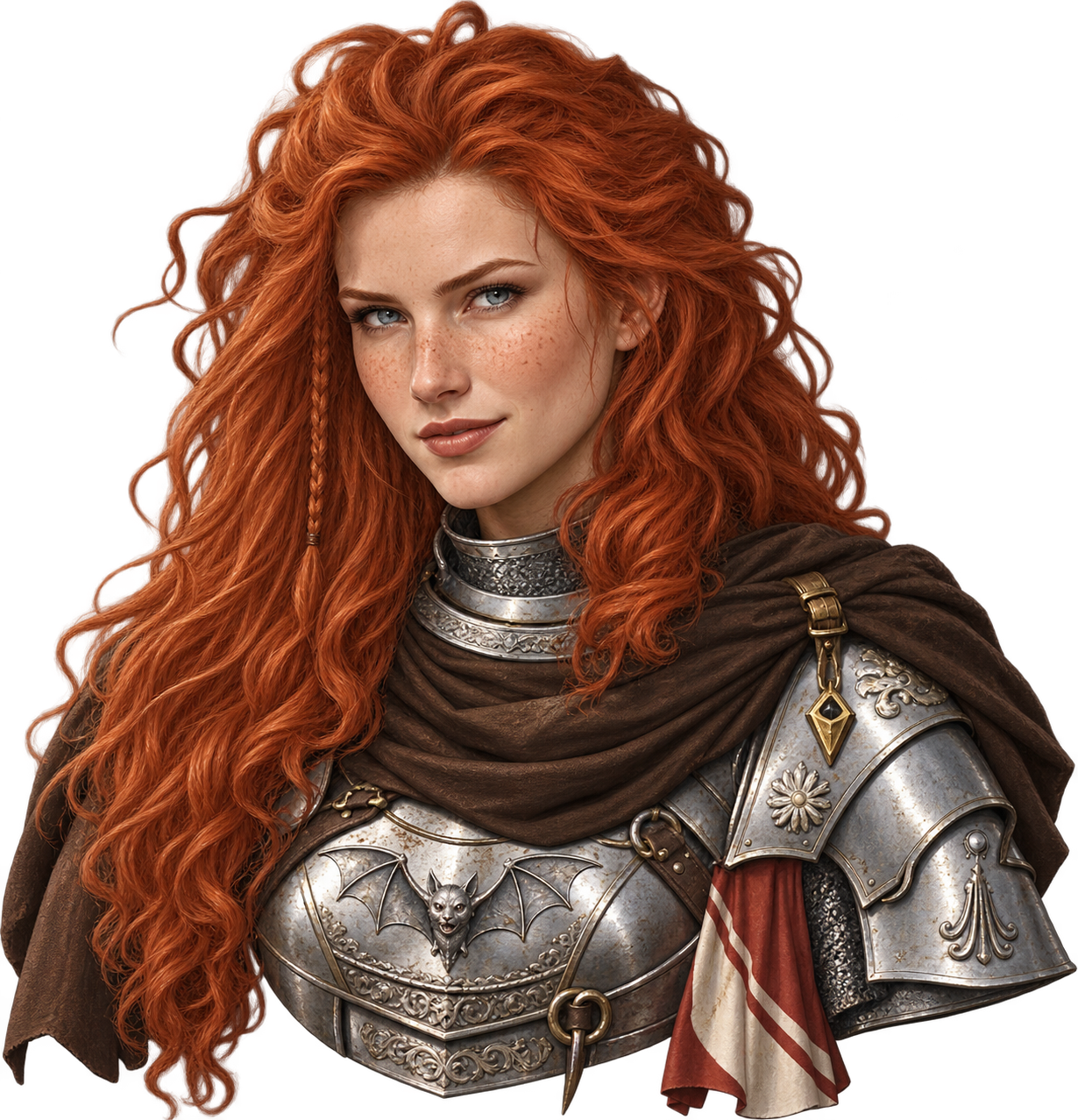
Puevon
Hamlet: Alignment: LN, Population 150 (90% human, 8% half-Orc, 2% other). Languages: Common & Sōren, Religion: Xerbo, Authority figures: Stal Pheral (male, scholar) Edelmir Grausam (human male, trader).
Puevon is a small, stoutly walled town with a modest harbour and a bustling market, home to around 300 inhabitants; an ideal population for its compact layout. An ancient settlement, Puevon was brought to Warlderia by the magic of the Fey Queen, replacing the newer town of Vrowbin. Many of Puevon's residents are members of the extended Crimson Coaster family, related to Maelara Grausam (pictured), a Ducal Knight of Everwatch.
The town features a small temple dedicated to Xerbo, the god of business and seafaring, as well as the Bat Inn and a trading store run by Edelmir Grausam. The mysterious scholar Stal Pheral resides in his magical mansion, surrounded by a garden of exotic plants. In recent months, more freed human and half-orc slaves have settled in Puevon alongside the Grausam family. The former slaves tend the fields while the Crimson Coasters focus on fishing and maintaining their boats. Puevon is protected by walls laced with cold iron and strong wards, preventing the fey from entering. This security is especially crucial as the town lies on the borders of the enchanted Silver Woods, keeping out the more malevolent and dangerous fey inhabitants. Maelara Grausam has been named Lady of Puevon and the Silver Woods by the Duchess of Everwatch, though she spends much of her time away on various duties for the Duchy.
Wyntern
This now destroyed settlement was located at the southern end of the Orc’s Cleft chasm. It was both a port to the west and a cliff top settlement to the east with a mere mile of land separating them. It was home to creatures that wander up from the Underdark and for stragglers from the recently defeated humanoid armies. Wyntern was a warren of a lanes and alleyways which were all in a sad state of disrepair. A magically created earthquake levelled the settlement and collapsed the strip of land flooding the southern part of the Orc's Cleft to become Loch Rayden.
Joyess
Village: Alignment: CG, Population: 470 (95% human, 5% other) Languages: Common, Religion: Lastai, Authority figure: Gabriel Spumanta (human male, fighter-bard)
Gabriel Spumanta was once a knight errant of the Primelliann Order of the Glorious, Fantastic Knights Valiant, until he took part in the Tournament at Tawney Meadows in Aelfshaw. Like many others, he answered the call and volunteered to aid Everwatch in her battle against the invading orcs and other humanoids. A skilled and valiant knight, Gabriel fought bravely, earning the title of Ducal Knight and lands to call his own. With these lands, he built his manor, but his greatest passion was not for war or conquest, he was a hopeless romantic at heart, driven by the pursuit of 'Courtly Love'. Gabriel’s village, Joyess, is a small but picturesque settlement, built around his magnificent manor house. The village is a beautiful sight to behold, though somewhat impractical, with a small but functional harbor to serve the needs of its residents. Despite its flaws, Joyess is known far and wide for the warm and extravagant welcomes Sir Gabriel offers to guests, often hosting lavish parties that are the talk of Harmonias and beyond.
However, Gabriel’s desire to live a life of romanticgrandeur comes at a cost. His wealth is not sufficient to sustain the lavish lifestyle he dreams of, so he frequently embarks on adventures in search of gold and other riches. His servants and the villagers enjoy a rare luxury in Harmonias as they are the least worked in the province, granted the freedom to amuse themselves when Gabriel is not in residence. Though Sir Gabriel may be absent for much of the time, his manor and village remain a testament to his desire for romance, beauty, and a life of elegance, no matter the cost.
The String Forts
During one of the many truces between Everwatch and the Harmonias Humanoids, Baron Jasper af Staller commissioned the construction of a defensive chain stretching from the southern border of Harmonia, near Mortesia, up to the northeastern coast by the Indersta Sea. Bastion, which faced Mortesia, was an unpopular posting. The largest of the fortifications, Bright Redoubt, was built to the east of Harmonia, close to a vast reliquum field. It served as a guard post for the many prospectors in the area and as a bustling trading hub. Further east, Seafort was constructed along the coast, while Fasthold stood between them. With Everwatch's eventual victory over Harmonias, the forts' roles initially shifted. Only Bright Redoubt remained garrisoned to oversee the nearby reliquum field, while the others were reduced to mere trading posts and inns for travelers. However, this change was short-lived. The resurgence of remnant humanoids led to the rapid reoccupation of all the forts, particularly Fasthold, which controlled the contested Reliquum Ash field. Orcs from the Red Canyon began preying on the local prospectors, prompting the appointment of Sir Hathus Amali as Warden. Leading elements of the Ducal Cavalry, Amali waged a brutal and relentless war of containment to protect the region.
Fasthold
Small Town: Alignment: TN, Population: 950 (90% human, 10% other) Languages: Common, Religion: Zilchus, Authority figure: Sir Hathus Amali (human male, fighter), Serafina Delarosa (human female, sorcerer).
After the final victory things have settled down, to a degree. The northern Redwardine hills and the Red Canyon have become a treaty reservation of the Dralkaal Kaarlec Hobgoblins, commonly referred to a Tuskland. Even with this Fasthold is still a bustling centre with many prospectors and trader based here.
Bright Redoubt
Village: Alignment: TN/CN, Population: 755 (80% human, 10% half-orc, 10% other) Languages: Common & Orcish, Religions: Kurrell & Zilchus. Authority figure: Sir Haxem Barleyvale (human male, fighter), Thurman Shades (human female, rogue)
The Ducal Knight, Sir Hexam, commands Bright Redoubt but spends the majority of his time patrolling the surrounding lands. A skilled warrior, he struggles with administration and leaves much of the daily management to Thurman Shades, a former slave now turned trader. Unfortunately, Bright Redoubt has deteriorated into little more than a hollow façade of a functioning village, with corruption and theft rampant throughout. Most honest traders and prospectors have moved their operations to Fasthold or Maidenvale, while the less scrupulous have taken up residence in Bright Redoubt, exploiting its crumbling order for their own gain.
Bastion
Village: Alignment: NG, Population: 455 (85% human, 5% half-orc, 10% other) Languages: Common & Orcish, Religions: Old Faith & Pelor. Authority Figures: Qarrick Harlowe (human, male fighter), Corwallon (human, male, druid)
Bastion is commanded by Qarrick Harlowe, a veteran soldier whose long years of campaigning have left him with little taste for glory and considerable respect for strong walls, full storehouses and well-drilled defenders. Practical and even-tempered, Qarrick has worked closely with Carwallon the Druid, whose knowledge of the surrounding wilderness and influence amongst the local people have proved invaluable. Although Qarrick is sympathetic towards the growing worship of Pelor, he leaves matters of faith largely to others, preferring to concern himself with the security and prosperity of the village. Under their stewardship, Bastion has developed into a remarkably peaceful frontier community. Humans form the great majority of its inhabitants, although a small but significant population of half-orcs has also settled here, many seeking lives far removed from the conflicts of the recent past. Carwallon's presence has helped preserve good relations with the surrounding wilderness, whilst Qarrick's firm but fair rule has ensured that old hatreds are given little opportunity to take root. Bastion remains a modest settlement, but its inhabitants have begun to regard it as something increasingly rare in these troubled lands: a place where a person might simply be allowed to start again.
Seafort
Village: Alignment: LN/LG, Population: 455 (95% human, 5% other) Languages: Common, Religions: Merikka and Heironeous. Authority Figures: Sir Bertram Pellenne (human, male, fighter), Daphiel (human, female, cleric)
Seafort is a peaceful, small fishing village along the coast, attracting those who seek a more orderly and virtuous way of life. While traders and prospectors occasionally pass through on their way to the Reliquum, they rarely linger for long. Sir Bertram commands the settlement, diligently fulfilling his duties, but the true heart of the community lies with Priestess Daphiel, a devoted follower of the farming deity Merikka. Under her guidance, Seafort thrives with a strong sense of community, though it comes with a strict emphasis on conformity, a way of life that not everyone may find appealing.