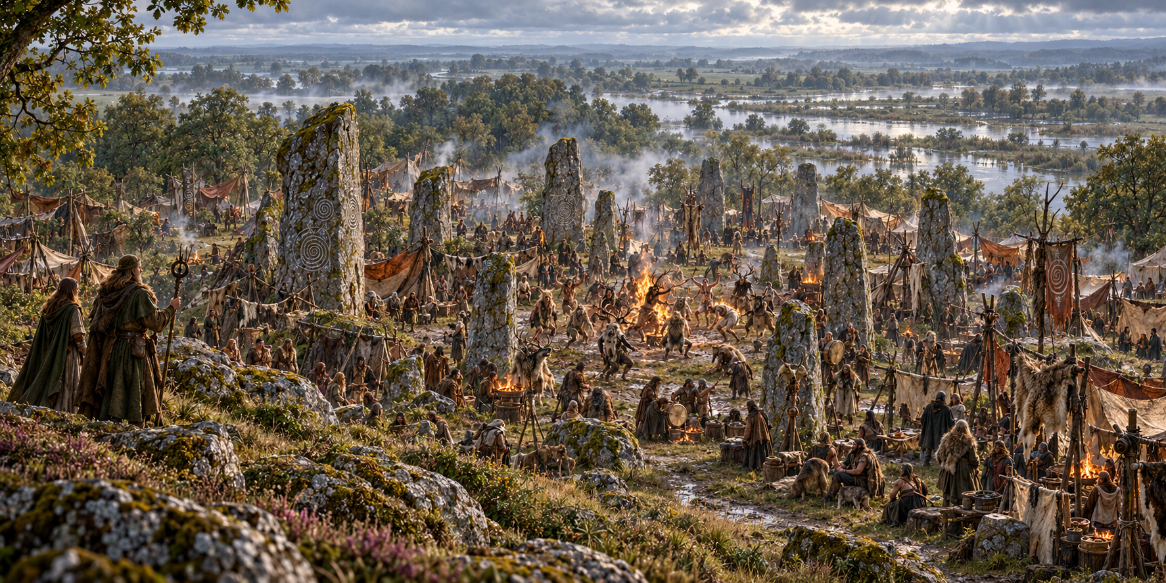
The Spiralling Stones of Cerne
At the heart of the complex stand the Spiralling Stones of Cerne, a remarkable arrangement of standing stones that gradually winds inwards towards a small central sanctuary. The spiral is not perfectly symmetrical. Its course widens unexpectedly in places, narrows sharply in others and occasionally appears to double back upon itself. Visitors who attempt to follow the stones without guidance often discover that the distances between them are rather greater than they first appeared.
According to the Druids, the spiral represents the passage of life through birth, growth, decline, death and renewal. Walking its course is therefore more than a physical journey. Each turn is intended to bring the pilgrim closer to an understanding of their place within the natural order. For ordinary pilgrims, walking the outer spiral is an act of devotion, usually undertaken in silence. Initiates may spend an entire night following its course, stopping at particular stones to meditate or perform prescribed observances. Senior Druids undertake far more demanding journeys, sometimes involving days of fasting, ritual purification and prolonged meditation.
It is said that those who follow the spiral correctly, with the proper preparation and guidance, may reach a higher state of consciousness. On rare occasions, the journey is believed to lead beyond the mortal world altogether. The Druids are notably reluctant to explain precisely what this means.
Surrounding the innermost spiral is the mysterious Invisible Labyrinth, one of the greatest surviving magical wonders of the Old Faith. Unlike an ordinary maze, the Labyrinth possesses no visible walls, hedges or barriers. To most visitors, the ground appears to be an uninterrupted expanse of grass between the standing stones. Yet those who wander into certain parts of the complex may find themselves unable to reach places that were clearly visible only moments before. A familiar path may suddenly lead between unfamiliar stones. A companion walking only a few paces ahead may disappear without warning. Voices can sometimes be heard from impossible directions, while landmarks appear to change position whenever the traveller looks away.
More disturbingly, time itself seems uncertain within the Labyrinth. Some visitors have emerged after what they believed to be a few minutes, only to discover that several hours have passed. Others claim to have wandered for an entire night, returning to find that scarcely any time has elapsed. The Druids insist that the Labyrinth is not inherently malicious. It was created, or perhaps awakened, to protect the innermost mysteries of Cerne from those who were not properly prepared to encounter them. Only the most senior members of the Druidic orders can perceive its true pathways, and even they approach the Labyrinth with considerable respect. Visitors are consequently warned not to leave the marked paths. Children are watched carefully, and inexperienced pilgrims are strongly discouraged from exploring the inner stones without an authorised guide. There are persistent stories of individuals who entered the Labyrinth and never returned. The Druids seldom discuss these accounts.
The Desecration of Cerne
Cerne suffered terribly during the humanoid occupation of Harmonias. The occupying forces regarded the stones as a centre of resistance and a symbol of the beliefs of the people they had conquered. Shrines were smashed, standing stones toppled and sacred groves cut down or burned. Buildings used by the Druidic orders were looted or destroyed, while many of those who had tended the sanctuary were killed or driven into hiding. The innermost sanctuary suffered the greatest desecration.
The occupiers deliberately defiled the sacred ground, conducting profane ceremonies amongst the stones and attempting to extinguish the ancient powers associated with the site. Several of the greatest standing stones were damaged, and the sacred pathways were deliberately broken. For the first time in centuries, the continuous observances of the Old Faith at Cerne ceased. Yet the stones themselves endured. Although damaged and neglected, the greater part of the spiral remained standing, and the Invisible Labyrinth continued to protect the inner sanctuary. Indeed, some accounts suggest that the Labyrinth became more unpredictable during the occupation, frustrating attempts by the humanoids to penetrate the deepest parts of the complex.
The Restoration of the Sacred Stones
Following the liberation of Harmonias, the restoration of Cerne became one of the foremost concerns of the Old Faith. Druids arrived from across Warlderia, accompanied by initiates, healers, craftsmen and ordinary followers determined to help restore the sanctuary. The first tasks were practical: clearing the wreckage, burying the dead, repairing the outer paths and making the surrounding countryside safe for returning pilgrims. The purification of the inner sanctuary proved considerably more difficult.
The corruption left by the occupiers had penetrated deeply into the sacred ground, and ordinary rites of cleansing were insufficient. The most senior Druids therefore undertook a series of increasingly demanding ceremonies intended to restore the spiritual balance of the stones. These ceremonies have exacted a terrible price. At least twelve Druids have died during the restoration, voluntarily sacrificing their lives in the effort to cleanse the innermost sanctuary. Their names are remembered with great reverence, and simple memorial stones have been raised to honour their sacrifice. Pilgrims frequently leave flowers, small offerings or handwritten prayers beside these memorials.
The Druids maintain that the sacrifices have not been in vain. The inner stones are once again regarded as consecrated ground, although the work of restoring the wider complex continues. There are nevertheless those who quietly question why the purification has demanded so many lives, and why certain ceremonies must still be repeated. Such doubts are rarely expressed openly.
The Great Pilgrimage Encampment
The liberation and restoration of Cerne have transformed the surrounding countryside. Where once there were only quiet meadows, scattered groves and a handful of buildings maintained by the Druidic orders, there is now an enormous temporary settlement. More than two thousand people may be found around the stones at any one time, and considerably more during important festivals or religious observances. Druids and initiates have established their own encampments, while pilgrims occupy long rows of tents and temporary shelters. Craftsmen maintain workshops for cutting timber, repairing tools and preparing the heavy equipment needed to raise fallen stones.
Merchants have arrived to supply food, clothing, candles, blankets and other necessities. Travelling healers tend the sick, while volunteers prepare meals for those labouring on the restoration. A small but increasingly busy market has developed on the outskirts of the settlement. Here, pilgrims may purchase simple charms, carved wooden symbols, bundles of medicinal herbs and small keepsakes commemorating their visit to Cerne. Not everyone who comes is particularly devout. Some are seeking employment, others opportunities for trade, and a few are undoubtedly attracted by the prospect of taking advantage of the enormous gathering.
Maintaining order amongst so many people has consequently become a considerable undertaking. The Druids have established rules governing access to the stones, the cutting of timber, the lighting of fires and the disposal of waste. Visitors are expected to respect the sacred groves, and hunting within the immediate precincts is strictly forbidden. Despite these restrictions, the encampment is generally a welcoming place. Many of those who have come to Cerne are refugees or survivors of the occupation, and the restoration offers them both employment and a renewed sense of purpose.
 The Hierophant of Cerne
Presiding over the spiritual restoration is Hierophant Maelgwyn Oakheart, one of the most senior servants of the Old Faith in Warlderia. The Hierophant is an elderly and greatly respected Druid whose authority rests upon decades of service and an exceptional understanding of the ancient mysteries. Maelgwyn seldom concerns himself with the everyday affairs of pilgrims, traders or labourers. These matters are delegated to other members of the Druidic orders, leaving him free to oversee the purification ceremonies and the restoration of the inner stones. His presence nevertheless carries enormous authority.
When the Hierophant speaks, even senior Druids listen carefully, and decisions concerning the most sacred parts of Cerne are rarely taken without his knowledge. The burden of the restoration has weighed heavily upon him. Those who have known Maelgwyn for many years remark that he has aged considerably since the liberation, and the deaths of so many fellow Druids have left him increasingly withdrawn. He remains determined that Cerne shall be fully restored, whatever sacrifices may yet be required.
The Sacred Groves
Beyond the standing stones lie several ancient groves, once carefully tended by generations of Druids. Many were destroyed during the occupation, leaving little more than blackened stumps and stretches of bare ground. Others survived, protected by their remoteness or by the strange reluctance of the occupying forces to enter certain parts of the woodland. The surviving trees are amongst the most treasured features of Cerne.
Some are believed to be many centuries old, their enormous trunks supporting spreading canopies beneath which generations of pilgrims have rested and prayed. The restoration of these groves is being undertaken with particular care. Saplings have been brought from distant forests, and Druids skilled in the tending of plants supervise their planting. The work is expected to take decades, perhaps centuries, before the groves regain anything approaching their former splendour. Yet already there are encouraging signs. Birds have returned to the younger trees, wildflowers are spreading across the disturbed ground and animals once frightened away by the occupation have begun to reappear.
The Creatures of Cerne
One of the more unusual features of the sanctuary is the extraordinary number of animals that live amongst the stones. Deer graze openly upon the surrounding grassland, seemingly unconcerned by the presence of pilgrims. Foxes and badgers are frequently seen near the sacred groves, while owls, ravens and smaller birds nest amongst the surviving trees. Many of these creatures display an unusual tolerance of people. The Druids regard this as evidence that the ancient harmony of Cerne is slowly returning.
Visitors are forbidden from harming the animals, and those who deliberately mistreat them may find themselves expelled from the sanctuary. Responsibility for the welfare of the creatures falls principally upon Morwenna Silverthorn, an elderly Druid whose particular concern is the protection of the lesser creatures that inhabit the sacred precincts. Morwenna is considerably more approachable than the Hierophant and is frequently encountered amongst the outer groves, tending injured animals or instructing younger initiates in their care. She has little patience for unnecessary cruelty and even less for those who regard the smaller creatures of the natural world as unworthy of consideration.
Pilgrims and the Old Faith
For many visitors, Cerne represents something far greater than a collection of ancient stones. The occupation of Harmonias destroyed villages, scattered families and brought an end to traditions that had endured for generations. The restoration of the sanctuary has therefore become a powerful symbol of recovery. Pilgrims come to offer thanks for survival, to mourn relatives lost during the fighting or to seek reassurance that the world has not been permanently diminished by the horrors of the occupation. Some bring small offerings of grain, flowers or carved wood. Others make promises to plant trees, repair shrines or assist in the restoration of their own communities.
The Druids encourage such acts, maintaining that the renewal of the Old Faith must begin not merely with the cleansing of sacred places but with the restoration of harmony throughout the land. Cerne has consequently become a gathering place for people of widely differing backgrounds, united less by formal religious doctrine than by a shared desire to see the wounds of Harmonias healed.
The Silence of the Inner Stones
Despite the crowds, there remains something profoundly ancient about Cerne. Beyond the tents, workshops and hammering of the restoration workers, the great stones stand much as they have for untold centuries. On quiet mornings, mist gathers amongst them, and the rising sun casts long shadows across the grass. Animals wander fearlessly through the outer circles, while birds settle upon the weathered stones as though they were ordinary features of the landscape. Closer to the inner spiral, however, the atmosphere changes.
The sounds of the encampment become strangely muted. The air seems cooler, even on warm days, and voices occasionally carry from places where nobody can be seen. Some visitors report hearing distant singing, the sound of running water or the faint ringing of bells. Others describe an overwhelming sensation of being watched, though whether by something benevolent or otherwise they cannot say. The Druids dismiss many of these experiences as the natural consequence of entering a place where the boundary between the mortal world and the powers of the Old Faith has always been unusually thin. They nevertheless advise visitors to exercise caution.
Those who serve at Cerne have a simple piece of advice for newcomers: Stay upon the paths. And should you hear someone calling your name from amongst the stones, make certain you recognise the voice before answering.
